Rural and Urban Settlement in Rwanda
Senior 4 · Geography
Rural and Urban Settlement in Rwanda
Lesson 2 of 5
25 min
In Kigali sector, Nyarugenge District, 240 households who had lived on dangerous slopes and in flood zones moved into Karama Integrated Model Village. MININFRA lists what was built: apartments, a secondary school with 24 classrooms, science and ICT laboratories and a library, an early childhood centre, six greenhouses, a poultry unit for over 9,000 chicks, a health post, sports facilities, a market, water, electricity, roads and a waste treatment system, at a cost of more than 8 billion Rwf including a 7.9 km asphalt road. It was built in six months with the Reserve Force of the Rwanda Defence Force, for the 25th anniversary of Liberation Day (2019).
Figure 3. An integrated model village, drawn by Ganzaa from MININFRA's description of Karama.
Why would a government spend so much on one village? The answer lies in the problems of ordinary rural settlement.
Definition
Grouped (villagisation) settlement policy: the government policy, adopted by the Cabinet in December 1996, of grouping rural households in planned villages (imidugudu) instead of scattered homesteads.
Integrated Development Program (IDP) model village: a planned village that provides housing together with services and income projects. By MININFRA's count, 130 had been built across the country, 70 of them with clustered housing units (2-in-1, 4-in-1 and 8-in-1) for over 4,200 households.
High-risk zone: land where homes are threatened by landslides, floods or rockfalls, from which people are relocated.
| Problem | Cause | Solution |
|---|---|---|
| Costly services for scattered homes | Dispersed homesteads need long water pipes, power lines and roads | Group houses in imidugudu near roads and services |
| Homes in high-risk zones | Steep slopes and valley floors used for building as land runs short | Relocate households; anti-erosion works; early warnings (MINEMA) |
| Loss of farmland to housing | Each family builds on its own plot | Multi-family housing (4-in-1, 8-in-1 units); land-use planning |
| Poor housing and sanitation | Low incomes, weak materials, no drainage | Housing support for vulnerable families; building standards |
| Lack of clean water | Springs far from homes; few piped connections | Water points in villages; spring protection |
| Few jobs outside farming | Small farms, little industry in rural areas | Income projects (greenhouses, poultry), cooperatives, rural trading centres |
| Pressure on wetlands and forests | Fields and houses spread into protected land | Zoning; buffer zones; enforcement |

Worked example 1: why grouping makes services cheaper (illustrative data)
Problem. A water pipe must reach 100 households. Scattered over a hill, the homes are on average 150 m apart along the paths. Grouped in a village, they stand in rows 20 m apart, and the village is 1 km from the main pipe. Compare the length of pipe needed.
Interpretation. In this illustrative case, scattered homes need five times as much pipe, and the same is true of power lines and access roads. This is the main economic argument for grouped settlement.

Worked example 2: how much land do multi-family units save? (illustrative data)
Problem. A district must house 120 households. Single houses need plots of about 400 m² each; a 4-in-1 building houses four households on about 800 m². Compare the land needed.
Interpretation. In this illustrative case, clustered units halve the land taken from farming. Where farms are already very small, every hectare saved matters.
| Advantages | Disadvantages and challenges |
|---|---|
| Cheaper and faster provision of water, electricity, roads, schools and health care | Some families live far from their fields and spend time walking to them |
| Saves farmland, especially with multi-family units | Land used for the village is lost to farming, and some owners must be compensated |
| Moves people out of high-risk zones, saving lives | Building costs are high for poor households and for the state |
| Encourages markets, trading centres and non-farm jobs | Close living needs good sanitation, drainage and waste management |
| Strengthens community organisation and security | Adjusting to a new place and new neighbours takes time |
Warning
Evaluate, don't just list. A question such as "Assess the imidugudu policy" needs a judgement: weigh the advantages against the problems, use evidence (65.4% of households grouped by 2022; 130 model villages), and reach a conclusion, for example that the policy succeeds where services and jobs come with the houses.
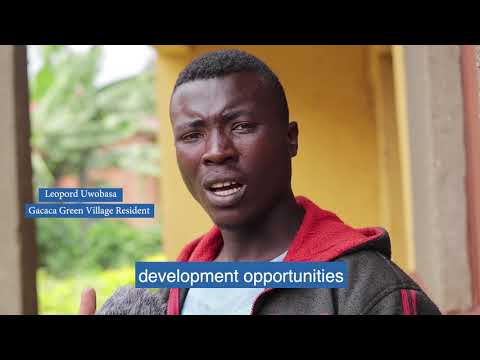
UNDP Rwanda: "Green Villages: Rwanda's story of shelter, sustainability and wealth". How planned green villages combine housing, biogas, water and income projects. Note two advantages and one challenge.
Practice
Key points
Sources and credits
Sources: Karama Integrated Model Village, home for 240 households, Ministry of Infrastructure (MININFRA) (Karama facilities and cost; number of IDP model villages and clustered units); Rwanda Mobilises Communities to Prevent and Reduce Disaster Risks Ahead of the 2026 Rainy Season, Ministry in charge of Emergency Management (MINEMA), 2026; Fifth Rwanda Population and Housing Census, 2022: Main Indicators Report, NISR, 2023 (type of habitat); Imidugudu, Wikipedia contributors, CC BY-SA 4.0, adapted by Ganzaa (date of the Cabinet decision).
Figure 3 and the worked examples (illustrative data) were drawn and written by Ganzaa.
Photos: Street Scene - Rubona - Near Rubavu-Gisenyi - Rwanda - 01, Adam Jones, CC BY-SA 3.0; Umudugudu w'imusanze, Germain92, CC BY-SA 4.0; via Wikimedia Commons.
Video: "Green Villages: Rwanda's story of shelter, sustainability and wealth", UNDP Rwanda, embedded from YouTube. The rest of the lesson and the exercises were written by Ganzaa.
This lesson adapts CC BY-SA material and is shared under CC BY-SA 4.0.
Quick check
What is the main economic reason for grouping rural houses in imidugudu?