Tradition and Modernity
Senior 4 · English (Languages)
Tradition and Modernity
Lesson 1 of 5
45 min
Let's begin
In many Rwandan families, the arrival of a school letter is a small earthquake. A place at a good school can open the way to a profession no one in the family has ever practised; it can also take a young person away from the work, the land and the knowledge that the family has kept for generations. Novels love such moments, because they set two goods against each other: loyalty to tradition and the promise of the new. The extract in this lesson comes from a novel about one such letter. It is told by a narrator who looks back on his younger self, and the second half of the lesson shows you how that choice of narrator shapes everything you read.
An extract from an imagined novel, written by Ganzaa for this lesson. The narrator, Shema, and his family are invented.
1 I was seventeen when the letter came, and I remember that my grandfather was oiling his walking stick when my mother read it aloud. It said that I had been admitted to a science school in Kigali, with a scholarship, to begin in September. My mother read it twice. The second time her voice shook. My grandfather went on oiling the stick.
2 In our family the herd had always passed to the eldest grandson. My grandfather had received it from his own grandfather, together with the name of every cow, the songs that calmed them, and the knowledge of which grasses made the milk sweet and which made it bitter. He could tell a sick cow from the way she held her ears, three days before she stopped eating. I was his eldest grandson. Everyone, including me until that year, had assumed that I would stay.
3 "Science," he said at last, as if he were testing the weight of the word. "And what will they teach you there that the cows cannot?"
4 I should have said nothing. Instead I told him what I had been rehearsing for weeks: that I wanted to study animal medicine; that the year before we had lost four calves to a fever that a vaccine could have prevented; that the world was changing and the herd would have to change with it. I spoke too fast and too long. When I finished, my father was looking at the floor, and my grandfather had put down the stick.
5 Looking back now, from the far side of twenty years and a veterinary degree, I can see what I could not see then. I thought I was arguing with my grandfather about the future. In fact I was telling him that everything he knew was out of date, and I was telling him in front of his son.
6 He did not answer that night. For three days he spoke to me only about cows. Each morning he took me to the pasture before the mist had lifted, and each morning he made me watch the same brown cow with a white star on her forehead. "Look at her ears," he said. I looked. I saw ears. "She will be sick on Sunday," he said. On Sunday she would not eat, and he treated her with a paste of leaves that he would not let me watch him prepare.
7 On the fourth evening he called me to sit beside him at the door of the house. He put the walking stick across my knees. "Go to Kigali," he said. "Learn their medicine. Then come back and tell me why I am right."
8 I laughed, because I thought it was a joke, and he let me think so. It was many years before I understood that he had not given in to me at all. He had given me a task.
Definition
Key terms
| Word or phrase (paragraph) | Word class | Meaning here | Use it |
|---|---|---|---|
| admitted (1) | verb, passive | accepted as a student | She was admitted to the university. |
| assumed (2) | verb | believed without checking or discussing | We assumed the shop was open. |
| rehearsing (4) | verb | practising what you will say | He was rehearsing his speech in the bus. |
| out of date (5) | adjective phrase | old-fashioned; no longer useful | This map is out of date. |
| from the far side of (5) | phrase | looking back from a much later time | From the far side of my exams, the worry seems small. |
| given in (8) | phrasal verb | accepted defeat in an argument | After an hour, his father gave in. |

| Point of view | Pronouns | What the reader can know | Effect |
|---|---|---|---|
| First person | I, we | only what the narrator knows, thinks or later learned | closeness and trust; but the view is limited and may be biased |
| Second person (rare) | you | the reader is placed inside the action | immediacy; often feels experimental |
| Third person limited | he, she, they | one character's thoughts, as in "The First Calf" | closeness to one character, with some distance |
| Third person omniscient | he, she, they | anything, in any mind, past or future | a wide view; the narrator can judge and comment, as in Maupassant's "How small a thing is needed to make or ruin us!" |
| Third person objective | he, she, they | only actions and words, no thoughts | the reader must infer everything, like an audience at a play |
Worked example: changing the point of view
Original (first person, retrospective): I laughed, because I thought it was a joke, and he let me think so.
Conclusion: the retrospective first person is the only version that keeps both the boy's mistake and the man's understanding in one sentence. A point of view is a choice about what the reader is allowed to know, and when.
Tip
Don't confuse narrator and author. In an exam, write "the narrator says…" or "Shema admits…", not "the author says…", unless you mean the writer's choices ("Maupassant ends with a twist"). The narrator is a character the author has built.
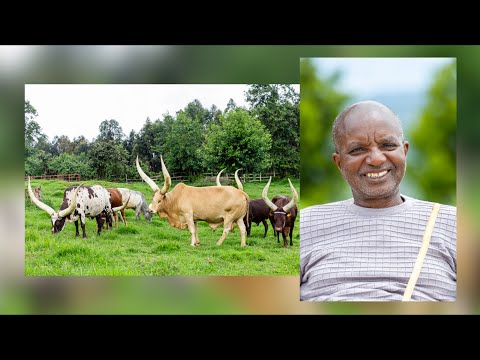
The story of Rutinywa Rugeyo, a lifetime guardian of Rwanda's Inyambo legacy, The New Times (about 14 minutes, 2025). In this interview a cattle keeper and author talks about the history of the Inyambo and why they should be preserved. Watch it and note two reasons he gives for preserving the Inyambo: is his view closer to Shema's or to his grandfather's?
Practice
Key points
Sources and credits
Quick check
From what point of view is the extract from Two Soils told?