Human Rights Codification and Its Impact
Senior 4 · History
Human Rights Codification and Its Impact
Lesson 1 of 3
25 min
On 10 December 1948, three years after the Second World War and one day after it adopted the Genocide Convention (unit 9), the UN General Assembly, meeting in Paris, adopted the Universal Declaration of Human Rights (UDHR). Its second paragraph and its first article read:
"Whereas disregard and contempt for human rights have resulted in barbarous acts which have outraged the conscience of mankind ..."
"Article 1. All human beings are born free and equal in dignity and rights. They are endowed with reason and conscience and should act towards one another in a spirit of brotherhood."
Universal Declaration of Human Rights, General Assembly resolution 217 A (III), 10 December 1948.
Analyse it. The "barbarous acts" are the crimes of the war, above all the Holocaust: the UN itself says the Declaration "was the result of the experience of the Second World War". Article 1 answers the patterns of unit 9 directly: against classification it puts equality, against dehumanisation it puts "dignity". Its wording was itself won by argument: Hansa Mehta of India is credited with changing "All men are born free and equal" to "All human beings". No state voted against it; eight abstained. But a declaration is a statement of principles, not a treaty. This lesson follows how its principles were codified, turned into written, binding law, over the next sixty years.
Definition
Human rights: the rights every person has because they are human, whatever their nationality, sex, origin, religion or status. Example: the right to life, liberty and security of person (UDHR, Article 3).
Codification: writing rules down in an organised, official text such as a treaty or a law, so that they can be applied and enforced. Example: the rights of the UDHR codified as binding duties in the two Covenants of 1966.
Declaration: a solemn statement of principles that is not, in itself, a binding treaty. Example: the UDHR.
Convention or covenant: a treaty, binding on the states that join it. Example: the Convention on the Rights of the Child (1989).
Ratification and accession: the acts by which a state agrees to be bound by a treaty, after signing it (ratification) or without having signed it (accession). Example: Rwanda acceded to the two Covenants on 16 April 1975.
State party: a state that is bound by a treaty.
Figure 1. Drawn by Ganzaa from the dates in the United Nations Treaty Collection, the UN Charter page and the African Commission on Human and Peoples' Rights.
The UN Charter, signed at San Francisco on 26 June 1945 and in force from 24 October 1945, opened with the promise "to reaffirm faith in fundamental human rights" and made "promoting and encouraging respect for human rights" one of the UN's purposes (Article 1). It did not list the rights. The UDHR listed them in 1948. The two Covenants of 16 December 1966 then made them binding: one for civil and political rights (ICCPR), one for economic, social and cultural rights (ICESCR). Specialised treaties followed for groups who needed particular protection.
| Treaty | Date of the treaty | In force | States parties (20 October 2026) | Rwanda became a party |
|---|---|---|---|---|
| Elimination of Racial Discrimination (CERD) | 7 March 1966 | 4 January 1969 | 182 | 16 April 1975 |
| Economic, Social and Cultural Rights (ICESCR) | 16 December 1966 | 3 January 1976 | 174 | 16 April 1975 |
| Civil and Political Rights (ICCPR) | 16 December 1966 | 23 March 1976 | 175 | 16 April 1975 |
| Discrimination against Women (CEDAW) | 18 December 1979 | 3 September 1981 | 189 | 2 March 1981 |
| Against Torture (CAT) | 10 December 1984 | 26 June 1987 | 176 | 15 December 2008 |
| Rights of the Child (CRC) | 20 November 1989 | 2 September 1990 | 196 | 24 January 1991 |
| Rights of Persons with Disabilities (CRPD) | 13 December 2006 | 3 May 2008 | 194 | 15 December 2008 |
Source: United Nations Treaty Collection, status pages for each treaty, as at 20 October 2026.
| Family (often called a "generation") | Examples | Main text |
|---|---|---|
| Civil and political rights | Life, freedom from torture, a fair trial, freedom of expression, the vote | ICCPR (1966) |
| Economic, social and cultural rights | Work, education, health, an adequate standard of living | ICESCR (1966) |
| Collective or peoples' rights | Development, peace, a satisfactory environment | African Charter (1981), Articles 22–24 |

African states wrote their own regional treaty. The African Charter on Human and Peoples' Rights was adopted by the Organisation of African Unity at Nairobi on 27 June 1981 and came into force on 21 October 1986. Rwanda ratified it by Law N° 10 of 1983, dated 17 May 1983. It differs from the UN texts in three ways:
The Charter set up the African Commission on Human and Peoples' Rights (Article 30), inaugurated on 2 November 1987; its secretariat is in Banjul, The Gambia.
Evaluate. Codification is not the same as protection. In 1994 Rwanda had been a party to the Genocide Convention and the two Covenants for nineteen years, and to the African Charter for eleven, yet its government planned a genocide. Treaties create obligations, standards and institutions that citizens and courts can use; they work only when states, and people, make them work.

Warning
Do not call the UDHR a treaty or say that it was "ratified". It was adopted by a vote of the General Assembly. The binding treaties are the Covenants and the conventions, which states ratify or accede to. Also keep the dates apart: the UDHR was adopted on 10 December 1948, the Genocide Convention on 9 December 1948.
Tip
"Charter, Declaration, Covenants, Conventions, Continent." The order of codification: the Charter promises (1945), the Declaration lists (1948), the Covenants bind (1966), the Conventions specialise (1965–2006), and the African Charter adapts to the continent (1981).
Important
Discuss. The African Charter puts duties beside rights. Does a list of duties strengthen human rights, by building responsible citizens, or weaken them, by giving governments a reason to limit rights? Use Article 27 in your answer.
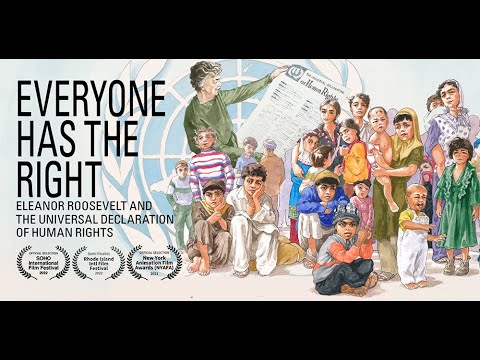
FDR Presidential Library, "Everyone Has the Right: Eleanor Roosevelt and the Universal Declaration of Human Rights" (about 5 minutes). Watch how the new UN Commission on Human Rights, chaired by Eleanor Roosevelt from 1946, drafted the Declaration, and note why a declaration was agreed before any binding treaty.
Practice
Key points
Sources and credits
Written by Ganzaa: the analysis, the timeline (Figure 1), the tables and the exercises.
Quick check
Put these in the order they were adopted, earliest first.
Tap the cards in the right order.