Introduction to Religious Scriptures
Senior 4 · General and Religious Studies
Introduction to Religious Scriptures
Lesson 3 of 5
40 min
Muslims believe that in the year 610 CE, in a cave on Mount Hira near Mecca, the angel Jibril (Gabriel) came to Muhammad, then about forty years old, with a command:
"Read: In the name of thy Lord who createth, Createth man from a clot. Read: And thy Lord is the Most Bounteous, Who teacheth by the pen, Teacheth man that which he knew not." (Surah 96:1–5, Pickthall)
Revelations continued for about 23 years, until the Prophet's death in 632. Together they form the Qur'an, a word that means "recitation". For Muslims, about a quarter of humanity (25.6% in 2020, according to the Pew Research Center), it is the very word of God. This lesson explains its structure, how it was collected, and its central message.
Definition
Qur'an: "recitation"; the holy book of Islam, believed by Muslims to be the word of God revealed to the Prophet Muhammad in Arabic.
Wahy: revelation, God's communication of his word to a prophet. Jibril: the angel Gabriel, who brought the revelation.
Surah: a chapter of the Qur'an (there are 114). Ayah: a verse; also means "sign".
Meccan and Medinan surahs: those revealed before and after the Hijra, the Prophet's migration from Mecca to Medina in 622.
Mushaf: a written copy of the Qur'an. Hafiz: a person who has memorised the whole Qur'an.
Tafsir: explanation and commentary on the Qur'an.
Basmala: the phrase "In the name of Allah, the Beneficent, the Merciful", which opens every surah except one.
The Qur'an has 114 surahs of very different lengths. After the short opening surah, Al-Fatiha, they are arranged roughly from the longest to the shortest. Meccan surahs, mostly earlier and shorter, call people to faith in one God and warn of the Day of Judgement; Medinan surahs also guide the life of the new Muslim community, with teaching on worship, family and justice. For reading, the text is also divided into 30 equal parts (juz'), so that it can be recited in full over the month of Ramadan.
The Prophet's companions memorised the revelations and wrote them on available materials. After his death they were gathered into one collection, and the caliph Uthman (reigned 644–656) established a standard copy, the archetype of the Qur'an used today. Memorisation remained central: across the world, Muslim children learn to recite it in Arabic, and those who memorise it all are honoured as hafiz.
Muslims hold that only the Arabic text is the Qur'an; a translation is an interpretation of its meaning. That is why Marmaduke Pickthall, the English convert to Islam whose 1930 translation this course quotes, called his book The Meaning of the Glorious Koran.

Important
The Opening (Al-Fatiha), Surah 1, in Pickthall's translation
"In the name of Allah, the Beneficent, the Merciful. Praise be to Allah, Lord of the Worlds, The Beneficent, the Merciful. Owner of the Day of Judgment, Thee (alone) we worship; Thee (alone) we ask for help. Show us the straight path, The path of those whom Thou hast favoured; Not (the path) of those who earn Thine anger nor of those who go astray."
Muslims recite it in every cycle of every prayer, at least 17 times a day (Unit 10). In seven verses it holds the heart of the message: God's mercy, his lordship over all worlds, judgement, worship of God alone and the prayer for guidance.
| Theme | Qur'an (Pickthall, 1930) |
|---|---|
| Tawhid: God is one | "Say: He is Allah, the One!" (112:1) |
| Guidance | "This is the Scripture whereof there is no doubt, a guidance unto those who ward off (evil)." (2:2) |
| Mercy and judgement | "The Beneficent, the Merciful. Owner of the Day of Judgment" (1:3–4) |
| The prophets | Believers make "no distinction between any of His messengers" (2:285), from Adam, Noah, Abraham and Moses to Jesus and Muhammad |
| Unity of the community | "And hold fast, all of you together, to the cable of Allah, and do not separate." (3:103) |
| Bible | Qur'an | |
|---|---|---|
| How believers see it | God's word written by inspired human authors | God's own words, revealed to one prophet |
| Writers and time | Many writers over many centuries | Revealed to Muhammad over about 23 years |
| Languages | Hebrew, Aramaic, Greek | Arabic |
| Translations | Fully scripture in any language | Interpretations of the meaning; the Arabic is the Qur'an |
| Structure | 66 or 73 books in two Testaments | 114 surahs |
Worked example: two verse counts
The Qur'an is often said to have 6,236 verses, but also 6,348. The difference is
The larger count includes the basmala at the head of each surah. Of the 114 surahs, one (Surah 9) has no basmala, and in Al-Fatiha the basmala is already counted as verse 1, so the extra basmalas are . The two counts agree once you know what each one includes: always check what a number counts before comparing.
Warning
Common mistakes
Important
Discuss. The first revealed word was "Read!", and Surah 96 praises the Lord "who teacheth by the pen". What does this suggest about the place of learning in Islam? Compare it with the place of reading in Christianity and Judaism.
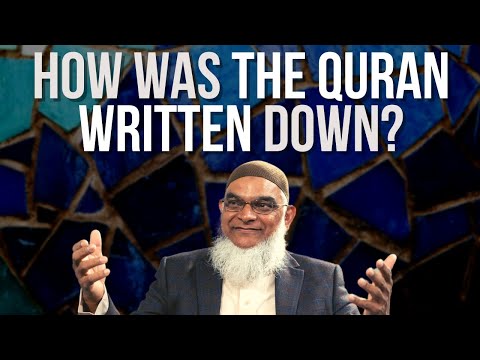
Let the Quran Speak: "How was the Quran Written & Compiled?" with Dr Shabir Ally, about 10 minutes. Note the roles of memorisation, writing, Abu Bakr and Uthman.
Practice
Key points
Sources and credits
Written by Ganzaa: the opening, Figure 3, the tables, the worked example and the exercises.
This lesson adapts CC BY-SA material and is shared under CC BY-SA 4.0.
Quick check