Fertilisers
Senior 4 · Chemistry
Fertilisers
Lesson 4 of 4
25 min
Rwandan farmers do not choose between organic and inorganic fertilisers: most use both. NISR's surveys show that in Season A of 2024, 89.1% of farmers applied organic fertiliser (manure, compost) and 64.5% applied inorganic fertiliser, and both shares had risen since 2022 (Figure 15.4). Each type has strengths the other lacks. Both can also do harm: too much fertiliser, or the wrong kind, pollutes water and soil, and a bag whose contents do not match its label cheats the farmer and can damage the crop. This lesson weighs the two types and examines what goes wrong.
Figure 15.4: Percentage of Rwandan farmers who used organic and inorganic fertilisers in Season A, 2022–2024 (NISR, Seasonal Agricultural Survey 2024, Table 0).
Definition
Manure: animal dung and urine, often mixed with bedding. Compost: plant and animal remains that microorganisms have broken down into a dark, crumbly material (humus) rich in organic matter.
Eutrophication: the over-enrichment of a lake, river or coastal water with nutrients (mainly nitrate and phosphate), which causes excessive growth of algae and loss of dissolved oxygen.
Substandard fertiliser: a fertiliser whose nutrient content or quality is below what its label states, or which contains harmful impurities. Adulteration: deliberately mixing in a cheaper material, such as sand, salt or a lower-grade fertiliser.
| Feature | Organic (manure, compost) | Inorganic (urea, DAP, NPK) |
|---|---|---|
| Nutrient content | low and variable; tonnes per hectare are needed | high and known (on the label); kilograms per hectare are enough |
| Speed of release | slow: nutrients are released as microbes decompose the material | fast: soluble ions are available at once |
| Effect on soil structure | adds organic matter: better crumb structure, holds water and nutrients, feeds soil life | none directly; long use without organic matter can harden and acidify the soil |
| Effect on pH | tends to buffer soil pH | ammonium fertilisers acidify |
| Cost and handling | made on the farm, but bulky and heavy to carry | must be bought, but easy to transport and dose |
| Risks | disease organisms and weed seeds if not well composted; nutrient losses if left in the rain | leaching and run-off of nitrate and phosphate; overuse; adulterated products |
The best practice, often called integrated soil fertility management, combines them: organic matter to keep the soil healthy and hold water, mineral fertiliser to supply exactly the nutrients that are short, and lime where the soil is acid.


A fertiliser can fall short in several ways:
The farmer pays for nutrients that are not there, the crop is under-fed or damaged, the soil may be harmed, and trust in fertilisers falls. The protections are to buy from registered agro-dealers, in sealed, labelled bags showing the grade, batch and supplier; to store fertiliser dry; and, for officials, to sample and analyse products.
The ions in a fertiliser can be identified with the tests you already know:
| Ion | Test | Positive result |
|---|---|---|
| warm with NaOH(aq) | ammonia gas turns damp red litmus blue | |
| warm with NaOH(aq) and aluminium foil (or Devarda's alloy) | ammonia gas turns damp red litmus blue | |
| acidify with dilute HCl, add (aq) | white precipitate of | |
| acidify with dilute , add (aq) | white precipitate of AgCl | |
| acidify with , add ammonium molybdate, warm | yellow precipitate | |
| flame test | lilac flame |
For example, pure urea gives no precipitate with acidified barium chloride; if a "urea" sample gives a heavy white precipitate, it contains sulfate, perhaps from ammonium sulfate mixed in.
Worked example 1: is the well water safe?
A laboratory reports that water from a well near heavily fertilised fields contains 13.5 mg of nitrate-nitrogen (N) per litre. Convert this to mg of nitrate ion per litre and compare it with the WHO guideline value of 50 mg per litre. (N = 14.01, O = 16.00)
Solution. Each ion () contains one N atom (14.01), so This is above the guideline of 50 mg per litre: the water should not be used to make up babies' feeds, and the fertiliser practice nearby should be examined.
Worked example 2: the cost of an adulterated bag
Illustrative case. A farmer buys a 50.0 kg bag sold as urea (labelled 46% N). Analysis shows only 35.0% N. (a) How much nitrogen is missing? (b) To supply 50 kg of N to a hectare, how much of this product is needed compared with genuine urea? (c) Evaluate the effect on the farmer.
Solution. (a) Labelled N ; actual N ; missing , about 24% of what was paid for. (b) Genuine: ; adulterated: , about a third more. (c) If the farmer spreads the usual 109 kg, the crop gets only of N and yields fall; if the farmer buys more, the cost per kilogram of nitrogen rises by about 31%. Either way the farmer loses, and if the filler is salt or another harmful material the soil may suffer too.
Warning
Common mistakes. (1) Saying organic fertilisers cannot pollute: manure washed into a stream causes eutrophication too. (2) Saying inorganic fertilisers "poison the soil" whatever the dose: used in the right amounts, with lime and organic matter, they raise yields safely. (3) Confusing nitrate with nitrate-nitrogen: 50 mg of nitrate per litre is only 11 mg of nitrogen per litre. (4) Judging a fertiliser by its colour or smell: only analysis shows its true content.
Safety. Wear gloves when handling manure and wash your hands afterwards, because it can carry disease organisms; compost it well before use on vegetables eaten raw. In the laboratory tests, barium chloride is toxic and silver nitrate stains skin: wear goggles and gloves, and warm test tubes gently, pointing them away from people.
Tip
Organic feeds the soil; inorganic feeds the crop. Use both, lime acid soil, apply the right amount at the right time, and buy sealed, labelled bags from registered dealers.
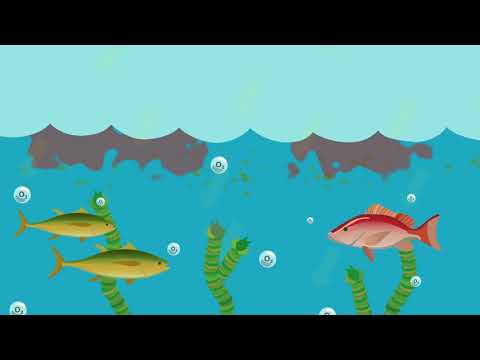
NOAA's National Ocean Service: What Is Eutrophication? (1 min). Watch for how nutrients from land lead to algal blooms, dead zones and fish kills.
Practice
Key points
Further reading
Sources and credits
Quick check
Which is an advantage of compost over urea?