Introduction to Classification of Organisms
Senior 1 · Biology
Introduction to Classification of Organisms
Lesson 1 of 5
25 min
Walk into Kimironko market in Kigali. Fruit is in one area and clothes in another. Inside the fruit area, bananas are kept apart from avocados, and cooking bananas (ibitoke) are kept apart from sweet bananas (imineke). Because things are grouped, you can find what you want in minutes.
Biologists face the same problem on a far bigger scale. About two million kinds of organism have been named so far, and Nyungwe forest alone shelters 13 kinds of primate and more than 300 kinds of bird. Without an agreed way of grouping them, no one could find information about any of them.
Work in pairs. Sort these twelve organisms from around a school into groups, and write down the feature you used for each group: bean plant, maize, eucalyptus tree, mushroom, goat, chicken, housefly, spider, earthworm, frog, bread mould, human.
Compare your groups with another pair. You will almost certainly disagree: one pair may put the mushroom with the plants because it grows in soil, another may group animals by "has legs" and "has no legs". This is the reason biologists need one agreed system, based on features that really show how organisms are related.
Definition
Classification: arranging organisms into groups according to the features they share.
Taxonomy: the science of describing, naming and classifying organisms. A person who does it is a taxonomist.
Taxon (plural taxa): any one group in a classification, for example the family Hominidae or the genus Gorilla.
Definition
Hierarchical classification: a system of groups within groups. Each organism is placed in seven main ranks, from the largest to the smallest:
kingdom → phylum → class → order → family → genus → species
Each rank contains one or more groups of the rank below it. (For plants, many books call the phylum a division.)
Definition
Species: a group of organisms that are similar to one another and can breed together to produce fertile offspring (offspring that can themselves breed). Example: all domestic dogs, from the smallest breed to the largest, belong to one species, Canis familiaris.
Figure 1: The classification hierarchy. Each rank sits inside the one above it. Humans and mountain gorillas share five ranks, from kingdom down to family.
Moving down the hierarchy, each group contains fewer kinds of organism, and its members share more features. The kingdom Animalia includes sponges, insects and elephants, which have little in common. The genus Gorilla contains only the two kinds of gorilla, which are alike in almost every way.
| Rank | Lion | Leopard | Domestic cat | Domestic dog |
|---|---|---|---|---|
| Kingdom | Animalia | Animalia | Animalia | Animalia |
| Phylum | Chordata | Chordata | Chordata | Chordata |
| Class | Mammalia | Mammalia | Mammalia | Mammalia |
| Order | Carnivora | Carnivora | Carnivora | Carnivora |
| Family | Felidae | Felidae | Felidae | Canidae |
| Genus | Panthera | Panthera | Felis | Canis |
| Species | Panthera leo | Panthera pardus | Felis catus | Canis familiaris |

Worked example 1: which is the closer relative?
Using the table, is a lion more closely related to a domestic cat or to a domestic dog?
Answer: the lion is more closely related to the domestic cat. The rule: the lower the rank two organisms share, the more closely related they are.
Worked example 2: placing a new organism
A taxonomist finds a mammal in Nyungwe that is clearly a monkey. Which ranks can she fill in straight away, and which need careful study?
Answer: the four highest ranks are quick to fill; the lower the rank, the more evidence is needed.
Warning
Common mistakes. (1) Mixing up the order of the ranks, especially order and family: family is the smaller group, inside order. (2) Thinking a "higher" rank means a more advanced organism: it only means a bigger group. (3) Giving the species as one word: the species name of the lion is Panthera leo, not just "leo".
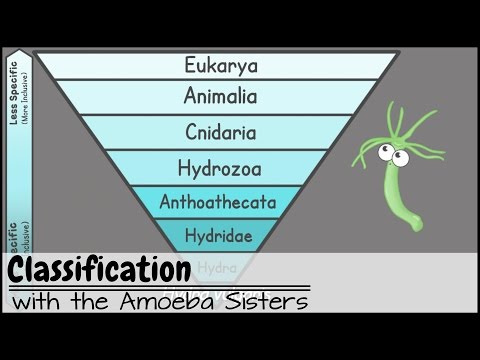
Classification (Amoeba Sisters). This video adds a rank above kingdom, the domain, which you will meet in later years. Watch for the memory sentence it uses for the order of the ranks.
Tip
Memory hook: "King Philip Came Over For Good Soup" gives kingdom, phylum, class, order, family, genus, species. Or make your own in Kinyarwanda or English.
Practice: the classification hierarchy
Key points
Sources and credits
Figure 1, the table, the activity, the worked examples and the practice questions are written by Ganzaa.