Introduction to Classification of Organisms
Senior 1 · Biology
Introduction to Classification of Organisms
Lesson 3 of 5
25 min
Over one weekend in Muhanga: a loaf left in a damp cupboard grows grey fur with black dots; mushrooms push up beside a termite mound after rain; the water in a pond turns green; a jug of milk sours into ikivuguto; and your younger brother catches the flu.
Each of these is caused by living things, or by something close to living. Are the mould and the mushroom plants, because they grow from the ground? Is the green scum in the pond a plant or an animal? And what is the flu? To answer, biologists sort all organisms into five kingdoms, then deal with viruses separately.
Bread mould. Look at mouldy bread with a hand lens (keep it in a closed plastic bag, and do not breathe in the spores). You will see fine white threads and tiny black balls on stalks. The threads feed on the bread; the black balls are full of spores, which spread the mould. There is no green colour anywhere: a mould cannot make its own food.
Pond water. Put a drop of pond water on a slide and look at it under a microscope. You may see single cells swimming with rows of tiny hairs, and green threads made of cells joined end to end. Each of these living things has a nucleus, yet many are only one cell. They are neither plants nor animals.
Definition
Prokaryote: an organism whose cell has no nucleus; its DNA lies loose in the cytoplasm (example: a bacterium). Eukaryote: an organism whose cells have a nucleus surrounded by a membrane (examples: yeast, a bean plant, you).
Unicellular: made of one cell. Multicellular: made of many cells.
Autotroph: an organism that makes its own food, usually by photosynthesis. Heterotroph: an organism that gets food from other organisms.
Definition
Kingdom: the largest rank in the classification used in this course. In the five-kingdom system, proposed by Robert Whittaker in 1969, the kingdoms are Monera (also called Prokaryotae), Protoctista, Fungi, Plantae and Animalia.
| Kingdom | Nucleus | Cells | Feeding | Cell wall |
|---|---|---|---|---|
| Monera | none | one | most absorb food; a few photosynthesise | yes, not cellulose |
| Protoctista | yes | mostly one | algae photosynthesise; others take in food | algae only |
| Fungi | yes | mostly many | absorb food from dead or living matter | yes, chitin |
| Plantae | yes | many | photosynthesis (autotrophs) | yes, cellulose |
| Animalia | yes | many | eat other organisms (heterotrophs) | none |
| Kingdom | Examples you may meet in Rwanda |
|---|---|
| Monera | Lactobacillus (sours milk into ikivuguto), Vibrio cholerae (cholera), Rhizobium (in bean root nodules) |
| Protoctista | Plasmodium (malaria parasite), Amoeba, Paramecium, Spirogyra (green pond alga) |
| Fungi | mushrooms, bread mould (Rhizopus), yeast, coffee leaf rust |
| Plantae | mosses, ferns, eucalyptus, beans, bananas, coffee |
| Animalia | earthworms, insects, tilapia, frogs, birds, gorillas, humans |


Warning
Fungi are not plants. A mushroom grows out of the soil and does not move, so it looks like a plant, but it has no chlorophyll, cannot photosynthesise, absorbs its food, and has cell walls made of chitin, not cellulose. Likewise, in the five-kingdom system the green algae in a pond are protoctists, not plants.
Worked example 1: which kingdom?
An organism from a pond is one cell, has a nucleus and contains chloroplasts. Classify it.
Answer: Protoctista (it is a single-celled alga).
Worked example 2: plant or fungus?
A white bracket grows out of a dead eucalyptus log. It is not green, and under a microscope it is made of threads whose walls contain chitin. Is it a plant or a fungus?
Answer: a fungus. All three pieces of evidence point the same way.
Figure 1: A bacterium is a complete cell. A virus has no cytoplasm, no ribosomes and no membrane of its own.
A virus is a particle of genetic material (DNA or RNA) inside a protein coat. It is not a cell. Outside a living cell a virus does nothing at all: it does not feed, respire, grow or excrete. It becomes active only when it gets inside a living host cell, where it takes over the cell's machinery to make copies of itself, often killing the cell.
Viruses cause HIV infection, measles, influenza, rabies and COVID-19 in humans, and cassava mosaic disease and maize streak disease in crops.
Definition
Virus: a non-cellular particle made of genetic material (DNA or RNA) in a protein coat, which can reproduce only inside a living host cell. Example: the human immunodeficiency virus (HIV).
Worked example 3: is a virus alive?
Weigh the evidence before you decide.
| Like living things | Unlike living things |
|---|---|
| It reproduces (inside a host cell) | It is not made of cells |
| It has genetic material (DNA or RNA) | It cannot feed, respire, grow or excrete |
| It changes over generations (new flu strains appear) | Outside a host it is inactive; some can even be crystallised like salt |
Conclusion: a virus shows only some features of life, and only inside another organism's cells. That is why it is placed in no kingdom. Most biologists describe viruses as being on the border between living and non-living.
Antibiotics kill bacteria by attacking structures such as the cell wall and ribosomes. Viruses have neither, so antibiotics do not cure viral infections such as colds and flu. This is why a nurse will not give antibiotics for a cold, and why taking antibiotics you do not need is harmful: it helps bacteria become resistant. Fungal diseases, such as coffee leaf rust on Rwandan farms, need different treatments again (fungicides), because fungi are a different kingdom with different cells.
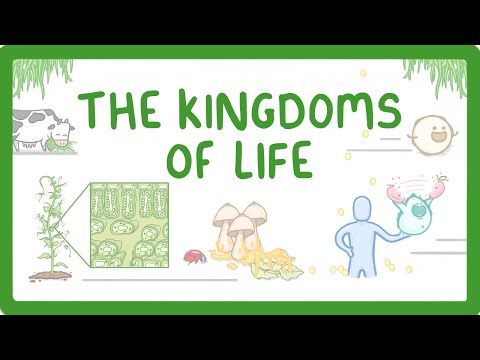
Kingdoms of Life: Animals, Plants, Fungi, Protoctists, Bacteria and Viruses (Cognito). Note the features used to tell each kingdom apart, and why viruses are kept separate.
Tip
Memory hook: "Many People Find Plants Amazing": Monera, Protoctista, Fungi, Plantae, Animalia, from the simplest cells to the most complex bodies.
Practice: the five kingdoms and viruses
Key points
Sources and credits
Written by Ganzaa: the lesson text, Figure 1, the tables, the worked examples and the practice questions.