Human Reproductive System and Sexual Maturation
Senior 1 · Biology
Human Reproductive System and Sexual Maturation
Lesson 3 of 5
25 min
Look around a Senior 1 class in any school in Rwanda. Some pupils look like young adults; others look much as they did in Primary 5. Some voices have deepened; others have not. Yet everyone in the room is about the same age.
What switches puberty on, and why does it happen at different times for different people? The answer is a set of chemical messengers called hormones, and the fact that every body follows its own timetable.
Definition
Hormone: a chemical messenger made by a gland and carried in the blood to target organs, where it changes how they work. Example: testosterone, made in the testes.
Puberty: the stage of development in which the reproductive organs mature and the body becomes able to reproduce, together with the physical and emotional changes that go with it.
Sexual maturation: the process of becoming sexually mature during puberty. Adolescence is the wider period of change from childhood to adulthood, which includes puberty; the WHO defines adolescents as people aged 10 to 19.
Figure 1: Hormones from the brain switch on the gonads at puberty; the gonads' hormones cause the changes.
From about age 8 or 9, the brain starts to release small amounts of two hormones from the pituitary gland, a pea-sized gland under the brain: FSH (follicle-stimulating hormone) and LH (luteinising hormone). Over the next years the amounts rise, and they act on the gonads. The gonads then make their own hormones, which cause the changes of puberty.
| Hormone | Made by | Main effects |
|---|---|---|
| FSH and LH | pituitary gland (in both sexes) | stimulate the testes or ovaries; control sperm production and the ripening and release of eggs |
| Testosterone | testes | starts sperm production; deeper voice (the larynx grows); facial, body and pubic hair; muscle growth |
| Oestrogen | ovaries | breast development; wider hips; rebuilds the lining of the uterus each month |
| Progesterone | ovaries (after ovulation) | keeps the lining of the uterus thick and ready for a pregnancy |
Both sexes make small amounts of each other's main hormones too: males make some oestrogen and females some testosterone, in different amounts.
Definition
Testosterone: the main male sex hormone, made by the testes. Oestrogen and progesterone: the main female sex hormones, made by the ovaries.
Secondary sexual characteristics: the body changes of puberty that are not the reproductive organs themselves, such as a deeper voice, facial hair or breast development.
| Boys | Girls | Both |
|---|---|---|
| testes and penis grow; the testes begin to make sperm | breasts develop, usually the first visible sign | a growth spurt (girls usually earlier, boys later) |
| voice deepens and may "crack" for a while | hips widen | hair grows under the arms and in the pubic area |
| hair grows on the face and body | ovulation begins, and the first period (menarche) | more sweat and body odour; oilier skin and spots |
| shoulders broaden; muscles grow | the menstrual cycle becomes regular over time | new, stronger feelings and moods |
| semen may be released during sleep (a wet dream); this is normal | a small amount of clear or white discharge from the vagina is normal | more interest in friends, independence and, often, romantic feelings |
Feelings change too. Hormones affect mood, so feeling happy one moment and irritable the next is common. Many young people begin to feel attracted to others. Having such feelings is a normal part of growing up; it does not mean you have to act on them. You will learn how to make safe decisions in the next unit.
Definition
Menarche: a girl's first menstrual period. Wet dream (nocturnal emission): the release of semen during sleep, common in boys during puberty and a sign that the testes have started to work.
Puberty follows the same order in most people, but it starts at different ages. According to the US National Institutes of Health, puberty typically begins between ages 8 and 13 in girls, and between 9 and 14 in boys.
Figure 2: Normal variation in the timing of puberty. Ranges: NICHD (US National Institutes of Health) and OpenStax Anatomy and Physiology.
The timing depends on family history (children often follow a similar timetable to their parents), nutrition and general health. If there are signs of puberty before these ranges, or none at all after them, a health worker can check that all is well, and usually it is.
Worked example 1: reading Figure 2
(a) Uwase is 12 and has not yet noticed any signs of puberty. Is she outside the normal range? (b) Gatete is 13 and is much shorter than the girls in his class. Explain why.
Worked example 2: which hormone?
| Change | Reasoning | Hormone |
|---|---|---|
| Mugisha's voice cracks and deepens | the larynx grows in boys | testosterone |
| Keza's breasts begin to develop | a female body change from the ovaries' hormone | oestrogen |
| A girl's ovaries release their first egg | the pituitary hormones act on the ovaries | FSH and LH |
| The lining of the uterus stays thick after ovulation | made by the ovary after the egg is released | progesterone |
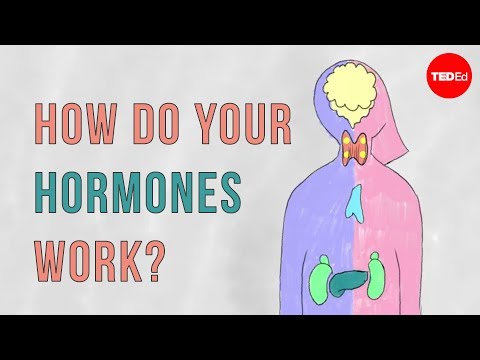
How do your hormones work? (TED-Ed, 5 min). Watch for the pituitary gland and the testes and ovaries, and notice the point that hormones influence behaviour but do not control us.
Puberty can make people feel self-conscious. In groups, list ways a class can make sure nobody is teased about early or late changes, a voice that cracks, spots or height. Agree on three class rules and share them.
Warning
Common mistakes. (1) "Puberty starts at exactly the same age for everyone": the normal range is several years wide. (2) "Hormones make people behave badly": hormones affect moods, but people still choose how they act. (3) "Boys have only male hormones and girls only female ones": both sexes make both, in different amounts.
Tip
Memory hook: "The brain sends the letter, the gonads read it." FSH and LH from the pituitary are the letter; testosterone, oestrogen and progesterone are the reply that changes the body.
Practice: hormones and puberty
Key points
Sources and credits
Figures 1 and 2, the tables, the worked examples, the discussion and the practice questions are written by Ganzaa.