Pure Substances and Mixtures
Senior 1 · Chemistry
Pure Substances and Mixtures
Lesson 2 of 5
25 min
After heavy rain, the Nyabarongo runs brown with soil washed off the hills. Fill a clear bottle with that water and leave it overnight: by morning, a layer of mud has settled at the bottom. Now stir two spoonfuls of sugar into a cup of tea: the sugar vanishes and never settles out, however long you wait. Both are mixtures, but they behave very differently.
Definition
Mixture: two or more substances mixed together but not chemically joined. Each keeps its own properties, and the amounts can vary. A mixture can be separated by physical methods. Examples: air, sugary tea, muddy water, soil.

In a homogeneous mixture the substances are spread evenly, so every part is the same and you cannot see the separate parts: sugary tea and air are examples. In a heterogeneous mixture you can see the different parts, or they separate on standing: muddy water, and sand mixed with iron filings.
Figure 2.1: Classifying matter.
A solution forms when one substance dissolves in another. The particles of the dissolved substance spread out evenly between the particles of the liquid (Figure 2.2), so the solution is clear (though it may be coloured) and nothing settles out.
Definition
Solution, solute and solvent: a solution is a homogeneous mixture formed when a solute dissolves in a solvent. The solute is the substance that dissolves (sugar); the solvent is the liquid it dissolves in (water). Solute + solvent → solution.
Figure 2.2: Dissolving sugar in water, as particles.
Definition
Soluble and insoluble: a substance that dissolves in a solvent is soluble in it (salt and sugar in water); one that does not is insoluble (sand in water). Water is called the universal solvent because so many substances dissolve in it.
Definition
Suspension: a heterogeneous mixture of a liquid with tiny particles of an insoluble solid spread through it. The liquid looks cloudy and the solid settles slowly on standing. Example: muddy river water.
Definition
Miscible and immiscible liquids: liquids that mix completely are miscible (water and ethanol); liquids that do not mix but form separate layers are immiscible (cooking oil and water).
The concentration of a solution tells you how much solute is dissolved in a given volume of solution. One way to give it is in grams per cubic decimetre:
Worked example
Problem. A health centre gives a mother a sachet of oral rehydration salts (ORS) for her child with diarrhoea. The sachet holds 20.5 g of salts and glucose and must be dissolved in exactly (one litre) of clean water. (a) What is the concentration of the solution? (b) What would it be if she used only half a litre by mistake?
Solution.
Answer: . A solution twice as concentrated can make a sick child worse, which is why the instructions give an exact volume of water.
Warning
Oral rehydration salts: always dissolve one sachet in the exact volume of clean water printed on it, and make a fresh solution each day. Too little water makes the solution too concentrated; too much makes it too weak to work.
Worked example
Problem. Byiringiro dissolves 20 g of salt in 100 g of water. What is the mass of the salt solution? Where has the salt "gone"?
Solution. Dissolving is a physical change and mass is conserved: The salt has not disappeared: its particles are spread evenly between the water particles, and evaporating the water would give all 20 g back.
Iron filings (grey) and powdered sulfur (yellow) are stirred together on a watch glass. A magnet held over the mixture pulls out the iron, leaving the sulfur behind (Figure 2.3 A): the two substances keep their own properties, so this is a mixture. In a fume cupboard, your teacher heats some of the mixture in a test tube. It glows red, and keeps glowing even when taken out of the flame (B). The black solid left is a new substance, iron(II) sulfide, which a magnet does not attract (C):
Figure 2.3: Iron and sulfur as a mixture, and as a compound after heating.
Warning
Teacher only, in a fume cupboard. Some sulfur may burn to give sulfur dioxide, a choking gas. The glowing tube stays hot for a long time; leave it to cool on a heat-proof mat.
Table 2.1: Mixtures and compounds compared
| Mixture | Compound | |
|---|---|---|
| Joined together? | no, only mixed | yes, chemically joined |
| Composition | any amounts | fixed ratio (FeS is always one Fe to one S) |
| Properties | each substance keeps its own | new properties, unlike its elements |
| Energy change when made | usually none | usually heat given out or taken in |
| Separation | physical methods: magnet, filtering, evaporating | only by a chemical reaction |
Tip
Solute dissolves; solvent does the dissolving; solution is the result. In sugary tea: sugar is the solute, water the solvent, and the tea is the solution.
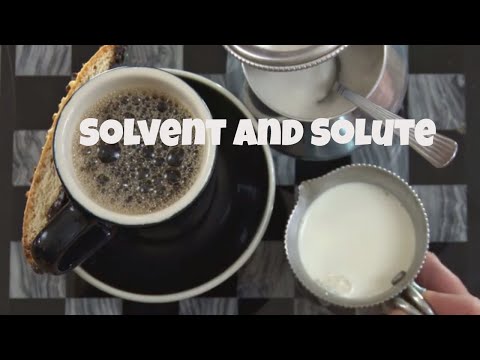
MooMooMath and Science: Solvent, Solute, Solution: what is the difference? (2 min). Name the solute and solvent in each example before they are given.
Practice
Sources and credits
This lesson adapts CC BY-SA material and is shared under CC BY-SA 4.0.