Chemical Reactions
Senior 1 · Chemistry
Chemical Reactions
Lesson 4 of 5
25 min
Hydrogen burns in oxygen to give water, and nothing else. Hydrogen fuel-cell buses use this reaction to run on hydrogen, with only water coming out of the exhaust. In Lesson 3 you wrote its skeleton equation:
There are two oxygen atoms on the left and only one on the right. Taken at face value, one oxygen atom has vanished, which the law of conservation of mass says cannot happen. The formulae are correct, so we must change the number of molecules of each substance until every atom is accounted for. This is called balancing the equation.
Definition
Balanced equation: a chemical equation with the same number of atoms of each element on both sides. Example: has 4 H and 2 O on each side.
Definition
Coefficient: the large number written in front of a formula in an equation. It multiplies the whole formula: means two molecules of water, containing 4 H atoms and 2 O atoms. A coefficient of 1 is not written.
Figure 4.1: The balanced equation drawn as particles: the atoms are the same on both sides, only rearranged.
Worked example
Problem. Balance .
Solution. Count:
| Atom | Left | Right |
|---|---|---|
| H | 2 | 2 |
| O | 2 | 1 |
Oxygen is short on the right. Put 2 in front of water: . Recount: the right now has H = 4 and O = 2.
| Atom | Left | Right |
|---|---|---|
| H | 2 | 4 |
| O | 2 | 2 |
Now hydrogen is short on the left. Put 2 in front of :
Check: H 4 = 4, O 2 = 2. Balanced.
Worked example
Problem. Magnesium burns in oxygen to form magnesium oxide. Write the balanced equation.
Solution. Skeleton: . Mg: 1 and 1; O: 2 and 1. Put 2 in front of to give 2 O on the right; that makes 2 Mg on the right, so put 2 in front of Mg:
Check: Mg 2 = 2, O 2 = 2.
Worked example
Problem. Many Kigali kitchens cook with LPG, which is mostly propane, . Balance the equation for propane burning completely in air to give carbon dioxide and water.
Solution. Skeleton: . Oxygen appears on its own, so leave it until last.
| Atom | Left | Right |
|---|---|---|
| C | 3 | 3 |
| H | 8 | 8 |
| O |
Worked example
Problem. Aluminium reacts with oxygen to form the protective layer of aluminium oxide, , on cooking pots. Balance the equation.
Solution. Skeleton: . Oxygen is 2 on the left and 3 on the right, an even number against an odd one. The smallest number that both 2 and 3 divide into is 6, so aim for 6 oxygen atoms on each side: and . Now there are Al on the right, so write 4Al on the left:
Check: Al 4 = 4, O 6 = 6.
Warning
Never change a formula to balance an equation. Changing into would balance the oxygen, but is hydrogen peroxide, a bleach, not water. Only the coefficients in front of formulae may be changed.
Tip
Leave single elements until last (, , ): putting a coefficient in front of them changes nothing else. If a radical such as appears unchanged on both sides, balance it as one unit.
Open the Balancing Chemical Equations simulation. Change the coefficients and watch the molecules and the balance scales: the equation is balanced only when every scale is level. Then try the game.
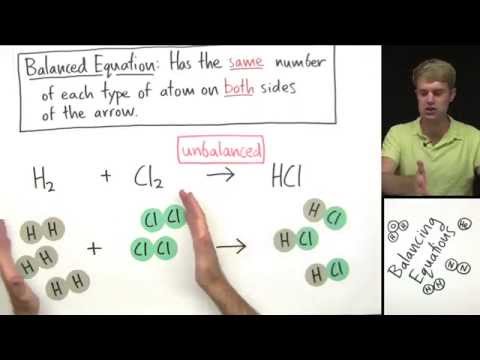
Tyler DeWitt: Introduction to Balancing Chemical Equations (12 min). Watch how he draws the molecules to show why only coefficients, never subscripts, can change.
Practice
Sources and credits