Acids, Bases and pH
Senior 1 · Chemistry
Acids, Bases and pH
Lesson 5 of 5
25 min
Every time you eat a sweet, a cake or a sugary drink, bacteria in the sticky plaque on your teeth feed on the sugar and make acid, mainly lactic acid. Tooth enamel is the hardest substance in your body, but it is made of a calcium mineral that dissolves in acid. Figure 5.1 shows what happens to the pH on the surface of the teeth after a sweet snack.
Figure 5.1: The pH of plaque on the teeth after a sweet snack (typical shape). Below pH 5.5 the enamel starts to dissolve.
Worked example
Problem. Use Figure 5.1. (a) For how long is the plaque below the critical pH after one snack? (b) Keza eats five sweet snacks spread through the day. Estimate how long her teeth are under acid attack each day, and suggest two ways to protect them.
Solution. (a) The curve drops below 5.5 at about 4 minutes and rises above it again at 20 minutes: about minutes.
(b) Each snack starts a new attack: minutes, well over an hour a day. She could eat sweet things only with meals, so that there are fewer attacks, and brush with fluoride toothpaste, which is slightly alkaline and helps to harden the enamel. Rinsing with water after eating also helps.
The same properties that make acids and bases dangerous also make them useful. Table 5.1 links each use to the property behind it.
Table 5.1: Uses of acids and bases
| Substance | Use | Property used |
|---|---|---|
| Lactic acid (made by bacteria) | turns milk into ikivuguto and keeps it from spoiling | few harmful microbes can grow at low pH |
| Ethanoic acid (vinegar) | pickling vegetables; flavouring food | acid stops food from going bad |
| Citric acid | flavouring drinks and sweets; keeps cut fruit from browning | sour taste; slows browning |
| Baking powder: sodium hydrogencarbonate with a dry acid | makes cakes rise | the acid and carbonate react when wet and hot, giving carbon dioxide |
| Sulfuric acid | car and motorcycle batteries; making fertilisers | conducts electricity; reacts with ammonia |
| Sodium hydroxide | making soap from palm oil or animal fat | a strong alkali splits fats into soap and glycerol |
| Magnesium hydroxide, sodium hydrogencarbonate | antacid tablets and powders for indigestion | weak bases that neutralise excess stomach acid |
| Agricultural lime (calcium carbonate) and slaked lime | raising the pH of acidic soil; treating drinking water | bases that neutralise acids |
| Ammonia solution | household cleaners for glass and floors | an alkali that loosens grease |
| Toothpaste | cleaning teeth | mildly alkaline: neutralises acid on the teeth |
Definition
Corrosive: able to destroy living tissue, such as skin and eyes, and to attack metals and other materials on contact. Concentrated acids and strong alkalis are corrosive. Example: concentrated sulfuric acid; sodium hydroxide solution.
Figure 5.2: Diluting a concentrated acid: the right way and the wrong way.
Warning
Always add acid to water, never water to acid. Dissolving a concentrated acid in water gives out a lot of heat. If water is poured into the acid, the first drops boil instantly and spit hot, concentrated acid into the face and eyes. Pour the acid slowly, down a glass rod, into a large volume of cold water, stirring all the time, and wear goggles.
Worked example
Problem. A technician needs 1 dm³ of dilute sulfuric acid and has 50 cm³ of the concentrated acid. Describe, step by step, how she should make it safely.
Solution. Put on goggles, gloves and a laboratory coat. Put about 800 cm³ of cold water into a large heat-proof beaker standing in a sink or a basin of cold water. Pour the 50 cm³ of concentrated acid slowly down a glass rod into the water, a little at a time, stirring all the time and letting the mixture cool between additions. When all the acid is in and the mixture is cool, make the volume up to 1 dm³ with water, then label the bottle "dilute sulfuric acid" with the date.
The large volume of water absorbs the heat, so it never boils. If the water were poured into the acid, the first drops would boil at once on the surface and spit hot, concentrated acid out.
Table 5.2: First aid for acid and alkali accidents
| Accident | What to do at once |
|---|---|
| Splash on the skin | Remove soaked clothing; wash with plenty of running water for at least 10 minutes; tell the teacher |
| Splash in the eye | Rinse the open eye under gently running water or at the eye-wash station for at least 15 minutes; get medical help |
| Swallowed | Rinse the mouth with water; do not make the person vomit; get medical help at once and take the label |
| Fumes breathed in | Move to fresh air; get medical help if coughing continues |
Worked example
Problem. Sodium hydroxide solution splashes onto Habimana's hand. His friend says: "Pour vinegar on it to neutralise the alkali!" Evaluate this advice.
Solution. The advice is poor. Neutralising an alkali on skin with an acid gives out heat, which can worsen the burn, and it wastes precious seconds while the alkali keeps damaging the skin; it is also hard to add exactly the right amount. The correct first aid is to wash the hand under plenty of cool running water at once, for at least 10 minutes, which both dilutes and removes the alkali, and then to tell the teacher.
Important
Most acids and alkalis you meet at home are weak and useful; the laboratory ones can be concentrated and corrosive. Treat every unlabelled liquid as dangerous.
Tip
"Do what you oughta, add acid to water." Acid goes into water, never water into acid.
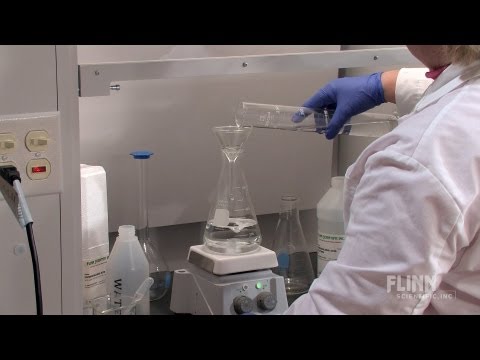
Flinn Scientific: How to Prepare a Dilute Acid Solution (3 min). Watch the order in which acid and water are mixed, and the protective equipment the technician wears.
Practice
Further reading
Sources and credits
This lesson adapts CC BY-SA material and is shared under CC BY-SA 4.0.