Waste Materials and Their Effective Management
Senior 1 · Chemistry
Waste Materials and Their Effective Management
Lesson 4 of 5
25 min
Shop in a Kigali market and your vegetables go into a paper bag, a woven basket or a cloth bag, never a thin plastic one. Since 2008 Rwanda has banned plastic carry bags, and in 2019 it went further, banning most single-use plastic items. Laws like these act at the top of what is called the waste hierarchy. What is the hierarchy, and why is preventing waste better than recycling it?
Definition
Waste hierarchy: a ranking of ways to manage waste from the most preferred to the least: reduce (make less waste), reuse, recycle (including composting), recover energy, and last of all dispose of what is left. Example: carrying your own bag (reduce) is better than recycling a plastic bag, which is better than dumping it.
Figure 4.1: The waste hierarchy.
Recycling saves raw materials and, above all, energy. Aluminium is made from its ore by electrolysis, which uses huge amounts of electricity; melting down old cans uses only about 5% of that energy. Glass is remelted at about and moulded again. Paper is soaked, pulped and pressed into new sheets, though its fibres get shorter each time. Plastics must first be sorted by type, because different plastics melt at different temperatures and do not mix; the number inside the triangle on a plastic item tells you its type.
Table 4.1: How common materials are recycled
| Material | How it is recycled | What it can become |
|---|---|---|
| Aluminium cans | shredded and melted; saves about 95% of the energy of making new aluminium | new cans, window frames, cooking pots |
| Other metals | scrap iron and copper sorted with magnets and by hand, then melted | roofing sheets, reinforcing bars, wire |
| Glass | sorted by colour, crushed and remelted | new bottles and jars |
| Paper and cardboard | soaked, pulped, cleaned and pressed | egg trays, cardboard, tissue paper |
| Plastic | sorted by type, washed, shredded and melted into pellets | buckets, pipes, fibres for clothing, poles |
| Food and garden waste | composted or digested (Lesson 5) | compost for gardens; biogas |
| E-waste | dismantled; metals and plastics separated; hazardous parts treated | recovered gold, silver and copper; refurbished computers |
Law N° 57 of 2008 of 10 September 2008 prohibited the manufacture, import, use and sale of polythene bags. Law N° 17 of 2019 of 10 August 2019, which came into force when it was published on 23 September 2019, replaced it and widened the ban to single-use plastic items, defined as disposable plastic items "designed to be used once before it is discarded or recycled". Under the 2019 law:
Worked example
Problem. Under Law N° 17 of 2019, a retailer is caught selling plastic carry bags, and caught again three months later. What is the total of the two fines?
Solution.
Answer: 900,000 Frw, and the bags are seized both times. Fines this size make it cheaper to switch to paper or cloth bags.
In December 2017 Rwanda opened a national e-waste dismantling and recycling facility in Bugesera District, Eastern Province, set up through the Ministry of Trade and Industry and the national environment fund, FONERWA (KT Press, 4 December 2017). It is run by Enviroserve Rwanda Green Park, which collects old phones, computers, appliances, batteries and solar products. Staff separate the parts that can be refurbished or recycled; the facility recovers metals such as copper and gold, and refurbished computers have been given to schools. In 2020 it was reported to have created about 300 green jobs, with e-waste collection centres in every district (Eos, 4 September 2020). Reported capacities differ between sources, so check the latest figure with the company.
On the last Saturday of every month, from 8 a.m. to 11 a.m., Rwandans take part in umuganda, compulsory community work. Many umuganda mornings are spent clearing litter and plastic from drains and streets, cleaning markets and planting trees, which is the waste hierarchy in action at the level of a whole village.

Worked example
Problem. A school club collects 500 aluminium cans in a term, each with a mass of 15 g. (a) What mass of aluminium is this, in kilograms? (b) If making this aluminium from ore uses 100 units of energy, how many units does recycling it use, and what percentage is saved?
Solution.
Answer: 7.5 kg of aluminium, recycled with only 5 units of energy instead of 100, a 95% saving.
Warning
E-waste and batteries go to a collection point, not the bin. Do not break open old phones, chargers or batteries to "get the metal out", and never burn cables to recover copper: the smoke contains poisonous substances and the circuit boards contain lead and other heavy metals. Store old items dry in a closed box and hand them to an e-waste collector.
Tip
"Refuse, reduce, reuse, recycle": say it in that order, because that is the order of preference.
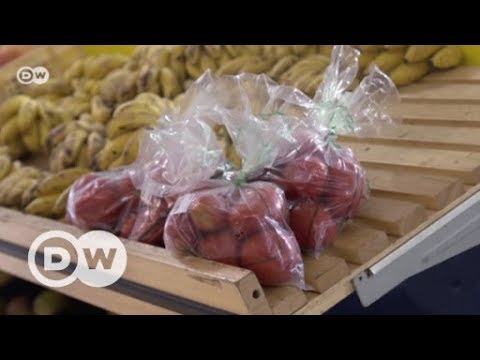
DW News: Ten years on, Rwanda's plastic ban (4 min, 2018). Note how shops and markets replaced plastic bags.
Practice
Sources and credits
This lesson adapts CC BY-SA material and is shared under CC BY-SA 4.0.