Introduction to Literary Genres
Senior 1 · English
Introduction to Literary Genres
Lesson 1 of 5
30 min
Imagine a football match between two friends that ends in a terrible quarrel. You could tell what happened in three different ways. You could write it down as a story, act it out with two classmates, or turn it into a short poem to recite. The events would stay the same, but each version would have a different shape, and a reader would recognise that shape at a glance. These shapes are called genres. In this unit you will learn to tell them apart, first in Rwanda's oral literature and then in written literature.
Below, one story comes to you three times: first as a story in prose, then as a scene from a play, and then as a poem.
Think first: What is your favourite story? Did you first meet it in a book, on the radio, on a screen, or from someone who told it to you?
Chicken and Millipede were friends. But they were always competing with each other. One day they decided to play football to see who the best player was.
They went to the football field and started their game. Chicken was fast, but Millipede was faster. Chicken kicked far, but Millipede kicked further. Chicken started to feel grumpy.
They decided to play a penalty shoot-out. First Millipede was goal keeper. Chicken scored only one goal. Then it was the chicken’s turn to defend the goal.
Millipede kicked the ball and scored. Millipede dribbled the ball and scored. Millipede headed the ball and scored. Millipede scored five goals.
Chicken was furious that she lost. She was a very bad loser. Millipede started laughing because his friend was making such a fuss.
Chicken was so angry that she opened her beak wide and swallowed the millipede.
As Chicken was walking home, she met Mother Millipede. Mother Millipede asked, “Have you seen my child?” Chicken didn’t say anything. Mother Millipede was worried.
Then Mother Millipede heard a tiny voice. “Help me mom!” cried the voice. Mother Millipede looked around and listened carefully. The voice came from inside the chicken.
Mother Millipede shouted, “Use your special power my child!” Millipedes can make a bad smell and a terrible taste. Chicken began to feel ill.
Chicken burped. Then she swallowed and spat. Then she sneezed and coughed. And coughed. The millipede was disgusting!
Chicken coughed until she coughed out the millipede that was in her stomach. Mother Millipede and her child crawled up a tree to hide.
From that time, chickens and millipedes were enemies.
Winny Asara, African Storybook, 2014.
A scene based on the story, written by Ganzaa.
CHARACTERS: CHICKEN · MILLIPEDE, her friend · MOTHER MILLIPEDE
A football field at the edge of a village, late in the afternoon. Two sticks in the grass make a goal. CHICKEN stands in the goal, flapping her wings. MILLIPEDE puts the ball on the penalty spot.
CHICKEN: Four goals is just luck. Nobody scores five against me.
MILLIPEDE: (wiggling all his legs) I have a hundred legs, my friend. Which one shall I use?
CHICKEN: Just kick it!
(MILLIPEDE heads the ball. It flies past CHICKEN into the goal.)
MILLIPEDE: Five! (He rolls on the grass, laughing.) Five goals to one! Look at you, all feathers and fuss!
CHICKEN: (slowly) Stop laughing.
MILLIPEDE: I can’t stop! Ha! Ha! Ha!
(CHICKEN opens her beak wide and swallows him. Silence. She smooths her feathers and walks away as if nothing has happened. MOTHER MILLIPEDE hurries in.)
MOTHER MILLIPEDE: Chicken! Have you seen my child? He came here to play football.
(CHICKEN looks up at the sky and says nothing.)
A TINY VOICE: (from inside CHICKEN) Help me, Mum!
MOTHER MILLIPEDE: (leaning close to CHICKEN’s stomach) Use your special power, my child!
(CHICKEN burps. She sneezes. She coughs and coughs, and MILLIPEDE tumbles out onto the grass. Mother and child hurry off to climb a tree. CHICKEN stands alone, wiping her beak.)
CHICKEN: (to the audience) Well. At least I didn’t lose that game five to one.
(The lights go down.)
A poem based on the story, written by Ganzaa.
Chicken and Millipede, friends at play,
Went down to the field one sunny day.
“A match!” they said. “And then we’ll see
Who is the champion: you or me!”But a hundred legs are hard to beat,
And the ball flew past poor Chicken’s feet.
Five goals to one! Her friend lay flat
And laughed and laughed: “Well, how about that?”Then Chicken’s temper boiled inside;
She opened her beak, she opened it wide,
And gulp! Her laughing friend was gone.
She smoothed her feathers and hurried on.“Help me, Mum!” called a voice within.
“Use your power, child! Let the stink begin!”
So Chicken coughed till her friend fell free,
And enemies now they will always be.

Before you read a single word, the shape of the page tells you the genre. These are the three texts you have just read, shown as shapes.
| Word or phrase | Meaning | Example |
|---|---|---|
| compete | to try to be better than someone else | Chicken and Millipede were always competing. |
| grumpy | in a bad mood and easily annoyed | Chicken started to feel grumpy. |
| furious | extremely angry | She was furious that she lost. |
| a bad loser | a person who becomes angry or unfair after losing | A bad loser never shakes hands after a match. |
| make a fuss | to show too much anger or worry about something small | Millipede laughed because his friend was making such a fuss. |
| burp | to let air from the stomach out noisily through the mouth | Chicken burped, then sneezed and coughed. |
| genre | a kind of literature with its own form and features | Prose, poetry and drama are the three main genres of written literature. |
| narrator | the voice that tells a story | The narrator tells us that Mother Millipede was worried. |
| stanza | a group of lines in a poem, like a paragraph in prose | The Bad Loser has four stanzas of four lines. |
| script | the written text of a play | Each actor learns her lines from the script. |
| stage direction | an instruction in a script that tells the actors what to do or describes the scene | (to the audience) is a stage direction. |
| audience | the people who watch or listen to a performance | Chicken speaks her last line to the audience. |
Definition
Literature: stories, poems, plays, songs and sayings in which language is used with imagination and skill to entertain, teach or move people. It can be spoken (oral literature) or written down (written literature). Example: a folktale told by a grandmother and a novel on a library shelf are both literature.
Genre (say ZHON-ruh): a kind or category of literature with its own form and features. Example: Chicken and Millipede and The Bad Loser tell the same events in two different genres.
Definition
Prose: ordinary written language in sentences and paragraphs, as in stories, novels, letters and newspapers. Example: Text 1.
Poetry (also called verse): writing arranged in lines and stanzas, usually with a strong rhythm and often with rhyme, in which the sound of the words matters as much as their meaning. One piece of poetry is a poem. Example: Text 3.
Drama: literature written to be performed by actors in front of an audience. One piece of drama is a play, and its written text is the script. Example: Text 2.
| Prose | Poetry | Drama | |
|---|---|---|---|
| What you see on the page | full lines that run to the edge of the page | short lines that stop before the edge, with gaps between groups | character names followed by their words, and instructions in brackets |
| Building blocks | sentences, paragraphs, chapters | lines and stanzas | speeches (dialogue), scenes and acts |
| Who tells it | a narrator | a speaker (the "I" of the poem, as you saw in Unit 1) | nobody: the characters speak for themselves |
| How we meet it | we read it, silently or aloud | we read it aloud, recite it or sing it | we watch actors perform it, or hear it on the radio |
| In this lesson | Chicken and Millipede | The Bad Loser | The Penalty Shoot-out |
| Function | What it means | Example |
|---|---|---|
| 1. To entertain | It gives pleasure: laughter, excitement, suspense. | Chicken's last line in the play makes the audience laugh. |
| 2. To teach values | It shows good and bad behaviour and what follows from it. | The story shows how a bad loser can lose a friend for ever. |
| 3. To keep culture and history alive | It carries a people's beliefs, customs and past from one generation to the next. | Rwanda's tales, proverbs and historical narratives were passed on by word of mouth for centuries (Lesson 2). |
| 4. To express feelings | It lets people share joy, love, grief and hope. | A love song at a wedding; a poem of mourning. |
| 5. To criticise and correct society | It shows a problem clearly so that people want to change. | Urunana ("hand in hand"), a Kinyarwanda radio drama first broadcast in 1999, follows families in an imaginary village, Nyarurembo, as they face problems of health and family life. |
| 6. To unite people | Shared stories and songs make people feel they belong together. | A whole stadium singing the same song. |
| 7. To develop language | Readers and listeners meet new words and skilful ways of saying things. | Reading widely in English improves your own speaking and writing. |
Most texts do several of these jobs at once. Chicken and Millipede entertains, teaches a value, and explains something about nature.
When you turn a play into prose, the characters' words become direct speech, and the stage directions become the narrator's words.
| In the script | In a story |
|---|---|
| MILLIPEDE: Five! | "Five!" shouted Millipede. |
| CHICKEN: (slowly) Stop laughing. | "Stop laughing," said Chicken slowly. |
| MOTHER MILLIPEDE: Have you seen my child? | "Have you seen my child?" asked Mother Millipede. |
| (CHICKEN looks up at the sky and says nothing.) | Chicken looked up at the sky and said nothing. |
Worked example
Name the genre of this extract, and give your evidence.
GRANDMOTHER: (putting more wood on the fire) Sit closer, children. Tonight's story is about a hare.
KALISA: Is it Bakame again?
Warning
Tip
Prose tells, drama shows, poetry sings. Look at the page before you read: paragraphs mean prose, names followed by colons mean drama, and short lines grouped in stanzas mean poetry.
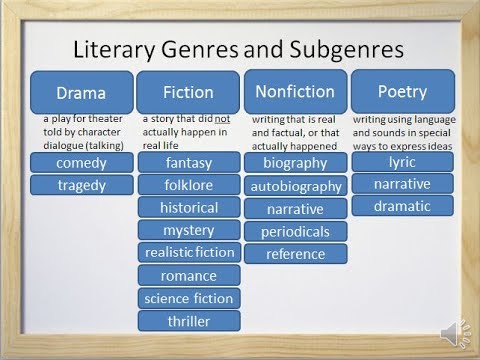
Literary Genres and Subgenres, from English Units, a channel made by a US teacher for learners of English. It is long (23 minutes), so watch it in two or three sittings. It sorts literature into four genres: fiction, nonfiction, drama and poetry. Fiction and nonfiction are both written in prose, so this matches the three shapes in this lesson. Pause at each practice description and name the genre before the answer appears.
In groups of three, perform The Penalty Shoot-out. Decide who plays each part (Millipede can also speak the tiny voice). Follow every stage direction: the audience must see the swallow and the coughing, because no narrator will tell them. Then discuss as a class: which version, the story, the play or the poem, did you enjoy most, and why?
I preferred the play because we could see Chicken's face when…
The poem was the easiest to remember because of the rhyme…
The story gave the most details, for example…
I disagree with Aline: I think the story is funnier, because…
Turn the end of the play, from "MOTHER MILLIPEDE hurries in" to the last line, back into prose (80 to 100 words). Use direct speech with correct punctuation, and turn every stage direction into narration.
Just then, Mother Millipede hurried onto the field. "Chicken! Have you seen my child?" she asked. "He came here to play football."
Chicken looked up at the sky and said nothing.
"Help me, Mum!" called a tiny voice from inside Chicken.
Mother Millipede leaned close to Chicken's stomach. "Use your special power, my child!" she shouted.
Chicken burped, sneezed and coughed until Millipede tumbled out onto the grass. Mother and child hurried away to climb a tree, and Chicken stood alone, wiping her beak.
"Well," she said to herself, "at least I didn't lose that game five to one."
Practice
Sources and credits