Introduction to Literary Genres
Senior 1 · English
Introduction to Literary Genres
Lesson 5 of 5
30 min
Let's begin
Some literature only comes fully alive when it is spoken. A poem is written for the ear: its beat and its sounds carry half of its meaning. A play is written to be seen and heard: its script is a set of instructions for actors. Rwandans have always known this. Warriors recited ibyivugo at speed and with pride, and today families gather round the radio for Urunana. This lesson gives you one poem to read aloud and one short play to perform.
Listen first: ask a classmate to read the poem below aloud while you close your eyes. What do you hear?
Whenever the moon and stars are set,
Whenever the wind is high,
All night long in the dark and wet,
A man goes riding by.
Late in the night when the fires are out,
Why does he gallop and gallop about?Whenever the trees are crying aloud,
And ships are tossed at sea,
By, on the highway, low and loud,
By at the gallop goes he.
By at the gallop he goes, and then
By he comes back at the gallop again.
From A Child's Garden of Verses, 1885.
| Word | Meaning |
|---|---|
| the moon and stars are set | the moon and stars have gone down and cannot be seen |
| gallop | (of a horse) to run as fast as possible; at the gallop: galloping |
| crying aloud | making loud, wailing sounds |
| tossed | thrown up and down by the waves |
| highway | a main road |
In Stevenson's Scottish and English speech, again is often said to rhyme with then.

Definition
Line and stanza: a poem is written in lines; a group of lines separated by a space is a stanza. Example: Windy Nights has two stanzas of six lines.
Rhyme: the same sound at the end of two words (set, wet). The rhyme scheme is the pattern of rhymes, shown with letters: each new sound gets the next letter. Example: the first stanza is ABABCC.
Rhythm: the pattern of strong and weak beats in a line. Example: BY at the GAL-lop he GOES, and THEN: four strong beats, like hooves on a road.
Repetition: using the same word or phrase more than once, for effect. Example: gallop appears five times.
Imagery: words that make pictures, sounds or feelings in the reader's mind. Example: ships are tossed at sea.
Personification: describing a thing as if it were a person. Example: the trees are crying aloud.
| Feature | In the poem | Its effect |
|---|---|---|
| Stanzas | two stanzas of six lines | The rider goes by in the first and comes back in the second. |
| Rhyme scheme | ABABCC (set, high, wet, by, out, about), then DEDEFF (aloud, sea, loud, he, then, again) | Each stanza ends with a rhyming pair, which snaps it shut like a door. |
| Rhythm | a fast, bouncing beat of about four strong stresses a line | It sounds like a horse's hooves. |
| Repetition | Whenever… Whenever…; gallop five times; By at the start of four lines | The rider seems to pass again and again; the night feels endless. |
| Imagery | "the dark and wet", "ships are tossed at sea", "low and loud" | We see darkness and hear the storm. |
| Personification | "the trees are crying aloud" | The storm seems alive and frightening. |
| Speaker | someone lying awake at night, asking a question | We share the speaker's wonder and fear. |
The speaker's question, Why does he gallop and gallop about?, is never answered. A poem is allowed to leave a mystery, and this one invites you to guess.
Worked example
Analyse the last two lines of Windy Nights: which devices does the poet use, and what is their effect?
By at the gallop he goes, and then
By he comes back at the gallop again.
A one-scene play written by Ganzaa for this lesson.
CHARACTERS: GRANDMOTHER · IRADUKUNDA, 12, who lives with her · KEVIN, 13, her cousin from Kigali, on holiday
A sitting room in a house in Rwamagana, on an evening in the school holidays. The electricity has just gone off. A small solar lamp stands on the table. GRANDMOTHER sits in her chair; IRADUKUNDA sits on a mat at her feet. KEVIN stands by the window, shaking his phone.
KEVIN: Two per cent! Grandma, when will the power come back?
GRANDMOTHER: When it wants to. (She settles back in her chair.) We managed for years without it. Sakwe sakwe!
IRADUKUNDA: (at once) Soma!
KEVIN: (looking from one to the other) What's happening?
IRADUKUNDA: Riddles. Grandma asks, you answer. If you can't answer, you lose the round.
KEVIN: Riddles are for little children.
GRANDMOTHER: (smiling) Then this will be easy for you. Havamo umwe twashira. If one of us leaves, we are finished.
KEVIN: (thinking hard) A… football team?
IRADUKUNDA: (laughing) A team can still play with ten!
GRANDMOTHER: (pointing towards the kitchen) Amashyiga. Three stones under the pot. Take one away, and nobody eats tonight.
KEVIN: (slowly) Oh. That's actually clever.
GRANDMOTHER: Another. I am full of holes, but I still hold water.
KEVIN: (quickly) A sponge!
IRADUKUNDA: (to the audience) He's learning.
KEVIN: My turn. (He stands in the middle of the room.) Sakwe sakwe!
GRANDMOTHER and IRADUKUNDA: Soma!
KEVIN: I sleep in your pocket and wake up singing, and I carry your voice over the hills without any legs.
GRANDMOTHER: (after a long pause) Hm. A drum?
IRADUKUNDA: A bird?
KEVIN: (holding up his phone) A phone! One point to the city!
(The lights come back on. KEVIN and IRADUKUNDA cheer, but neither of them moves towards the charger.)
GRANDMOTHER: (to the audience) The power is back, and nobody has noticed.
(Lights down.)
Definition
Playwright: a person who writes plays. (Note the spelling: wright is an old word for a maker, as in a maker of wheels.)
Dialogue: the words the characters speak to each other. In a script, each speech follows the character's name.
Stage directions: the words in a script, usually in italics or brackets, that tell the actors how to move and speak, and describe the setting, sounds and lights. They are not spoken aloud.
Aside: a short speech that a character says to the audience, which the other characters on stage are supposed not to hear. Example: IRADUKUNDA: (to the audience) He's learning.
Scene and act: a scene is a part of a play in one place and time; an act is a larger part made of several scenes. The Riddle Contest is a one-scene play.
| Term | Meaning | In The Riddle Contest |
|---|---|---|
| Cast | the list of characters, and the actors who play them | Grandmother, Iradukunda, Kevin |
| Set | the scenery and furniture that show where the play happens | a sitting room: a chair, a mat, a table, a window |
| Props | objects the actors carry or use (short for properties) | the phone, the solar lamp |
| Costume | the clothes an actor wears for a part | for example, a mushanana for Grandmother, a city T-shirt for Kevin |
| Lighting and sound | changes of light and sound effects, written as stage directions | "The lights come back on." · "Lights down." |
| Stage directions | instructions for movement, tone and gesture | (after a long pause), (pointing towards the kitchen) |
| Aside | words to the audience only | two asides: Iradukunda's and Grandmother's last line |
| Kind | Features | Example |
|---|---|---|
| Comedy | light and funny; misunderstandings; a happy ending | The Riddle Contest; The Penalty Shoot-out (Lesson 1) |
| Tragedy | serious; a main character suffers or dies, often because of a weakness such as pride | Shakespeare's Romeo and Juliet |
| Radio drama | performed with voices, music and sound effects only; the listener imagines the scene | Urunana, on Rwandan radio since 1999 |
| Film and television drama | performed for a camera; can change place in a second | a television series or a film |
Stage directions often tell an actor where to go: (She crosses down left.) These names come from the actor's point of view, standing on the stage and facing the audience.
| A stage direction can show… | Form | Example |
|---|---|---|
| an action or movement | present simple, full sentence | (She settles back in her chair.) |
| how a line is spoken | an -ing form or a short phrase | (smiling) · (at once) · (after a long pause) |
| a gesture | an -ing form + object | (holding up his phone) |
| who is spoken to | to + person | (to the audience) |
| light and sound | a short phrase or sentence | (Lights down.) · (A dog barks outside.) |
When a stage direction is a full sentence, its verb is always in the present simple, because they describe what happens on stage now, every time the play is performed.
Warning
Tip
Tap the beat. Before you recite a poem, read it once while tapping the table on each strong beat. For Windy Nights you will hear the horse: BY at the GAL-lop he GOES. When you perform a play, underline every stage direction in your script in one colour, so that you act it instead of reading it.

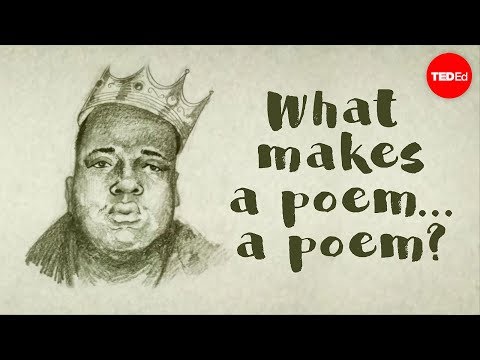
What makes a poem … a poem?, a TED-Ed lesson by Melissa Kovacs (5 minutes). Poets themselves disagree about what a poem is; the video names three features that most poems share. Write them down, then check whether Windy Nights has all three.
We could hear every word when…
The aside worked well because you turned to face us…
Next time, try pausing before…
We didn't see the lights come back on: maybe someone could…
Write a short scene (12 to 16 lines of dialogue) that continues The Riddle Contest the next evening, or a new scene of your own set in Rwanda. Include a list of characters, a description of the setting in italics, at least four stage directions of different kinds (movement, tone, gesture, light or sound) and one aside.
CHARACTERS: GRANDMOTHER · IRADUKUNDA · KEVIN
The same sitting room, the next evening. The lights are on. KEVIN sits on the mat with a notebook. IRADUKUNDA enters with a tray of tea.
IRADUKUNDA: What are you writing?
KEVIN: (hiding the notebook) Nothing.
GRANDMOTHER: (to the audience) Nothing, he says. He has been writing since lunch.
KEVIN: (standing, clearing his throat) All right. Sakwe sakwe!
GRANDMOTHER and IRADUKUNDA: Soma!
KEVIN: (reading carefully) I have a face and two hands, but no arms and no legs.
IRADUKUNDA: (at once) A clock! Too easy.
KEVIN: (turning a page) Then: I go up the hill full, and come down empty.
GRANDMOTHER: (slowly) Hm. Is it… a jerrycan going to the well?
KEVIN: No! It's the other way round: up empty, down full. (He frowns at his notebook.) Wait.
(IRADUKUNDA and GRANDMOTHER burst out laughing. Outside, a dog barks.)
KEVIN: (laughing too) I'll write a better one tomorrow.
GRANDMOTHER: (smiling) Good. And tomorrow I will have a harder one for you.
(Lights down.)
Practice
Further reading
Sources and credits
This lesson adapts CC BY-SA material and is shared under CC BY-SA 4.0.