Introduction to Literary Genres
Senior 1 · English
Introduction to Literary Genres
Lesson 2 of 5
30 min
Let's begin
Long before there were books in Rwanda, there was literature. In the evening, when the work was done, an older person might call out "Sakwe sakwe!", and the children would shout back "Soma!": the riddle game had begun. Later a tale might start with "Kera habayeho…" ("Long ago there lived…"). None of this was written down, yet it was learned, remembered and passed on for hundreds of years. This is oral literature: literature that lives in the voice and the memory.
Every people in the world has its own oral literature. The tale below comes from the Akan people of Ghana, in West Africa. Its hero is Anansi, a spider who is famous for being clever and greedy at the same time.
Long long ago people didn't know anything. They didn't know how to plant crops, or how to weave cloth, or how to make iron tools. The god Nyame up in the sky had all the wisdom of the world. He kept it safe in a clay pot.
One day, Nyame decided that he would give the pot of wisdom to Anansi. Every time Anansi looked in the clay pot, he learned something new. It was so exciting!
Greedy Anansi thought, "I'll keep the pot safe at the top of a tall tree. Then I can have it all to myself!" He spun a long thread, wound it round the clay pot, and tied it to his stomach. He began to climb the tree. But it was hard climbing the tree with the pot bumping him in the knees all the time.
All the time Anansi's young son had been standing at the bottom of the tree watching. He said, "Wouldn't it be easier to climb if you tied the pot to your back instead?" Anansi tried tying the clay pot full of wisdom to his back, and it really was a lot easier.
In no time he reached the top of the tree. But then he stopped and thought, "I'm supposed to be the one with all the wisdom, and here my son was cleverer than me!" Anansi was so angry about this that he threw the clay pot down out of the tree.
It smashed into pieces on the ground. The wisdom was free for everyone to share. And that is how people learned to farm, to weave cloth, to make iron tools, and all the other things that people know how to do.
A Ghanaian folktale, as published by the African Storybook, 2014.
| Word or phrase | Meaning | Example |
|---|---|---|
| wisdom | knowledge and good judgement that come from learning and experience | Nyame had all the wisdom of the world. |
| crops | plants grown on a farm for food or sale | People didn't know how to plant crops. |
| weave | to make cloth by passing threads over and under each other | Ghana is famous for woven kente cloth. |
| iron tools | tools made of metal, such as hoes and axes | A blacksmith makes iron tools. |
| clay pot | a pot made of earth that has been shaped and baked hard | He kept the wisdom in a clay pot. |
| spin, spun | (of a spider) to make a thread from its own body | Anansi spun a long thread. |
| wind, wound | to wrap something round and round something else (wound rhymes with round here) | He wound the thread round the pot. |
| smash | to break into many pieces, suddenly and violently | The pot smashed on the ground. |
| trickster | a clever character in folktales who plays tricks on others and is sometimes tricked himself | Anansi and Bakame the hare are famous tricksters. |
Definition
Oral literature: literature that is composed, performed and passed on by word of mouth, from memory, rather than in writing. Tales, riddles, proverbs, songs and praise poems are oral literature. Example: the riddle game that begins "Sakwe sakwe!"
Written literature: literature that is composed and passed on in writing, in a fixed text that readers can return to. Example: a novel, or a book of poems.
| Oral literature | Written literature | |
|---|---|---|
| How it is passed on | by word of mouth, from memory | on paper or a screen, in a fixed text |
| Who made it | usually nobody knows: it belongs to the whole community | usually a known author, whose name is on the work |
| Does it change? | yes: each teller changes details, so there are many versions | no: every copy has the same words |
| The audience | present, and often takes part: answers "Soma!", sings the chorus, claps | usually reads alone, far away from the author |
| Special features | opening and closing formulas, repetition, songs inside tales, the teller's voice and gestures | chapters, titles, punctuation, and a text you can read again and again |
| Examples | imigani, ibisakuzo, indirimbo, Anansi tales | novels, short stories, printed poems, play scripts |
Oral literature does the same jobs as all literature (Lesson 1), and some jobs of its own. It taught children the values and taboos of the community, entertained people after a day's work, kept the history of kings and heroes, praised brave deeds, sharpened quick thinking through riddles, and gave rhythm to work, weddings and lullabies.
The two kinds of literature meet. When a tale is written down, as Anansi and Wisdom was by the African Storybook, it becomes written literature too. You will see this happen again in Lesson 3.
Definition
Folktale: a traditional story told by ordinary people and passed on by word of mouth. Folktale is the general name; myths, legends, fables and trickster tales are all kinds of folktale.
Myth: a traditional story, often about gods or the first people, set in a time before history, that explains how something in the world began. Example: Anansi and Wisdom explains how people came to share wisdom.
Legend: a traditional story about a real person or place from the past, told as if it were history but mixed with wonders that cannot be proved. Example: the footprints that King Ruganzu II Ndoli is said to have left in solid rock.
Fable: a short story, usually with animals that talk and act like people, that teaches a moral. Example: Aesop's The Goose with the Golden Eggs (Unit 7).
Definition
Song: words sung to a tune, often with a chorus that the audience repeats. Oral songs go with work, ceremonies and rest. Example: a lullaby (igihozo) sung to calm a baby.
Riddle: a question in disguise: a description whose hidden answer the listener must find. Example: "I have many teeth, but I never eat." (a comb)
Proverb: a short, well-known saying that gives advice or states a truth, often in two balanced halves. Example: Igiti kigororwa kikiri gito ("A tree is straightened while it is still young").

| Genre | Main features | Main purpose | Example |
|---|---|---|---|
| Myth | gods or first beings; set before history; explains how something began | to explain the world and its beliefs | Anansi and Wisdom: how wisdom came to all people (Akan, Ghana) |
| Legend | a real hero or place from the past; told as history, with wonders added | to honour heroes and explain places | King Ruganzu II Ndoli's footprints in the rock at Rusiga (Rulindo) and Ngarama (Gatsibo) |
| Fable | short; talking animals; ends with a clear moral | to teach how to behave | Aesop's fables (Unit 7) |
| Trickster tale and "why" story | a clever, cunning hero; or a tale that ends by explaining something in nature | to entertain and teach | tales of Bakame the hare; Chicken and Millipede (Lesson 1) |
| Song | sung to a tune; a chorus that everyone repeats; goes with an activity | to express feelings and bring people together | lullabies, work songs for farming, wedding songs |
| Riddle | a question in disguise, played in pairs or groups | to sharpen thinking and quick speech | Havamo umwe twashira (see below) |
| Proverb | one short sentence, often in two balanced halves; says more than it seems to | to advise or warn in few words | Uburere buruta ubuvuke ("Upbringing is greater than birth") |
| Kinyarwanda | English | What it is |
|---|---|---|
| umugani, plural imigani | tale; also proverb | the general word for traditional stories and sayings |
| imigani miremire | long tales: folktales | tales such as those of Bakame the hare and Impyisi the hyena |
| imigani migufi | short sayings: proverbs | Igiti kigororwa kikiri gito ("A tree is straightened while it is still young") |
| igisakuzo, plural ibisakuzo | riddle | a word game played in pairs, which always begins "Sakwe sakwe!" "Soma!" |
| indirimbo | song | songs for work, celebration, worship and rest |
| igihozo, plural ibihozo | lullaby | a song to calm, comfort or praise a small child |
| icyivugo, plural ibyivugo | heroic self-praise poem | recited by warriors, who praised their own brave deeds in fast, proud verse |
| igitekerezo, plural ibitekerezo | historical narrative | stories of the kings and heroes of old Rwanda, such as Ruganzu Ndoli (in everyday speech, igitekerezo also means "an idea") |
Player A: "Sakwe sakwe!" Player B: "Soma!" Player A then gives the riddle, and B must find the answer. Here is a well-known Rwandan riddle:
Havamo umwe twashira. ("If one of us leaves, we are finished.")
Answer: amashyiga, the three stones of a cooking fire. A pot sits on three stones; take one away and the pot falls, so nobody eats.
Worked example
Is Anansi and Wisdom a myth, a legend or a fable? Give your reasons.
Warning
Tip
Myths explain, legends remember, fables teach. Ask one question: is the story mainly explaining how something began (myth), remembering a hero or a place (legend), or teaching a lesson with animals (fable)?

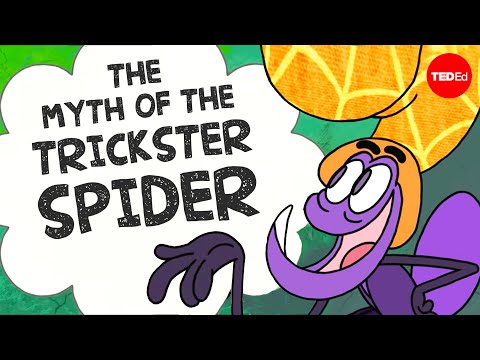
The myth of Anansi, the trickster spider, a TED-Ed lesson by Emily Zobel Marshall (4 minutes 30 seconds). In this second Akan myth, Anansi asks Nyame, the Sky God, to give him all the world's stories, and Nyame sets him a task that seems impossible. Watch for the god who appears in both myths, and for how Anansi uses his cleverness. Then compare: in one myth Anansi wins the stories; in the other he loses the wisdom.
Write a short myth (100 to 130 words) that explains something in nature. Choose one: why the cow has no top front teeth; why the chameleon changes colour; why the hyena laughs at night. Begin with the opening formula, use at least one piece of dialogue, and end with "And that is why…" and the closing formula.
Kera habayeho… Long ago, the cow had a full set of teeth, and she was very proud of her smile. She laughed at the goat's small yellow teeth. One day Lion, the king of the animals, called everyone to share out the grass. "Come early," he said, "and each of you will receive a field." But the cow spent the morning admiring her smile in the lake, and she arrived last. "There is no field left," said Lion. "You may eat the grass beside every path, if you give me your top teeth." The cow agreed. And that is why, to this day, the cow has no top front teeth, and why she eats a little here and a little there, wherever she walks. Si jye wahera, hahera umugani.
Practice
Sources and credits
This lesson adapts CC BY-SA material and is shared under CC BY-SA 4.0.