The Role of Work in Society
Senior 1 · Entrepreneurship
The Role of Work in Society
Lesson 2 of 4
25 min
On the steep hills of Nyabihu District, tea pickers move along the rows, plucking the top two leaves and a bud from each bush and dropping them into baskets on their backs. The same day, lorries carry the green leaf to a tea factory, where machines wither, roll, dry and grade it into black tea. Most of Rwanda's tea is exported, so the chests of tea then travel by road to buyers abroad, while some is packed for shops, hotels and cafés in Kigali.
Count the kinds of work in that journey: pickers, factory workers, lorry drivers, tea tasters, brokers, bankers, shopkeepers and waiters. Every one of them is needed before you can drink the tea.

Economists group all the work in a country into sectors according to what the work does to a product: take it from nature, turn it into goods, or provide a service.
Definition
Sector of activity (economic sector): a large group of jobs and businesses that do the same kind of work in the economy.
Example: all farms, fisheries and mines together form the primary sector.
Definition
Primary sector: work that takes raw materials directly from nature: farming, fishing, mining, quarrying and forestry.
Example: picking tea; fishing on Lake Kivu; mining tin ore.
Definition
Secondary sector: work that turns raw materials into finished goods: manufacturing, processing and construction.
Example: a tea factory; a cement factory; a builder putting up a house; a tailor sewing a dress.
Definition
Tertiary sector: work that provides services rather than goods: trade, transport, banking, health, education and tourism.
Example: a lorry driver, a shopkeeper, a nurse, a tour guide at Volcanoes National Park.
| Sector | What the work does | Examples of work in Rwanda |
|---|---|---|
| Primary | Takes resources from nature | Growing beans and bananas; picking tea and coffee; fishing on Lake Kivu; mining tin and coltan; quarrying stone |
| Secondary | Turns raw materials into goods | Processing tea and coffee; making cement, bricks and furniture; brewing; sewing clothes; building houses and roads |
| Tertiary | Provides services | Moto and bus transport; shops and markets; banks and mobile money; schools and hospitals; hotels and tourism |
| Quaternary (a fourth group some writers add) | Works with knowledge and information | Software development; research; data analysis |
The sectors depend on each other. A tea factory (secondary) has nothing to process without pickers (primary) and cannot sell without transport and banks (tertiary). In 2019 agriculture, the largest part of the primary sector, made up about 29% of Rwanda's economy.
Tip
Ask what happens to the product. Taken from nature? Primary. Changed into something new? Secondary. Nothing made, but something done for people? Tertiary. A tailor is secondary (makes clothes); a tailor who only mends them is giving a service.
To compare sectors, count the workers in each and turn the counts into percentages:
Worked example
A class survey (illustrative figures)
A Senior 1 class in Nyamasheke asked 40 parents where they work: 18 in the primary sector, 6 in the secondary sector and 16 in the tertiary sector.
Primary:
Secondary:
Tertiary:
Check: .
Almost half the parents work in the primary sector, mostly farming, and the secondary sector is the smallest.
Worked example
Where the value is added (illustrative figures)
Suppose a factory needs 4.5 kg of green leaf, bought at Frw 300 a kilogram, to make 1 kg of black tea. It sells that kilogram to a shop for Frw 4,000, and the shop sells it in packets for Frw 8,000.
Primary (the grower): , so Frw 1,350 for the leaf.
Secondary (the factory): , so Frw 2,650 added.
Tertiary (the shop): , so Frw 4,000 added.
Check: , the price the customer pays. Every sector earns part of it.
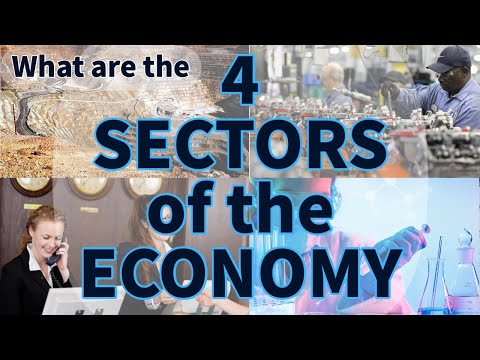
Think Econ, "The 4 Sectors of the Economy" (about 5 minutes). Watch for the definition of each sector and the example the video follows through all four. Then think of a Rwandan product that could replace it.
Practice
Sources and credits
Written by Ganzaa: the tea case, the diagram, the chart, the table, the worked examples, the activity and the practice items. The survey figures and tea prices are illustrative (2026).
This lesson adapts CC BY-SA material and is shared under CC BY-SA 4.0.