Egyptian Civilization
Senior 1 · History and Citizenship
Egyptian Civilization
Lesson 5 of 5
25 min
In July 1799 French soldiers rebuilding a fort near the town of Rashid (Rosetta), in the Nile delta, found a broken slab of dark stone covered in writing. The same text was carved on it three times: in hieroglyphs at the top, in a flowing Egyptian script called Demotic in the middle, and in ancient Greek at the bottom. Scholars could read the Greek. Could it unlock the other two?

Worked example: why the Rosetta Stone was the key
Definition
Hieroglyphs: the picture-signs of ancient Egyptian writing, used from about 3200 BCE. Some signs stand for sounds, others for whole words or ideas. The name is Greek for "sacred carvings".
Definition
Papyrus: a writing material made from strips of the papyrus reed, which grows beside the Nile, pressed together and dried into sheets and rolls. The English word "paper" comes from it.
Definition
Scribe: a trained writer who kept records for the government, temples or rich families. Scribes spent years at school learning hundreds of signs.
| Field | Egyptian achievement | Legacy today |
|---|---|---|
| Writing | hieroglyphs, and faster scripts for daily use; ink and papyrus | one of the world's first writing systems; the word "paper" |
| Calendar | a year of 365 days: 12 months of 30 days, plus 5 extra days | Julius Caesar based the Roman calendar, the ancestor of ours, on Egyptian advice |
| Time | day and night each divided into 12 hours; shadow clocks and water clocks | our 24-hour day |
| Mathematics | a decimal number system; fractions; geometry for measuring fields and building pyramids | land surveying; geometry |
| Medicine | the Edwin Smith Papyrus (c. 1600 BCE) describes 48 injuries with examination, diagnosis and treatment | the step-by-step method of examining a patient |
| Architecture | pyramids, stone temples with columns, obelisks | columns and obelisks copied by Greeks, Romans and modern cities |
| Farming | basin irrigation, canals, the shaduf, the ox-drawn plough | irrigation farming along rivers worldwide |
| Crafts | glass, jewellery, cosmetics, linen, boat-building with sails | world museums; many techniques still in use |

Worked example: the area of a round field (Rhind Papyrus, problem 50)
Problem: A round field has a diameter of 9 khet (a unit of length). What is its area?
Tip
Memory hook for the number signs, from 1 to a million: Stroke, Hobble, Coil, Lotus, Finger, Tadpole, God: "Some Hungry Cats Like Fresh Tilapia, Generally."
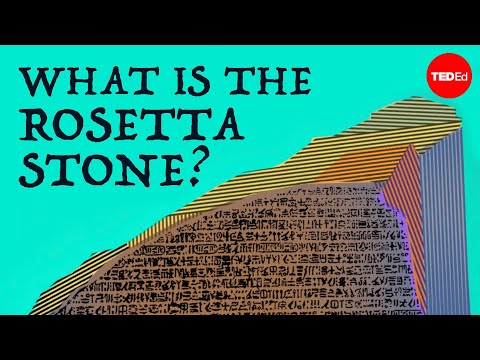
TED-Ed: "Why was the Rosetta Stone so important?". Watch for how the names of rulers helped scholars to read the hieroglyphs.
Class debate: The Rosetta Stone was found in Egypt but was taken to Britain in 1801 and has been in the British Museum since 1802. Egyptian scholars have asked for it to be returned. Where should it be kept today, and why? Think of Rwandan objects held in museums abroad as well.
Practice
Further reading for this unit
Sources and credits
This lesson adapts CC BY-SA material and is shared under CC BY-SA 4.0.