Uniform Rectilinear Motion
Senior 1 · Physics
Uniform Rectilinear Motion
Lesson 1 of 5
20 min
You sit in a bus as it pulls out of Nyabugogo bus station. Your neighbour in the next seat stays exactly the same distance from you: to her, you are not moving. A moto driver waiting at the roadside sees you pass at : to him, you are moving fast. Who is right?
Both are. Whether something is moving depends on what you compare it with. Physics begins every description of motion by choosing that reference.
Definition
A reference point (or frame of reference) is the object or place from which positions and motion are measured. Example: the bus station, or a seat in the bus.
An object is in motion if its position changes with time compared with the reference point. It is at rest if its position does not change.
The position of an object is where it is, given as a distance and direction from the reference point, for example "300 m east of the school gate".

Roll a tennis ball slowly across the classroom floor. Your partner claps once every second, and at each clap a third pupil puts a chalk mark beside the ball. Join the marks: the line you get is the ball's trajectory. Now repeat with the ball rolled across a sloping board, or tied to a string and swung in a circle. The shape of the trajectory changes each time.
Definition
The trajectory of a moving object is the path it follows. When the trajectory is a straight line, the motion is called rectilinear motion (from the Latin for "straight line").
Figure 1.1: Three kinds of trajectory. The dots are the positions at equal time intervals.
This whole unit is about rectilinear motion: motion along a straight line, such as a car on a straight stretch of road or a stone dropped from a bridge. A moto climbing a winding street in Kigali follows a curvilinear trajectory.

Definition
Distance () is the total length of the path travelled. It is a scalar and is never negative. SI unit: metre (m).
Displacement is the change in position: how far the object ends up from where it started, AND in which direction. It is a vector. Along a straight line, with positions at the start and at the end,
The symbol (the Greek capital letter "delta") means "change in".
Put your reference point (home) at and take east as the positive direction. You walk 600 m east to a shop, then turn back and walk 200 m west to a friend's house.
Figure 1.2: The distance travelled is 800 m, but the displacement is only 400 m east, the straight-line change from home to the friend's house.
Worked example 1: a walk to the shop and back
For the walk in Figure 1.2, find the distance travelled and the displacement.
Distance: add the lengths of both parts of the path, whatever their direction.
Displacement: the change of position, from to .
Worked example 2: one lap of a track
An athlete runs one full lap of a 400 m track and stops exactly where she started. Find her distance and her displacement.
Distance . She ends where she began, so her change in position is zero: displacement .
Worked example 3: a negative displacement
A moto is at east of a roundabout. It rides west along a straight road to (0.3 km west of the roundabout). Find its displacement.
The minus sign means the displacement is towards the negative direction: 1.5 km west.
Warning
Common mistakes: (1) giving a displacement without a direction; (2) thinking a negative displacement is impossible, when it only means "in the negative direction"; (3) adding the legs of a journey that goes back on itself to get the displacement. Distance adds up every metre walked; displacement only compares the start and the finish.
Tip
Distance is what your legs feel; displacement is what a bird flying straight from start to finish would cover, with an arrow showing which way.
Moto and taxi apps used in Kigali show two different numbers. The fare is based on the distance along the roads, because that is what the driver actually rides. The straight-line gap between you and the driver is his displacement from you. For example, a trip of 5.2 km along Kigali's winding hill roads may join two places only 3.9 km apart in a straight line.
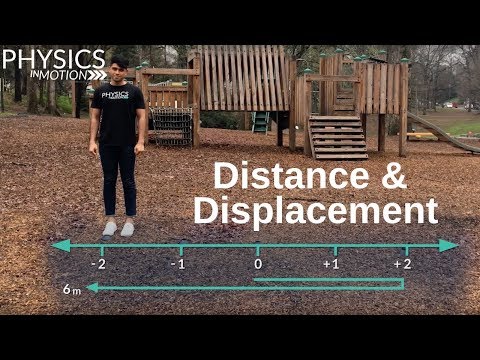
What Are Distance and Displacement? (GPB Education, Physics in Motion). Watch for the difference between the path travelled and the straight arrow from start to finish.
Practice
Key points
Sources and credits
The worked examples, diagrams, Rwandan applications and practice exercises are written by Ganzaa.