Renewable and Non-Renewable Energy Sources
Senior 3 · Physics
Renewable and Non-Renewable Energy Sources
Lesson 1 of 4
25 min
It is evening in Rubavu. A phone is charging from a socket, beans are cooking on a charcoal stove, and a moto rumbles past burning petrol. Each of these gets its energy from somewhere. The charcoal was once a tree that grew using sunlight. The petrol came from crude oil pumped out of the ground in another country. The electricity may have come from methane gas drawn up from the bottom of Lake Kivu a few kilometres away, from water falling through a turbine, or from a solar panel.
In S1 you learned the forms of energy and that energy is never created or destroyed. This unit asks a practical question: where does the energy we use come from, how long will it last, and what does using it do to the environment?
Definition
An energy source (energy resource) is anything from which useful energy can be obtained. Examples: sunlight, falling water, wind, wood, petrol, methane gas.
A primary energy source is found in nature and used directly or converted: sunlight, water, wind, wood, crude oil, coal, peat, natural gas, uranium. A secondary energy source (energy carrier) is made from a primary one so that energy can be carried and used easily: electricity, petrol and diesel (refined from crude oil), and charcoal (made from wood).
You need: a large plastic bottle with a small hole near the bottom, a clamp stand, a cork, 8 plastic spoons, a thin rod (a knitting needle) as an axle, a small toy motor, two wires, an LED (or a voltmeter), a tray and a metre rule.
Figure 1.1: The falling water turns the paddle wheel, the wheel turns the motor, and the motor, working backwards as a generator, lights the LED.
Observation: the greater the height of fall, the faster the wheel turns and the brighter the LED (the higher the voltmeter reading). If the LED does not light at all, reverse its two wires: an LED lets current through in one direction only.
Explanation: the water's gravitational potential energy becomes kinetic energy as it falls. The water pushes the paddles, turning the axle, and the generator changes this kinetic energy into electrical energy. More height means more energy per kilogram of water (), so more electrical power.
Important
Safety. Keep water well away from mains sockets and extension leads; use only the toy motor and LED, never mains electricity. Wipe up spills at once so that nobody slips, and make sure the clamp stand cannot tip over.
Almost every power station uses the same idea as the model: something makes a turbine spin, and the turbine turns a generator. The generator is a coil turning inside magnets (you will study it in A-level physics). What differs is what spins the turbine.
Figure 1.2: Energy chains in three kinds of power station. A transformer raises the voltage before the electricity is sent along the grid; solar panels also need an inverter, because they produce direct current.
No energy change is perfect. The efficiency of a power station tells what fraction of the energy put in comes out as electricity:
The rest is wasted, mostly as heat. Electrical energy is often measured in kilowatt-hours: . This is the "unit" on an electricity bill.
Worked example 1: power from a small hydro scheme
At a small hydro plant, of water flows through the turbine every second after falling 40 m. The whole plant is 75% efficient. Find its electrical power output. (Density of water , .)
Mass of water each second: .
Worked example 2: where does the rest go?
A thermal power station burns fuel that supplies 100 MW of chemical energy each second and delivers 35 MW of electrical power (illustrative values). Find its efficiency and the power wasted.
The 65 MW leaves as heat in the exhaust gases and the cooling water. Energy is conserved, but most of it ends up as heat that is not useful.
Worked example 3: a day's output from Lake Kivu methane
According to Rwanda Energy Group (REG), the KivuWatt plant has operated at base load, running day and night, with a nominal capacity of 26 MW since 31 December 2015. How much electrical energy does 26 MW give in one day, in MWh and in joules?
Warning
Electricity is not an energy source. It is a way of carrying energy from a source (water, gas, sunlight) to where it is used. When someone asks "Where does Rwanda's energy come from?", "electricity" is not an answer; "hydropower, methane, peat, solar and imports" is. Also, a power station does not "make" energy: it changes it from one form to another.

Tip
Turbine + generator = most power stations. Ask "what spins the turbine?" and you know the energy source: falling water (hydro), steam from burning fuel (thermal), wind, or steam from hot rocks (geothermal). Only solar cells skip the turbine.
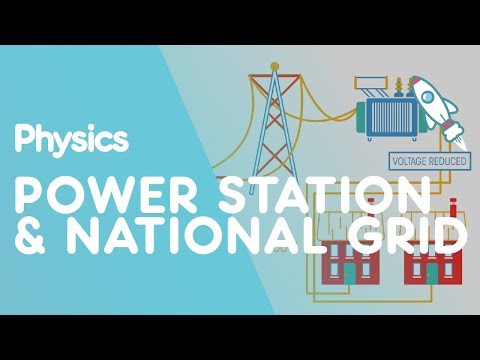
Power Stations & The National Grid (FuseSchool). Watch how a fuel's energy becomes steam, then turbine motion, then electricity, and why transformers are used on the grid.
Practice
Key points
Sources and credits
Written by Ganzaa: the lesson text, the model generator experiment, the diagrams, worked examples and practice exercises.