Logarithmic and Exponential Functions
Senior 6 · Mathematics
Logarithmic and Exponential Functions
Lesson 3 of 4
25 min
Lesson 2 showed that is continuous and strictly increasing on , with range . So for every real number there is exactly one with : the function has an inverse (S4, Composite and Inverse Functions). That inverse is the exponential function. It is the function behind every "grows by the same percentage each year" model, and it is the only function (apart from constant multiples of it) that is its own derivative.
Definition
Exponential function (base ): the inverse of ,
Domain , range . As inverse functions, for every real and for every . For rational , is the ordinary power of , and all the laws of indices hold: , , .
Example: .
The graph of an inverse function is the reflection of the original graph in the line , because the point lies on exactly when lies on .
Reflecting the limits of gives
so the -axis, , is a horizontal asymptote on the left. The exponential beats every power of . Put : as , and , since . In the same way,
Important
Theorem. , and by the chain rule .
Proof. Let , so . Differentiate both sides with respect to , using Lesson 2 and the chain rule: . Hence . ∎
Consequences: and , so is strictly increasing and concave up. Its tangent at is , and the curve lies above it: for every real .
Worked example 1: differentiating exponentials
Differentiate (a) (b) (c) (d) .
Solution
Worked example 2: study of
Solution Domain .
Definition
Exponential function to base (): for every real ,
This agrees with the powers you know, since . By the chain rule,
For , is the inverse of . Example: the gradient of at is .
Worked example 3: exponential equations
Solve (a) (b) .
Solution
Warning
Tip
Inverse functions swap everything: domain and range, and in every point, the vertical asymptote of and the horizontal asymptote of . Learn the facts for one curve, and reflect them to get the other.
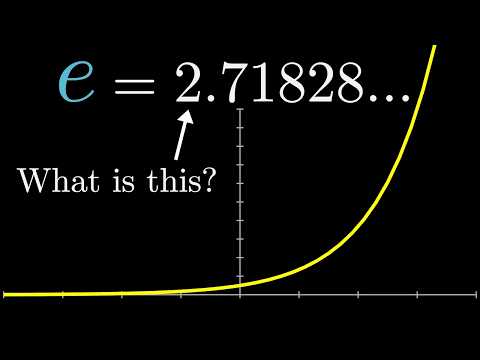
3Blue1Brown: What's so special about Euler's number e? (Chapter 5, Essence of calculus). Watch for why the derivative of 2ˣ is a constant multiple of 2ˣ, and why that constant is exactly 1 for base e.
Practice
Questions 6 to 8 need the derivative.
Sources and credits