Sound Waves
Senior 6 · Physics
Sound Waves
Lesson 5 of 5
25 min
A wedding band with big speakers, a motorcycle engine, a workshop grinder: every day many people in Kigali and elsewhere spend hours near sounds loud enough to damage their hearing slowly and permanently. To judge the danger we need to measure sound, and the ear itself gives a clue about how: it responds to an enormous range of powers, from the faintest whisper to a jet engine, a range of more than a million million. This lesson turns that range into the decibel scale and then shows how sound is put to work.
The intensity of a wave is the power it carries per unit area perpendicular to its direction of travel. A small source radiating sound power equally in all directions spreads it over a sphere of area , so
Figure 5.1: The same power spreads over 4 times the area at twice the distance.
Intensity also depends on the wave itself. The energy of each oscillating layer of air is proportional to , and a detailed calculation gives
So intensity is proportional to the square of the amplitude and, for a fixed displacement amplitude, to the square of the frequency.
Definition
Sound intensity is the sound power passing through unit area at right angles to the direction of travel: , unit . The threshold of hearing is the faintest sound a healthy ear detects at 1000 Hz; at about sound becomes painful.
Because the ear responds to ratios of intensity, roughly equally to each tenfold step, sound is measured on a logarithmic scale. The sound intensity level is
Useful consequences: multiplying by 10 adds 10 dB; doubling adds ; doubling the distance from a point source divides by 4 and so subtracts 6 dB. The threshold of hearing is 0 dB and the threshold of pain about 120 dB.
| Sound level | Example | Safe listening time per week |
|---|---|---|
| 30 dB | soft whispering | unlimited |
| 60 dB | normal conversation | unlimited |
| 80 dB | doorbell | 40 hours |
| 85 dB | heavy traffic (inside a car) | 12 h 30 min |
| 90 dB | shouted conversation | 4 hours |
| 95 dB | motorcycle | 1 h 15 min |
| 100 dB | hair dryer | 20 minutes |
| 110 dB | shouting in the ear | 2.5 minutes |
| 120 dB | standing near a siren | 12 seconds |
Levels, examples and safe listening times from the World Health Organization, "Deafness and hearing loss: safe listening" (questions and answers).
Notice the pattern: every 3 dB rise doubles the intensity and roughly halves the safe time (80 dB for 40 hours is the same sound energy as 83 dB for 20 hours).
Definition
The sound intensity level of a sound of intensity is , measured in decibels (dB), where . It compares a sound with the threshold of hearing; it is a ratio, not an amount of energy.
Worked example 1: a loudspeaker at a party
A loudspeaker radiates of sound equally in all directions. Find the intensity and the intensity level 5.0 m away.
By the WHO table (safe time halves for every 3 dB above 85 dB), roughly 6 hours a week at this level is the safe limit.
Worked example 2: adding sources, moving away
(a) One grinder in a workshop gives 80 dB at a worker's position. What level do two identical grinders give? (b) A generator gives 90 dB at 2.0 m. How far away is the level 70 dB?
(a) Intensities add, not decibels: (not 160 dB).
(b) A fall of 20 dB means is divided by . Since , must be multiplied by : .
Worked example 3: pressure amplitude of a loud sound
Find the pressure amplitude of a 100 dB sound in air (, ).
Less than three thousandths of one percent of atmospheric pressure, yet harmful after 20 minutes a week.
Apparatus: a loudspeaker and signal generator (a steady 1 kHz tone), a sound level meter or a phone with a sound level app, a 10 m tape measure, open ground away from walls (Figure 5.2).
Figure 5.2: Measuring the sound level at doubling distances.
Reflections from the ground and nearby walls, and background noise at large distances, are the main reasons real results differ from exactly 6 dB per doubling.
Warning
Safety. Keep the level at 1 m below about 85 dB and never put your ear close to the loudspeaker. Keep the tests short. Choose an area without traffic, and do not leave the tone running while people are nearby.
An ultrasound probe contains a piezoelectric crystal that sends short pulses of ultrasound, typically a few megahertz, into the body and detects the echoes. The time of each echo gives the depth of a boundary (, with in soft tissue), and the strength of each echo depends on how different the two materials are. That difference is measured by the acoustic impedance . For a wave meeting a boundary head-on, the fraction of the intensity reflected is
Figure 5.3: Echoes from tissue boundaries. The percentages are the reflected fractions of intensity calculated in Worked example 4.
| Medium | () |
|---|---|
| air | |
| fat | |
| muscle | |
| bone | (upper value) |
Impedances from OpenStax College Physics, Table 17.7.1.
Ultrasound is used because its short wavelength shows small detail, and it is not ionising radiation, unlike X-rays; at the low intensities used for imaging it is considered safe, which is why it is used to check on a baby before birth.
Ultrasound reflected from blood cells moving at speed towards the probe is Doppler shifted twice: once as the cells receive it (moving observer) and once as they re-emit it (moving source):
The machine measures as a beat frequency and so finds the speed of blood flow.
Worked example 4: why the gel?
Use the table to find the fraction of ultrasound intensity reflected (a) at an air-to-muscle boundary, (b) at a fat-muscle boundary, (c) at a muscle-bone boundary.
(a) An air gap between probe and skin would reflect 99.9% of the ultrasound, so almost none would enter the body: the gel removes the air. (b) Soft-tissue boundaries reflect about 1.4%, enough to see and weak enough that most of the pulse carries on deeper. (c) Bone reflects about 41%, which is why it shows bright and casts a "shadow" behind it.
Worked example 5: blood flow
A 4.0 MHz Doppler probe points straight along an artery in which blood moves towards it at . Find the frequency shift (), and the smallest detail the 4.0 MHz wave can show.
The shift of about 1.6 kHz is in the audible range, so many machines play it through a loudspeaker as a "whooshing" sound.
Warning
Common mistakes. (1) Adding decibels: two 80 dB sources give 83 dB, not 160 dB. (2) Forgetting to square in or . (3) Using to base instead of base 10. (4) Using in air for ultrasound in the body: use about 1540 m s⁻¹.
Tip
Decibel shortcuts to learn: ×2 intensity = +3 dB; ×10 = +10 dB; ×100 = +20 dB; double the distance = −6 dB.
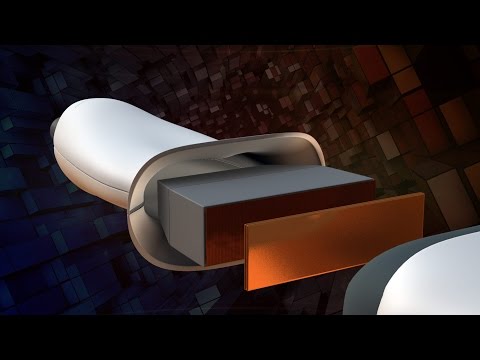
How does ultrasound work? (NIBIB, the US National Institute of Biomedical Imaging and Bioengineering). Watch how ultrasound uses echoes to “see” inside the body, and compare it with Figure 5.3.
Practice
Key points
Further reading
Sources and credits
The experiment, the three diagrams, the worked examples and the practice exercises are written by Ganzaa.