Rotational Motion
Senior 6 · Physics
Rotational Motion
Lesson 4 of 4
25 min
A figure skater begins a spin slowly with her arms and one leg stretched out. She draws them in towards her body and, with no push from anything outside, spins several times faster. A diver leaving the high board does the same trick by tucking into a ball. Neither pushes on anything, so what speeds them up? The answer is a conservation law as fundamental as the conservation of linear momentum you studied in S4.

For a particle of mass moving with velocity at position from an axis point, the angular momentum is
For a particle moving in a circle of radius , and . Adding over all the particles of a rigid body turning about a fixed axis gives
If is constant, . In general (and even when changes):
This is the rotational form of Newton's second law, ; is the angular impulse.
Definition
The angular momentum of a rigid body turning about a fixed axis is ; for a particle it is . Unit: (equivalently ). Its direction lies along the axis, given by the right-hand rule.
Important
The principle of conservation of angular momentum. If the resultant external torque on a system is zero, its total angular momentum stays constant:
Internal forces (a skater's muscles, the tension in a string pulled from the centre) can change , but they cannot change .
Worked example 1: the spinning skater
A skater spinning at 2.0 rev/s has a moment of inertia of with her arms out. She pulls them in, reducing it to . Find her new rate of spin and compare the kinetic energies. Friction from the ice is negligible.
Angular momentum is conserved, but kinetic energy is NOT: it has tripled (). The extra 569 J is the work her arm muscles do pulling the masses inwards against their tendency to fly outwards.
Worked example 2: jumping onto a roundabout
The playground roundabout of lesson 2 (, radius 1.5 m) spins freely at . A 40 kg child running straight towards the centre jumps onto its edge. Find the new angular velocity and the kinetic energy lost.
The child moves radially, so she brings no angular momentum about the axis. Treating her as a point mass at the rim:
Like a completely inelastic collision, this "rotational collision" conserves angular momentum but turns kinetic energy into heat and sound.
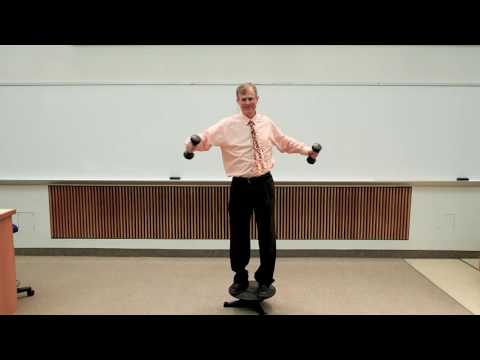
Apparatus: a stool or platform that turns freely on a bearing, two dumbbells of 1 to 2 kg, a stopwatch, and a partner to spin you gently.
Figure 4.1: Pulling the dumbbells in reduces , so rises to keep constant.
Warning
Safety. Spin slowly: a gentle push is enough. Keep the area around the stool clear, have a spotter standing by to steady you, keep your feet off the floor while turning and put them down gently to stop. Hold the dumbbells firmly and never let go of them while spinning. Anyone who feels dizzy stops at once and stays seated until it passes.
Figure 4.2: The string pulls towards the centre, so its torque about the axis is zero and stays constant.
Worked example 3: pulling in the string
A 0.10 kg ball moves in a horizontal circle of radius 0.50 m at on a string through a tube (Figure 4.2). The string is pulled down until the radius is 0.25 m. Find the ball's angular momentum, its new speed and the work done in pulling the string.
Halving the radius doubles the speed. The same law explains why a planet moves fastest when it is closest to the Sun (Kepler's second law).
Worked example 4: angular impulse
In lesson 2, a child pushed the roundabout () with a torque of 90 N m for 5.0 s from rest. Use angular impulse to find its final angular velocity.
This agrees with the answer from in lesson 2.

Warning
Common mistakes. (1) Saying kinetic energy is conserved when a skater pulls her arms in: only angular momentum is. (2) Applying conservation when there IS an external torque, for example a motor still driving the system. (3) Forgetting to add the new mass's to after something lands on a turning body. (4) Mixing rev/s and rad/s between the two sides of an equation (either is fine if both sides use the same one).
Tip
Match the pairs: ; ; no external force constant no external torque constant.
Angular momentum demo: platform and dumbbells (Physics Demos, Utah State University). Watch the rate of spin change as the dumbbells are pulled in and pushed out, as in Experiment 4.1.
Practice
Key points
Further reading
Sources and credits
The rotating-stool experiment, the two diagrams, the worked examples and the practice exercises are written by Ganzaa.