Rotational Motion
Senior 6 · Physics
Rotational Motion
Lesson 2 of 4
25 min
Take two wheels of the same mass: a bicycle rim with all its mass at the edge, and a solid wooden disc. Give each the same push and the solid disc spins up faster. Mass alone does not decide how hard it is to change a rotation; what matters is how far that mass is from the axis. The quantity that captures this is the moment of inertia, and it plays the part in rotation that mass plays in linear motion.
Think of a rigid body as many small particles of mass at distances from the axis. When the body turns at , particle moves at , so the total kinetic energy is
For a continuous body the sum becomes an integral, . For example, a uniform rod of mass and length has ; about an axis through its centre
and about one end, integrating from 0 to , : four times as much, because more of the mass is far from the axis.
Figure 2.1: The axis (dashed) must always be stated: the same body has a different about a different axis.
| Body (mass ) | Axis | Moment of inertia |
|---|---|---|
| (a) thin hoop or ring, radius | central axis, perpendicular to the ring | |
| (b) solid disc or cylinder, radius | central axis | |
| (c) thin rod, length | through the centre, perpendicular to the rod | |
| (d) thin rod, length | through one end, perpendicular to the rod | |
| (e) solid sphere, radius | a diameter | |
| (f) thin hollow sphere, radius | a diameter | |
| hollow cylinder, radii and | central axis |
Definition
The moment of inertia of a body about an axis is (or ), where is the perpendicular distance of each particle from the axis. Unit: . It measures a body's resistance to a change in its rotation. The radius of gyration is defined by : the distance from the axis at which all the mass could be placed to give the same .
Important
The parallel-axis theorem. If is the moment of inertia about an axis through the centre of mass, then about any parallel axis a distance away
Check with the rod: . For a flat plate (lamina) in the -plane there is also the perpendicular-axis theorem, ; for a disc this gives .
Worked example 1: the axis matters
Two 2.0 kg masses are fixed to the ends of a light rod 0.60 m long. Find the moment of inertia (a) about the centre of the rod, (b) about one end, both axes perpendicular to the rod.
The same body has twice the moment of inertia about the end. (Check with the parallel-axis theorem: .)
Worked example 2: a disc turning about its rim
A uniform disc of mass 3.0 kg and radius 0.20 m turns about an axis through a point on its rim, parallel to its central axis. Find and the radius of gyration.
Let a tangential force act on particle . Newton's second law gives . Multiplying by turns it into a torque: . Adding over all the particles (the internal forces come in equal and opposite pairs along the same line, so their torques cancel):
| Linear | Rotational |
|---|---|
| mass | moment of inertia |
| force | torque |
Worked example 3: pushing a playground roundabout
A playground roundabout is a uniform disc of mass 150 kg and radius 1.5 m. A child pushes tangentially at the rim with a steady 60 N. Ignoring friction, find the angular acceleration and the angular velocity after 5.0 s from rest.
Apparatus: a flywheel on a wall bracket, a string, a hanging mass, a metre rule, a stopwatch, a padded box (Figure 2.2).
Figure 2.2: The falling mass drives the flywheel through the string wound on the axle.
Theory (ignoring friction at the bearing). For the mass: . For the flywheel: , so . Substituting:
Warning
Safety. Check that the bracket is firmly fixed and the flywheel spins freely before you start. Place the padded box under the mass and keep feet and hands out of its path. Keep fingers, hair and sleeves away from the spinning wheel, and let it stop by itself.
Worked example 4: analysing the flywheel results
With , and , the mean time of fall was 6.0 s (illustrative results). Find ().
Friction at the bearing makes smaller, so this method slightly OVERESTIMATES . A better experiment also measures how far the flywheel turns after the string falls off, to find the friction torque.
Warning
Common mistakes. (1) Quoting without saying which axis. (2) Using the distance from the axis to the CENTRE of an extended body in : that works only for point masses; for extended bodies use the table and the parallel-axis theorem. (3) Using with in rev/s². (4) Forgetting that the tension in a string driving a wheel is less than when the mass accelerates.
Tip
The further the mass from the axis, the bigger : a hoop () beats a disc (), which beats a solid sphere (). Learn the table in that order.
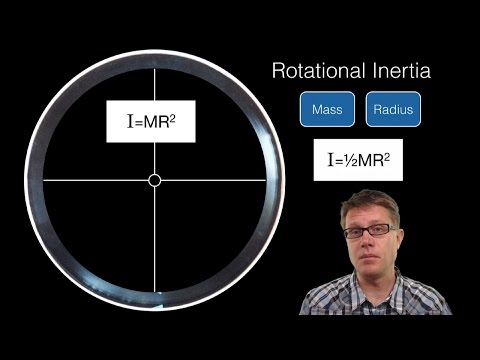
Rotational inertia (Bozeman Science). Listen for how the moment of inertia depends on how the mass is spread about the axis, not just on the total mass, and link it to the table of shapes in this lesson.
Practice
Key points
Sources and credits
The flywheel experiment, the two diagrams, the worked examples and the practice exercises are written by Ganzaa.