Electromagnetic Induction
Senior 6 · Physics
Electromagnetic Induction
Lesson 4 of 4
25 min
Switch off a large electric motor, a car's ignition coil or even a relay, and a spark may jump across the switch. A few volts in the circuit, yet a spark needs hundreds of volts or more. The coil itself is the source: when its current collapses, its own magnetic flux collapses, and by Faraday's law it induces a large emf in itself. This lesson looks at induction within a single coil (self-induction), between two coils (mutual induction), and in solid lumps of metal (eddy currents), and at the uses of each, from transformers to induction cookers.
A current in a coil produces a magnetic field and so a flux linkage through the coil itself, proportional to . The constant of proportionality is the coil's self-inductance :
By Lenz's law this back emf opposes the change in current: it resists a rise when the circuit is switched on and tries to keep the current flowing when it is switched off. An inductor is the electrical equivalent of inertia.
A solenoid of turns, length and cross-section has an internal field (S5), so
An iron core multiplies many times, which is why large inductors are wound on iron.
Definition
The self-inductance of a coil is the flux linkage per unit current, , or equivalently the back emf per unit rate of change of current, . Its unit is the henry (H): a coil has an inductance of 1 H if a current changing at induces an emf of 1 V in it ().
Worked example 1: a solenoid
A solenoid of 500 turns is 0.25 m long with a cross-section of and an air core. Find its inductance, and the emf induced when its current falls steadily from 2.0 A to zero in 10 ms.
Apparatus: a 1.5 V cell, a switch, a large coil on a closed iron core (for example 0.50 H with a resistance of ), a small neon lamp, leads (Figure 4.1).
Figure 4.1: A neon lamp needs roughly 70 V to 90 V to light, far more than the cell provides.
Warning
Safety. This is a teacher demonstration. At switch-off the coil's terminals reach well over 100 V for an instant: do not touch the coil terminals or bare leads while switching, and use a switch with an insulated handle. Keep the circuit on an insulated bench. The same effect is why relay coils in electronic circuits are protected by a diode across them.
When a circuit of emf , resistance and inductance is switched on, the back emf holds the current back at first, so it rises smoothly rather than jumping:
Figure 4.2: After one time constant the current has reached of its final value.
For the coil of Demonstration 4.1, . You will meet inductors in AC circuits in the next unit.
While the current rises, the source must do work against the back emf. In a time the work done is . Building the current up from 0 to :
This energy is stored in the magnetic field. For a solenoid, substitute and : . Dividing by the volume gives the energy density of any magnetic field:
This stored energy is what lit the neon lamp.
Worked example 2: energy in an inductor and in a field
(a) Find the energy stored in a 0.50 H coil carrying 3.0 A. (b) Find the energy density in a field of 1.0 T, such as that between the poles of a laboratory electromagnet.
When two coils are close together, a changing current in the first changes the flux linking the second and induces an emf in it:
The mutual inductance depends on the numbers of turns, the shapes of the coils, how close they are and whether they share an iron core; it is largest when all the flux of one coil passes through the other. A transformer (lesson 3) is two coils with a large on one core. The pad that charges a phone without a cable uses the same effect across a small air gap.
Worked example 3: two coils
Two coils have a mutual inductance of 0.050 H. The current in the first rises steadily at . Find the emf induced in the second.
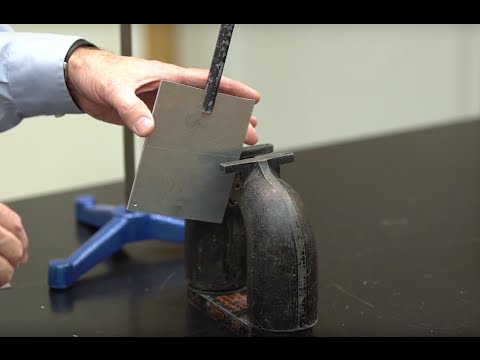
A changing flux induces emfs not only in wires but in any piece of metal. In a solid block the induced currents swirl round inside the metal in closed loops, called eddy currents. By Lenz's law they oppose the change that causes them, and because the resistance of a solid block is small they can be large, heating the metal.
Apparatus: a strong U-shaped magnet (or two magnets on an iron yoke), a clamp stand, two pendulums each carrying a copper or aluminium plate, one solid and one with slots cut into it (Figure 4.3).
Figure 4.3: Slots break up the paths of the eddy currents.
Warning
Safety. Clamp the stand firmly and weight its base so it cannot tip. Strong magnets can pinch fingers and snap onto steel tools: keep them apart and handle them one at a time. Keep faces clear of the swinging plate, and keep magnets away from phones and bank cards.
| Application | How eddy currents are used or reduced |
|---|---|
| transformer and motor cores | made of thin, insulated laminations so that eddy currents (and their heating) are small |
| induction cooker | a coil under the glass carries a high-frequency current; eddy currents heat the pan's metal base directly |
| magnetic brakes | trains, rollercoasters and exercise bicycles are slowed by eddy currents in a metal disc or rail, with no rubbing parts |
| moving-coil meters | eddy currents in the metal former damp the pointer so it settles quickly |
| metal detectors | a changing field from a coil induces eddy currents in hidden metal, whose own field is detected |
| recycling | eddy-current separators throw aluminium cans off a conveyor belt away from plastic and glass |

Warning
Common mistakes. (1) Thinking a back emf stops a current: it opposes the CHANGE in current, so the current still reaches , only more slowly. (2) Forgetting to square or in and . (3) Thinking laminations stop the magnetic flux: they carry the flux well but block the eddy-current paths. (4) Expecting an induction hob to heat a clay or glass pot: there must be metal for eddy currents to flow in.
Tip
Inductance behaves like inertia: matches , and matches .
Faraday's law demo: eddy pendulum (Physics Demos). Watch an aluminium sheet on a pendulum being braked as it swings through the poles of a horseshoe magnet, and explain the braking with Lenz's law.
Practice
Key points
Further reading
Sources and credits
The demonstration, the experiment, the three diagrams, the worked examples and the practice exercises are written by Ganzaa.