Cellular Respiration
Senior 6 · Biology
Cellular Respiration
Lesson 4 of 5
25 min
Three familiar things share one piece of biochemistry. Ikigage, the sorghum beer brewed across Rwanda, gets its alcohol from yeast working in a closed pot. Ikivuguto, fermented milk, gets its sharp taste from lactic acid made by bacteria. And after a 400 m race, a runner's burning legs are full of lactate made by her own muscles. In each case, cells are respiring without enough oxygen. This lesson explains how, why it yields so little ATP, and what else controls the rate of respiration.
Definition
Anaerobic respiration: the release of energy from glucose without oxygen; only glycolysis produces ATP, giving 2 ATP per glucose.
Fermentation: anaerobic respiration in which pyruvate (or a product of it) accepts the hydrogen of reduced NAD, regenerating NAD so that glycolysis can continue. Lactate fermentation produces lactate; alcoholic fermentation produces ethanol and CO₂.
Oxygen debt (excess post-exercise oxygen consumption): the extra oxygen taken in after exercise to oxidise lactate and restore the body's ATP, creatine phosphate and oxygen stores.
Efficiency of respiration: the percentage of the energy released from the substrate that is trapped in ATP.
Without oxygen, the electron transport chain stops, so reduced NAD cannot be oxidised there. A cell has only a small amount of NAD; once it is all reduced, glycolysis stops at the oxidation step, and so does its 2 ATP. Fermentation solves this by passing the hydrogen of reduced NAD to pyruvate or ethanal, regenerating NAD (Figure 1).
Figure 1: Lactate fermentation and alcoholic fermentation. Dashed green arrows: NAD returned to glycolysis.
| Lactate fermentation | Alcoholic fermentation |
|---|---|
| Where: Mammalian muscle in hard exercise; lactic acid bacteria (in ikivuguto and yoghurt) | Where: Yeast (in ikigage, urwagwa and bread dough); plant roots in waterlogged soil |
| Equation: | Equation: ; |
| CO₂ released?: No | CO₂ released?: Yes: it makes dough rise and beer froth |
| Reversible?: Yes: lactate is later oxidised or turned back into glucose in the liver | Reversible?: No: ethanol is lost from the cell |
The oxygen debt. After a sprint, lactate is carried in the blood to the liver, where some is oxidised to CO₂ and water and most is converted back to glucose. This needs oxygen, which is why you keep breathing hard for minutes after you stop.

Worked example 1: the efficiency of aerobic and anaerobic respiration
The complete oxidation of glucose releases , and each mole of ATP traps . Calculate the efficiency of (a) aerobic respiration with 38 ATP, (b) aerobic respiration with 32 ATP, (c) anaerobic respiration.
Interpretation: aerobic respiration yields 16 to 19 times as much ATP per glucose. The rest of the energy is released as heat, and in anaerobic respiration most of it stays locked in lactate or ethanol: ethanol is a fuel precisely because it still holds so much energy.
Investigation: the effect of temperature on yeast respiration. Mix yeast with glucose solution in test tubes, stand them in water baths at 10, 20, 30, 40, 50 and 60 °C, allow 5 minutes to reach temperature, then collect the CO₂ given off for 10 minutes in a gas syringe (or count bubbles). Keep the mass of yeast, the volume and concentration of glucose and the time constant, and repeat each temperature three times.
Safety: handle hot water baths with care and set them no higher than 60 °C; wipe up spills; wash your hands after handling yeast cultures.
Figure 2: CO₂ released by yeast in 10 minutes at different temperatures (illustrative data).
Worked example 2: analysing the temperature data
Use Figure 2. The temperature coefficient is . Calculate between 20 and 30 °C, and between 30 and 40 °C, and explain the shape of the graph above 40 °C.
Limitation: readings every 10 °C cannot locate the optimum exactly; it lies somewhere between 30 and 50 °C. Extra readings at 35 and 45 °C would narrow it down.
Warning
Common mistakes
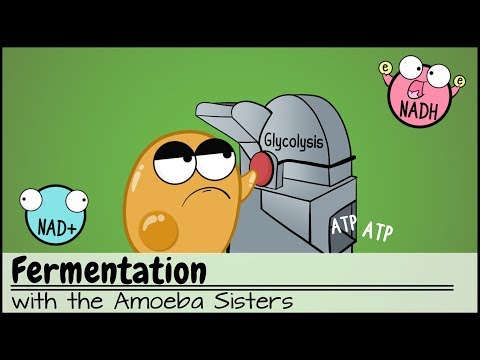
Amoeba Sisters: "Fermentation". Watch for why cells without oxygen must regenerate NAD, and for the difference between lactic acid and alcoholic fermentation.
Tip
Exam technique. To explain why anaerobic respiration makes so little ATP, give the chain: "no oxygen as final electron acceptor → electron transport chain stops → no oxidative phosphorylation, and NAD and FAD are not regenerated in the mitochondrion → Krebs cycle and link reaction stop → only the 2 ATP of glycolysis remain, kept going by fermentation regenerating NAD."
Practice: anaerobic respiration, efficiency and rate
Key points
Sources and credits
Figures 1 and 2, the table, the investigation, the worked examples and the practice questions are written by Ganzaa. The data in Figure 2 are illustrative.
This lesson adapts CC BY-SA material and is shared under CC BY-SA 4.0.