Simultaneous Linear Inequalities
Senior 3 · Mathematics
Simultaneous Linear Inequalities
Lesson 4 of 4
25 min
A weaving cooperative in Gisagara makes two products: baskets and table mats. Each week the members have a fixed number of weaving hours and a fixed stock of dyed sisal, and they want to earn as much as possible. Making more baskets means making fewer mats. How many of each should they make?
Questions like this are called linear programming problems. Every condition is a linear inequality, so the possible plans form a feasible region, which you learned to draw in Lesson 3. The best plan is then found at one of its corners.

Definition
Linear programming: a method for finding the largest or smallest value of a linear expression when the unknowns must satisfy a system of linear inequalities.
Important
The corner-point rule. If a linear programming problem has an optimal solution, then one is found at a vertex (corner) of the feasible region.
Why: all the points with the same profit, , lie on a straight line. Changing moves this line parallel to itself. Slide it across the region in the direction that increases : the last point of the region it touches, just before it leaves, is a corner (or a whole edge, which includes corners).
Worked example 1: the cooperative's best week
A basket takes 2 hours to weave and a mat takes 3 hours; the members have 60 hours in a week. Each item uses one bundle of dyed sisal, and 25 bundles are in stock. A hotel has ordered at least 5 mats. The profit is 3,000 Frw on a basket and 4,000 Frw on a mat. How many of each should they make to earn the greatest profit? (All figures are illustrative.)
Solution Let be the number of baskets and the number of mats.
| Condition | Inequality |
|---|---|
| Weaving time | |
| Sisal bundles | |
| The hotel order | |
| Numbers of items |
Maximise .
Vertex C is where meets . From the second, ; substitute: , so and . The other vertices come from the axes and : for D, gives , and ✓.
| Vertex | Value of the objective | ||
|---|---|---|---|
| A | |||
| B | |||
| C | |||
| D |
The greatest profit is 85,000 Frw, at C. The cooperative should weave 15 baskets and 10 mats a week. It then uses all 60 hours and all 25 bundles.
Worked example 2: the cheapest feed mix
A dairy farmer in Nyagatare mixes two feeds for a calf. Each kilogram of feed A gives 2 units of protein and 1 unit of energy; each kilogram of feed B gives 1 unit of protein and 2 units of energy. The calf needs at least 8 units of protein and 10 units of energy a day. Feed A costs 300 Frw per kg and feed B costs 400 Frw per kg. Find the cheapest daily mix. (Illustrative figures.)
Solution Let kg of A and kg of B be used. Minimise subject to
Vertex Q: from , ; then , so and .
| Vertex | Value of the objective | ||
|---|---|---|---|
| P | |||
| Q | |||
| R |
The cheapest mix is 2 kg of feed A and 4 kg of feed B, costing 2,200 Frw a day. The dashed line touches the region only at Q, which confirms it.
Warning
Check every vertex against every constraint. Where two boundary lines cross outside the region, that point is not a vertex. In Worked example 1, meets at , but breaks the sisal limit, so it is not a possible plan.
Whole numbers. You cannot weave half a basket. If the best vertex has fractions, test the whole-number points inside the region near it.
Tip
A vertex table earns the marks. List every vertex with its coordinates and the value of the objective, then state the answer in words: "15 baskets and 10 mats, profit 85,000 Frw". Examiners look for the table and the sentence.
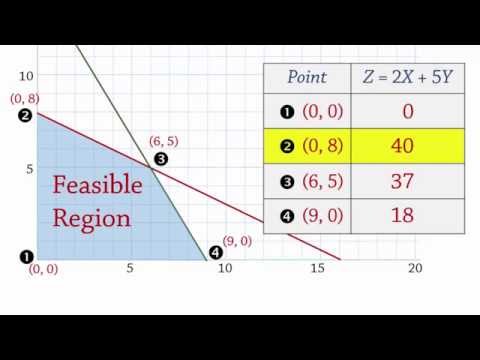
Joshua Emmanuel: Linear Programming 1, maximisation at the corner points. Watch how the problem is written as variables, constraints and an objective, how the feasible region is drawn, and how each corner point is tested.
Practice
Draw the feasible region for each problem. The last three are harder.
Further reading for this unit
Sources and credits
The cooperative, feed and tailor problems use illustrative figures. The graphs, worked examples, practice items and quiz questions were written by Ganzaa. This lesson adapts CC BY-SA material and is shared under CC BY-SA 4.0.