Mitosis and Meiosis
Senior 3 · Biology
Mitosis and Meiosis
Lesson 1 of 4
25 min
You began as a single cell, the zygote, made when a sperm fertilised an egg. A 2016 estimate puts the number of human cells in an adult man at about , thirty million million, and nearly every one of them carries a copy of the instructions that were in that first cell. Each time a cell divides, those instructions must be copied exactly and shared out fairly, or the new cells will be faulty.
Yet the sperm and the egg that made you each carried only half of a parent's set of instructions. So cells need two kinds of nuclear division: mitosis, which keeps the chromosome number the same, and meiosis, which halves it. Before you can follow either, you need the words that describe chromosomes and the cycle a cell goes through between one division and the next.
Definition
Chromosome: a thread-like structure in the nucleus, made of one long molecule of DNA wound round proteins. Chromosomes carry the genes. They become short, thick and visible under a light microscope only when a cell is dividing.
Gene: a length of DNA on a chromosome that carries the instruction for one characteristic, for example the gene that decides your ABO blood group.
Chromatid: one of the two identical copies of a chromosome that exist after its DNA has been copied. The two copies are called sister chromatids.
Centromere: the narrow region where the two sister chromatids are held together.
For most of a cell's life its chromosomes are long, thin and uncoiled, spread through the nucleus as chromatin, too fine to see as separate threads. Before the cell divides, every chromosome is copied. The copy stays attached to the original at the centromere, so the chromosome now has two sister chromatids and looks like an X or a narrow H. It is still counted as one chromosome, because it has one centromere.
Figure 1: Chromosomes drawn as they look during division, when they are coiled up. A replicated chromosome (B) has two chromatids but one centromere. A homologous pair (C) is two separate chromosomes, one inherited from each parent.
Definition
Homologous chromosomes: a pair of chromosomes, one from each parent, that have the same length, the centromere in the same position, and the same genes at the same positions (loci, singular locus). The two versions of a gene they carry may differ, for example one for blood group A and one for blood group B.
Diploid (2n): having two complete sets of chromosomes, one set from each parent, arranged in homologous pairs. Human body cells are diploid: .
Haploid (n): having one complete set of chromosomes, one from each pair. Human sperm and egg cells (gametes) are haploid: .
A human body cell has 46 chromosomes: 22 pairs of autosomes and one pair of sex chromosomes (XX in a female, XY in a male, as you saw in Senior 1). The X and Y differ in size, yet they still behave as a pair when gametes are made. Every species has a fixed diploid number, and because the chromosomes come in pairs, that number is almost always even.
| Organism | Diploid number (2n) in body cells | Haploid number (n) in gametes |
|---|---|---|
| Human | 46 | 23 |
| Chimpanzee | 48 | 24 |
| Cattle, goat | 60 | 30 |
| Dog, chicken | 78 | 39 |
| Fruit fly (Drosophila) | 8 | 4 |
| Maize | 20 | 10 |
| Rice | 24 | 12 |
| Common bean | 22 | 11 |
| Onion | 16 | 8 |
Notice that a dog has more chromosomes than a person, and cattle more than a chimpanzee. The number of chromosomes tells you nothing about how complex an organism is; what matters is the genes they carry.

Worked example 1: counting in a maize cell
Maize has . For a cell from a maize leaf, state: (a) the number of chromosomes before its DNA is copied; (b) the number of homologous pairs; (c) the number of chromatids after the DNA is copied; (d) the number of chromosomes in a maize egg cell.
Check: count centromeres for chromosomes, count the separate rods (each X is two chromatids) for chromatids.
A cell that divides does not divide all the time. It spends most of its life growing and preparing, and only a short time dividing. The whole sequence, from the moment a cell is formed until it has divided into two, is the cell cycle. It has two main parts: a long interphase and a short division phase.
Figure 2: The cell cycle, read clockwise from the top. The slices are roughly to scale for a fast-dividing human cell grown in the laboratory, whose whole cycle takes about 24 hours; G1 alone takes about 11 of them, and the division phase only about an hour.
Three points about interphase are often tested:
Worked example 2: DNA through one cycle
A cell holds 8 units of DNA at the start of G1. Sketch how the amount of DNA in the cell changes through one cycle, and give the amount (a) at the end of S, (b) during G2, (c) in each daughter cell after cytokinesis.
Warning
Common mistakes. (1) Counting chromatids as chromosomes: an X-shaped chromosome is ONE chromosome with TWO chromatids, so count the centromeres. (2) Calling interphase a resting stage: the cell is busy growing and copying its DNA. (3) Thinking haploid means half a chromosome: it means one of each pair, one complete set. (4) Calling the two chromosomes of a homologous pair "sister chromatids": sister chromatids are identical copies joined at one centromere; homologous chromosomes are separate chromosomes from two different parents.
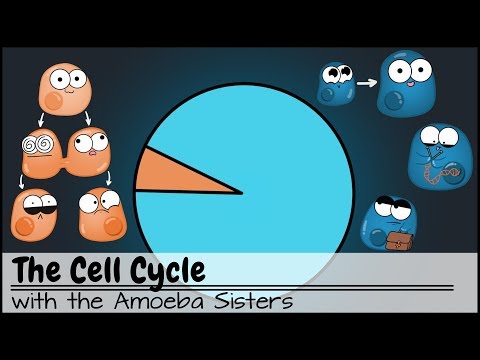
The Cell Cycle (and cancer), Amoeba Sisters. Watch for what happens in G1, S and G2, and why interphase is not a rest. The second half, on checkpoints and cancer, leads into the next lesson.
Tip
Memory hook: "Grow, Synthesise, Grow, Move apart." G1, S, G2, M. And for counting: chromosomes = centromeres.
Practice: chromosomes and the cell cycle
Key points
Sources and credits
Written by Ganzaa: Figures 1 and 2, the graph in Worked example 2, the table of chromosome numbers, the worked examples and the practice questions.