Mitosis and Meiosis
Senior 3 · Biology
Mitosis and Meiosis
Lesson 2 of 4
25 min
Germinate a bean seed on damp paper until its root is about 2 cm long. With a fine pen and waterproof ink, mark lines on the root 1 mm apart, starting at the tip. Two days later the root is longer, but not evenly: the marks near the top are still 1 mm apart, while the marks in the few millimetres behind the tip have spread far apart. New cells are being made in a small region at the tip, and then they grow longer. The cells in that region are dividing by mitosis.
Figure 1: Ink marks on a bean root, drawn from what the experiment shows. Growth happens only near the tip: cells divide at the tip, then lengthen just behind it.
Definition
Mitosis: the division of a nucleus into two daughter nuclei, each with the same number of chromosomes as the parent nucleus and genetically identical to it. A diploid (2n) cell gives two diploid cells.
Cytokinesis: the division of the cytoplasm that follows mitosis, making two separate cells.
Spindle: a set of protein fibres that forms across the cell during division, running from one pole to the other. The fibres attach to the chromosomes and move them.
Meristem: a region of a plant where cells keep dividing by mitosis, for example at a root tip or shoot tip.
Mitosis is one continuous process, but biologists describe it in four stages: prophase, metaphase, anaphase and telophase. Figure 2 follows an animal cell with : one long pair and one short pair of chromosomes, with the chromosomes from the father drawn blue and those from the mother orange. Count the chromosomes in every drawing.
Figure 2: Mitosis in an animal cell with 2n = 4. The + signs mark the centrosomes at the two poles, and the dashed line in metaphase is the equator. Each daughter cell ends with one copy of every chromosome, long and short, blue and orange, exactly like the parent cell.
| Stage | Chromosomes | Chromatids |
|---|---|---|
| Prophase | 4 | 8 (2 per chromosome) |
| Metaphase | 4 | 8 (2 per chromosome) |
| Anaphase | 8 in the cell, 4 moving to each pole | separated: each is now a chromosome |
| Telophase | 4 in each new nucleus | 1 per chromosome |
| After cytokinesis | 4 in each cell | 1 per chromosome (until the next S phase) |
Plant and animal cells divide in the same four stages, with two differences: plant cells have no centrioles in their centrosomes, and they divide their cytoplasm with a cell plate instead of pinching in. In a flowering plant, mitosis happens mainly in the meristems; in an animal it happens in many tissues, such as the skin, the lining of the gut and the bone marrow.
Worked example 1: counting through mitosis
A fruit fly has . One of its cells divides by mitosis. State the number of (a) chromosomes at metaphase, (b) chromatids at metaphase, (c) chromosomes moving to each pole at anaphase, (d) chromosomes in each daughter cell.
Root tips are used because, as Figure 1 showed, they hold a meristem where many cells are dividing at any moment.
Warning
Safety. Hydrochloric acid is corrosive, and warm acid is more dangerous: wear eye protection, and let your teacher handle the acid. Stains mark skin and clothes. Slides and coverslips are glass; press gently and report any breakage.

Worked example 2: how long is each stage?
In a root tip squash, a student counted 200 cells: 170 in interphase, 14 in prophase, 6 in metaphase, 4 in anaphase and 6 in telophase. (Illustrative data.) The whole cell cycle in these cells takes 24 hours. (a) What percentage of cells were dividing? (b) Estimate how long metaphase lasts.
Conclusion: interphase takes of the cycle, which is why most cells in any squash are in interphase.
Mitosis gives two cells with exactly the same chromosomes as the parent. That is what an organism needs in four situations:
Normally, cells divide only when the body needs new cells, and checks during the cell cycle stop a damaged cell from dividing. If the genes that control division are damaged, a cell may divide again and again, out of control. The mass of cells it forms is a tumour. A benign tumour stays in one place; a malignant tumour, a cancer, invades nearby tissue and can spread to other parts of the body. Things that raise the risk of the damage include tobacco smoke, too much ultraviolet light from the sun, and some viruses, such as the HPV you met in Senior 2. Many cancer treatments, such as chemotherapy and radiotherapy, work by stopping dividing cells from dividing.
Worked example 3: a field of clones
A farmer in Musanze plants a whole field with potato tubers taken from her best plants. (a) Explain why the new plants are genetically identical. (b) Suggest one risk of planting a field this way.
Warning
Common mistakes. (1) Saying chromosomes line up in pairs at metaphase of mitosis: in mitosis they line up singly; pairs line up only in meiosis. (2) Saying mitosis makes gametes: in animals, gametes are made by meiosis. (3) Mixing up telophase (two nuclei form) and cytokinesis (the cytoplasm divides). (4) Saying bacteria divide by mitosis: bacteria have no nucleus and divide by binary fission.
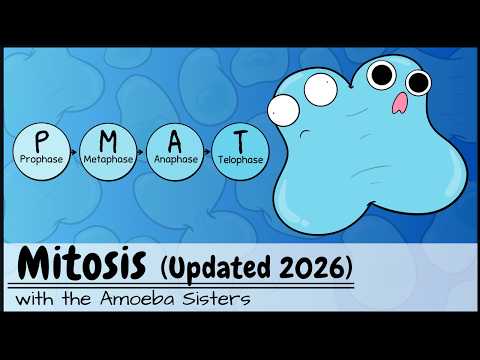
Mitosis (Updated 2026), Amoeba Sisters. Watch for the chromosome count at each stage, and for the difference between a chromosome and a chromatid when the sister chromatids separate.
Tip
Memory hook: PMAT. Prophase: chromosomes aPpear. Metaphase: they line up in the Middle. Anaphase: chromatids pulled Apart. Telophase: Two nuclei.
Practice: mitosis
Key points
Sources and credits
Written by Ganzaa: Figures 1 and 2, the stage table, the method for the root tip squash, the worked examples (illustrative data) and the practice questions.