Quantity of Heat and Heat Transfer
Senior 3 · Physics
Quantity of Heat and Heat Transfer
Lesson 5 of 5
25 min
On a sunny morning, a house with an iron-sheet roof often ticks and cracks for an hour or so. Nobody is walking on it. As the Sun warms the metal sheets they get slightly longer and wider, the nails and wooden battens hold them back, and every so often a sheet slips a little with a sharp click. In the evening, as the roof cools and shrinks, the ticking can start again.
Almost every substance expands when it is heated and contracts when it cools. In S1 you saw this as a property of matter; in this lesson you will calculate it, and see how engineers build around it or use it.
When a solid is heated, its particles vibrate with larger amplitude and push one another slightly further apart, so the whole body gets bigger. In a liquid the particles move about more and take up more room. The change is small for solids, larger for liquids and very large for gases (S2's gas laws).
Experiments show that the increase in length of a rod is proportional to its original length and to its rise in temperature :
The constant depends on the material.
Definition
Linear expansivity (coefficient of linear expansion, ): the increase in length per unit original length per kelvin rise in temperature, . SI unit: per kelvin (). Example: for steel , so each metre of steel grows by 0.012 mm for each kelvin.
Area (superficial) expansivity . Volume (cubic) expansivity for a solid.
| Solid | () | Liquid | () |
|---|---|---|---|
| Aluminium | Petrol | ||
| Brass | Ethanol | ||
| Copper | Water (at 20 °C) | ||
| Steel, iron, concrete | Mercury | ||
| Ordinary glass | |||
| Heat-resistant (borosilicate) glass |
Liquids expand far more than solids: petrol's is about 26 times the volume expansivity of steel (). Steel and concrete have almost the same , which is why steel rods can reinforce concrete without cracking it as the temperature changes.
Worked example 1: a steel footbridge beam
A steel beam in a footbridge is 12 m long at 15 °C on a cool night. In the afternoon sun it reaches 45 °C. By how much does it lengthen?
The beam must rest on a roller or sliding bearing at one end, with a gap of at least 5 mm, or it will push against the supports and bend them.
Heat a square plate of side . Each side becomes , so the area becomes
because is tiny and its square is tinier still. So and, by the same reasoning for a cube, :
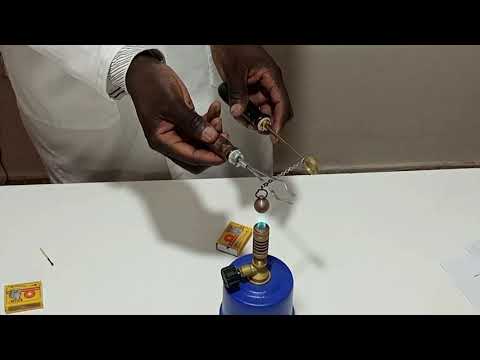
A hole in a plate expands exactly as if it were made of the plate's material: heating a metal ring makes the hole bigger, not smaller. This is how the classic ball-and-ring demonstration works: a ball that just passes through a cold ring will not pass once the ball is heated, but will pass again if the ring is heated too.
Worked example 2: an aluminium sheet
An aluminium sheet measures 2.0 m by 1.0 m at 20 °C. Find the increase in its area when it is heated to 60 °C.
Worked example 3: a full fuel tank in the sun
A steel fuel tank is filled to the brim with 50 L of petrol at 15 °C, and the vehicle is then parked in the sun until the tank and petrol reach 35 °C. How much petrol overflows?
The container expands too, but far less than the liquid. This is why fuel tanks, jerrycans and bottles are never filled right to the top.
Worked example 4: measuring
A metal rod 0.800 m long at 20 °C is heated in a steam jacket to 95 °C (the boiling point in Kigali). A micrometer screw gauge shows that it grows by 1.02 mm. Find and identify the metal.
This matches copper.
A bimetallic strip is two strips of different metals, such as brass and iron, fixed firmly together along their length. When it is heated, the brass expands more than the iron, so the strip must bend, with the brass on the outside of the curve. Cooled below room temperature, it bends the other way.
This makes a simple automatic switch, a thermostat: in an electric iron, an oven or a water heater, the strip bends away from the contact when the set temperature is reached and switches the heater off; as it cools it straightens and switches the heater on again. Bimetallic strips are also used in fire alarms, in dial thermometers, and in the thermal trips of some circuit breakers (unit 7).

As S1 mentioned, water does not follow the rule between 0 °C and 4 °C: when it is heated in this range it contracts, so water is densest at about 4 °C. Above 4 °C it expands like other liquids. In cold countries this is what keeps fish alive in winter: the densest water (4 °C) sinks to the bottom of a lake, and the ice forms on top and floats, insulating the water below.
Warning
Watch the units and the power of ten. Expansivities are tiny numbers such as ; a calculator slip of one power of ten gives an answer ten times too big. Keep in metres and convert to millimetres only at the end. And for area or volume, use or , not .
Tip
Same shape as . Every expansion formula reads "change = constant × original amount × temperature change": , , , with and for solids.
Thermal expansion explained using the ring and ball experiment (Mwalimu Ndolo). Watch what happens when the ball is heated, and then when it cools again.
Practice
Key points
Further reading
Sources and credits
Written by Ganzaa: the lesson text, the two diagrams, the table, worked examples and practice exercises.