Differential Equations
Senior 6 · Mathematics
Differential Equations
Lesson 1 of 5
35 min
In Unit 2 you met : the rate of change of a quantity is proportional to the quantity itself. Notice what kind of statement that is. It does not give ; it gives a rule for how changes. Science is full of such rules. Newton's second law says how velocity changes under a force; Kirchhoff's laws say how current changes in a circuit; Newton's law of cooling says how fast a cup of tea loses heat. Each rule is an equation that contains a derivative, and solving it means finding the function itself. This unit is about such equations.
Definition
Differential equation: an equation that relates an unknown function to one or more of its derivatives. If the unknown depends on one variable only, it is an ordinary differential equation (ODE); all the equations in this unit are ordinary.
Order: the order of the highest derivative in the equation. Degree: the power of that highest derivative, once the equation is written as a polynomial in the derivatives (no roots or fractions of them).
Linear: and its derivatives occur only to the first power, are not multiplied together and are not inside other functions. A linear equation of order 2 has the form .
Example: is an ODE of order 2 and degree 1, and it is linear.
| equation | order | degree | linear? |
|---|---|---|---|
| 1 | 1 | yes | |
| 2 | 1 | yes | |
| 1 | 2 | no: is squared | |
| 2 | 1 | no: multiplies | |
| 2 | 3 | no | |
| 1 | 1 | no: is inside |
Notice the last row: on the right of an equation is harmless, but makes it non-linear, because is the unknown.
Definition
Solution: a function that turns the equation into a true statement for every in an interval. The general solution of an equation of order contains arbitrary constants; a particular solution is one member of that family, picked out by extra conditions such as an initial condition .
Example: is the general solution of ; the condition gives the particular solution .
Going the other way, a family of curves with arbitrary constants satisfies a differential equation of order that contains no constants. To find it, differentiate times and eliminate the constants between the equations.
Worked example 1: eliminating constants
Form the differential equation of (a) the family of parabolas (b) the family .
Solution
Definition
Separable equation: a first order equation that can be written as
a function of times a function of . Method (separating the variables): where , write and integrate both sides:
Reason: if , the chain rule gives , so . One constant is enough: constants on both sides would merge into one.
Worked example 2: separating the variables
Solve (a) with (b) with .
Solution
Warning
Dividing by can lose solutions. Each value with is a constant solution. In part (a), dividing by hid ; we recovered it by allowing . Always check the zeros of separately.
Worked example 3: a draining tank (illustrative figures)
A rainwater tank has a tap at the bottom. By Torricelli's law, the depth metres of water in an upright cylindrical tank falls at a rate proportional to : . The depth is when the tap is opened and after 10 minutes. When will the tank be empty?
Solution Separate: , so . At : , so . At : , so and
The tank is empty when , at minutes. Note that the level falls fast at first and slowly at the end, because the pressure at the tap drops as the tank empties.
Tip
To test whether an equation is separable, try to factor the right-hand side as (something in ) × (something in ). is separable; is not, and needs the methods of the next lesson.
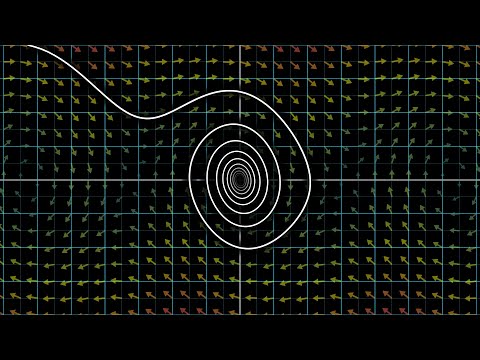
3Blue1Brown: Differential equations, a tourist's guide (about 27 min). Watch for the pendulum: the equation tells you how the state changes from moment to moment, and the picture of arrows (a slope or vector field) shows every solution at once, like the slope field above.
Practice
Questions 7 and 8 are harder.
Sources and credits