Solubility and Solubility Product of Sparingly Soluble Salts
Senior 6 · Chemistry
Solubility and Solubility Product of Sparingly Soluble Salts
Lesson 4 of 4
25 min
Boil hard water in a kettle for a few months and a pale, rock-hard crust of calcium carbonate builds up inside. Scraping barely touches it, yet leaving vinegar or lemon juice in the kettle overnight loosens it with a fizz of carbon dioxide. Nothing about for calcium carbonate has changed; what changed is the chemistry of the ions in solution.
This lesson shows the three ways to push a sparingly soluble salt's equilibrium: add one of its own ions, change the pH, or tie up one ion in a complex. Each has uses, from purifying chemicals to medicine.

Definition
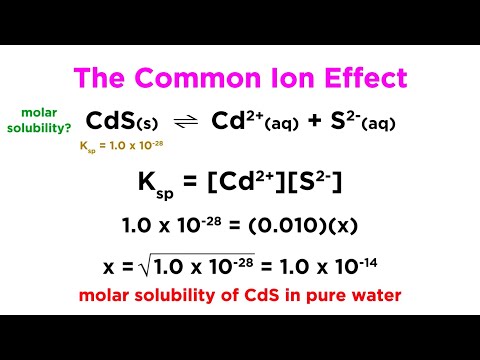
Common-ion effect: the lowering of the solubility of a salt by the presence of one of its own ions from another source. Example: silver chloride is about 7500 times less soluble in 0.10 mol dm⁻³ NaCl than in pure water.
Complex ion: a central metal ion bonded to ligands by dative bonds (Unit 1). Example: the diamminesilver(I) ion, .
Amphoteric hydroxide: a hydroxide that dissolves in both acids and excess strong alkali. Example: zinc hydroxide, which dissolves in excess NaOH to give .
For , adding chloride ions (as NaCl) makes . By Le Chatelier's principle the equilibrium shifts left, AgCl precipitates, and less of it can dissolve. The same now has to be shared with a large, fixed , so must be tiny. Chemists use this:
If the anion of a salt is the conjugate base of a weak acid (, , , , ), adding acid removes that anion and the salt dissolves:
For a hydroxide the effect is easy to calculate: , so each unit fall in pH makes magnesium hydroxide 100 times more soluble (Figure 4.1). A salt such as AgCl, whose anion comes from a strong acid, is unaffected by pH: does not react with .
Figure 4.1: The solubility of a hydroxide depends strongly on pH; that of a chloride does not.
The same chemistry decides the health of your teeth. Tooth enamel is mainly hydroxyapatite, . Acids made by mouth bacteria from sugar remove its and ions, so it dissolves. Fluoride helps by forming fluorapatite, which resists acid better.
Silver chloride dissolves in aqueous ammonia because ammonia ties up the silver ions:
Removing free keeps below , so more solid dissolves. AgBr (smaller ) needs concentrated ammonia, and AgI (smaller still) does not dissolve; this is why ammonia helps tell the three halides apart. In the same way, the pale blue precipitate of copper(II) hydroxide dissolves in excess ammonia to give the deep blue tetraammine complex (photo below), and amphoteric hydroxides dissolve in excess alkali: .

| Application | The idea behind it |
|---|---|
| Qualitative analysis: identifying halide and metal ions | Each ion is precipitated by a reagent when ; complexing (e.g. with ammonia) then tells similar precipitates apart. |
| Gravimetric analysis: sulfate weighed as | Very small plus a common ion (excess ) makes the precipitation essentially complete. |
| Water softening with washing soda, | Excess pushes for far above , removing hardness as a precipitate. |
| Removing iron and heavy metals from water | Raising the pH precipitates metal hydroxides with tiny values. |
| Barium meal for X-ray imaging of the gut | Soluble barium compounds are toxic, but is so sparingly soluble () that the patient absorbs no harmful amount. |
| Kidney stones | Stones of calcium oxalate () can form when urine becomes supersaturated; drinking more water lowers the ion concentrations, and so . |
Worked example
Problem. Calculate the molar solubility of silver chloride (a) in pure water and (b) in 0.10 mol dm⁻³ sodium chloride, at 25 °C. By what factor does the common ion reduce the solubility?
Solution.
(a) .
(b) Let the solubility be . Then and , because is tiny:
The approximation is valid: is negligible beside 0.10.
Answer: (a) ; (b) ; about 7500 times less soluble.
Worked example
Problem. Hard water contains of . Enough sodium carbonate is added to precipitate calcium carbonate and leave in excess. Calculate the calcium ion concentration left and the percentage of calcium removed.
Solution.
Answer: remains; 99.8% of the calcium is removed, thanks to the common ion .
Warning
Common mistakes
Safety. Soluble barium and lead compounds are toxic, and concentrated ammonia gives off a choking vapour: use small quantities, work in a fume cupboard where possible, and wash your hands. If any reagent splashes into an eye, rinse it with clean running water for at least 15 minutes and get medical help.
Tip
Three levers, one idea: anything that adds one of the salt's ions lowers its solubility; anything that removes one of its ions (acid removing a weak-acid anion, a ligand removing a metal ion) raises it. Ask: "Does this change add to, or take away from, the right-hand side of the equilibrium?"
Professor Dave Explains: The common ion effect. Watch how adding an ion already present shifts the dissolving equilibrium to the left, and how the calculation simplifies because s is tiny.
Practice
Further reading
Sources and credits