Solubility and Solubility Product of Sparingly Soluble Salts
Senior 6 · Chemistry
Solubility and Solubility Product of Sparingly Soluble Salts
Lesson 1 of 4
25 min
Dissolve a large mass of sodium ethanoate in a little hot water, cover it and let it cool undisturbed. It stays a clear liquid, although it now holds more dissolved salt than cold water can normally keep. Drop in one tiny crystal and white needles race outward from it; within seconds the dish is filled with solid, and it feels warm. This is how reusable "click" hand warmers work.
That solution was supersaturated. To understand why it can exist, and why it collapses, you need to know exactly what solubility means. This lesson sets out those ideas; the rest of the unit applies them to salts that hardly dissolve at all.

Definition
Solubility: the maximum amount of a solute that dissolves in a stated amount of solvent at a stated temperature, giving a saturated solution. It may be quoted in g per 100 g of water, in or in . Example: 35.9 g of NaCl per 100 g of water at 20 °C.
Molar solubility, : the solubility in moles of solute per cubic decimetre of saturated solution, . Example: at 25 °C.
Saturated solution: a solution that holds as much solute as it can at that temperature and is in dynamic equilibrium with undissolved solute. Unsaturated solution: one that can still dissolve more solute. Supersaturated solution: one that holds more dissolved solute than a saturated solution at the same temperature; it is unstable and crystallises when disturbed or seeded.
Sparingly soluble salt: a salt whose solubility is very small, typically below about , so that only a tiny fraction of it dissolves. Example: silver chloride, barium sulfate.
When a salt is shaken with water, ions leave the surface of the crystal and become hydrated. As their concentration in the solution rises, more of them collide with the crystal and rejoin it. Eventually the two rates are equal (Figure 1.1): the solution is saturated, and its concentration no longer changes, although ions are still dissolving and crystallising all the time. For silver chloride:
Figure 1.1: In a saturated solution the undissolved solid and the dissolved ions are in dynamic equilibrium.
Most solids become more soluble as the temperature rises, but by very different amounts. A solubility curve (Figure 1.2) shows this. Any point on a curve is a saturated solution; a point below it is unsaturated; a point above it is supersaturated, which can only exist if the solution was cooled carefully without any crystals present.
Figure 1.2: Solubility curves of three potassium and sodium salts (data: Wikipedia, "Solubility table").
The steep curve of potassium nitrate is why it is purified by recrystallisation: dissolve the impure solid in the minimum of hot water and cool it; most of the nitrate crystallises while the small amounts of impurity stay dissolved. Sodium chloride cannot be purified this way, because its solubility hardly changes. That is why salt is obtained from seawater or brine by evaporating the water, not by cooling.
Stir excess solid with water at constant temperature until no more dissolves. Filter, weigh a sample of the clear saturated solution in an evaporating basin, evaporate it to dryness and weigh again. For a sparingly soluble salt the dissolved mass is far too small to weigh this way. Its solubility is found instead by measuring an ion concentration, for example by the conductivity of the saturated solution or by titration, and then by calculation from , as you will see in the next lesson.
| Salt | Solubility at 20–25 °C | Description |
|---|---|---|
| potassium nitrate, | 31.6 g per 100 g water | soluble |
| sodium chloride, NaCl | 35.9 g per 100 g water | soluble |
| calcium sulfate, | about 0.96 () | sparingly soluble |
| silver chloride, AgCl | about () | sparingly soluble ("insoluble") |
Worked example
Problem. 210 g of a solution of potassium nitrate, saturated at 60 °C, is cooled to 20 °C. Use the data in Figure 1.2 (110 g per 100 g water at 60 °C; 31.6 g at 20 °C) to find the mass of crystals formed.
Solution. A saturated solution at 60 °C contains 110 g of per 100 g of water, i.e. 210 g of solution. So our 210 g of solution is exactly 100 g of water + 110 g of salt.
At 20 °C, 100 g of water can hold only 31.6 g. The rest crystallises:
Answer: 78.4 g of potassium nitrate crystallises (assuming no water evaporates).
Worked example
Problem. An evaporating basin weighs 25.40 g. With a sample of saturated sodium chloride solution at 20 °C it weighs 45.80 g; after evaporation to dryness, 30.79 g. Calculate the solubility of NaCl in g per 100 g of water.
Solution.
mass of NaCl = 30.79 − 25.40 = 5.39 g; mass of water = 45.80 − 30.79 = 15.01 g
Answer: 35.9 g per 100 g of water at 20 °C.
Worked example
Problem. At 25 °C a saturated solution of silver chloride contains 1.91 mg of AgCl in 1.00 dm³. Calculate the molar solubility of AgCl ().
Solution.
Answer: . Every dissolved AgCl gives one and one , so .
Warning
Common mistakes
Tip
On a solubility curve: on the line = saturated, below = unsaturated, above = supersaturated. Mass of crystals on cooling = (solubility at the higher temperature − solubility at the lower temperature) × .
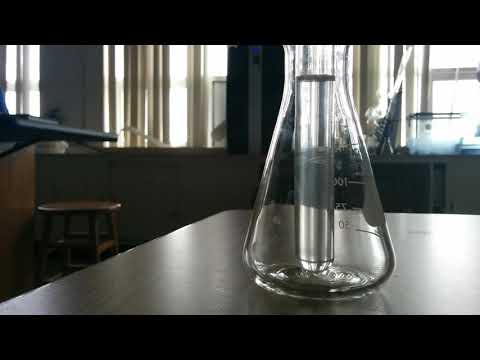
chemistNATE: Supersaturated sodium acetate crystallizing. Watch a single seed crystal turn the whole supersaturated solution solid, and notice that the flask becomes warm.
Practice
Sources and credits