Genetics and Gene Technology
Senior 3 · Biology
Genetics and Gene Technology
Lesson 3 of 5
25 min
The four o'clock plant, Mirabilis jalapa, is a garden flower that opens in the late afternoon. When a pure-breeding red-flowered plant is crossed with a pure-breeding white one, the F1 flowers are neither red nor white: they are all pink. It looks as if the two colours have mixed like paint. But cross two pink plants and the F2 contains red, pink and white flowers. Paint, once mixed, cannot be unmixed. So the red and white alleles were never blended; they were passed on whole, and only their effect in the heterozygote was in between.
In Lesson 2 one allele completely masked the other. In this lesson neither allele is completely dominant, and the heterozygote has a phenotype of its own.
Definition
Incomplete dominance (partial dominance): neither allele is completely dominant, so the heterozygote has a phenotype in between the two homozygotes. Example: pink four o'clock flowers from red and white.
Co-dominance: both alleles are fully expressed in the heterozygote, so both phenotypes appear together, side by side. Example: roan cattle, with red hairs and white hairs mixed on one coat.
Multiple alleles: three or more alleles of one gene exist in a population, although each diploid organism carries only two of them. Example: the alleles , and of the ABO blood group gene.
When neither allele is dominant, a capital and small letter would be misleading. Instead, use one capital letter for the gene and a superscript for each allele. For flower colour, use C for the gene, for the red allele and for the white allele.
| Genotype | Phenotype (incomplete dominance) |
|---|---|
| red | |
| pink | |
| white |
Each genotype has its own phenotype, so here you can read the genotype from the flower.
Worked example
Worked example 1: incomplete dominance. A red four o'clock () is crossed with a white one (). Give the F1, then the F2 from crossing two F1 plants.
F2: 1 red : 2 pink : 1 white. With incomplete dominance the phenotype ratio is the same as the genotype ratio, 1 : 2 : 1, instead of 3 : 1.
In Shorthorn cattle, a coat-colour gene has an allele for red hair, , and an allele for white hair, . A animal is not pink. Its coat has red hairs and white hairs growing side by side, which looks reddish-grey from a distance and is called roan. Both alleles are fully expressed, each in its own hairs: that is co-dominance.
| Incomplete dominance | Co-dominance | |
|---|---|---|
| Heterozygote | one phenotype in between the two | both phenotypes, side by side |
| Example | pink four o'clock flower | roan coat: red and white hairs; blood group AB |
| F2 ratio from heterozygote × heterozygote | 1 : 2 : 1 | 1 : 2 : 1 |

In Unit 7 you met the four blood groups, A, B, AB and O, set by antigens A and B on the red blood cells. One gene, called I, decides them, and it has three alleles:
| Blood group (phenotype) | Possible genotypes | Antigens on red cells |
|---|---|---|
| A | or | A |
| B | or | B |
| AB | A and B | |
| O | neither |
Three alleles give six genotypes but only four phenotypes, because is hidden whenever or is present.
Worked example
Worked example 2: all four groups in one family. A father of group A and a mother of group B have a child of group O. Find the parents' genotypes and the chance of each blood group in their children.
Each child has a chance of each group: AB, A, B or O. Parents of groups A and B can have a child of any group.
Worked example
Worked example 3: a question of parentage. Two babies are born on the same night in a hospital, and their name tags are found loose. Couple 1 are both group O. Couple 2 are group AB and group O. Baby X is group O and baby Y is group A. Which baby belongs to which couple?
Blood groups can rule a parent out, but they cannot prove who a parent is: many people share each group.
Warning
Two common mistakes. (1) Calling a pink flower "co-dominant". Pink is a blend of effects, so it is incomplete dominance; co-dominance shows both phenotypes separately, like red and white hairs. (2) Writing blood group genotypes as "AO" or "AB" with no gene letter. Examiners expect and , so the reader can see which alleles are co-dominant and which is recessive.
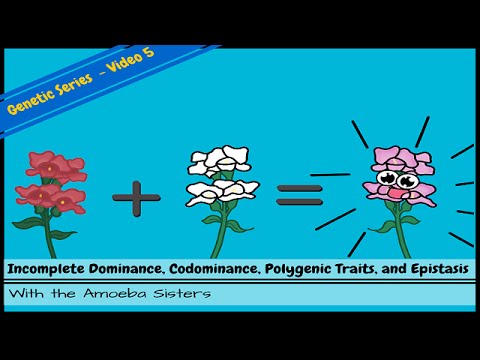
Incomplete Dominance, Codominance, Polygenic Traits, and Epistasis!, from the Amoeba Sisters. For this lesson, watch the first two parts, on incomplete dominance and co-dominance; polygenic traits come up again in Unit 14.
Tip
Blend or both? Ask what the heterozygote looks like. Something new in between (pink) means incomplete dominance. Both parents' features showing at once (red and white hairs; antigens A and B) means co-dominance. Either way, the F2 ratio from two heterozygotes is 1 : 2 : 1.
Practice: when neither allele dominates
Key points
Sources and credits
Written by Ganzaa: the text, the tables, the Punnett squares, the worked examples and the practice questions.