General Principles of Reception and Response in Animals
Senior 6 · Biology
General Principles of Reception and Response in Animals
Lesson 2 of 5
25 min
When you pull on a shirt in the morning you feel the cloth on your shoulders. Ten minutes later you feel nothing, although the shirt has not moved. The cloth is still pressing on thousands of touch receptors, yet they have almost stopped sending impulses. To understand this, and to understand how any receptor turns a stimulus into a signal the brain can use, A-level biologists study one receptor in detail: the Pacinian corpuscle, a pressure receptor found deep in the skin, especially of the fingertips, palms and soles.
Definition
Resting potential: the potential difference across the membrane of a neurone or receptor cell when it is not being stimulated, about (inside negative). Unit 6 explains how it is kept.
Generator potential (receptor potential): a local depolarisation of a receptor's membrane caused by a stimulus. Its size is graded: a stronger stimulus gives a larger generator potential.
Threshold: the level of depolarisation that must be reached before an action potential (nerve impulse) starts.
Sensory adaptation: the decrease in the response of a receptor, that is, in the frequency of impulses it starts, when a stimulus continues unchanged.
How the corpuscle produces impulses:

Action potentials are all-or-nothing: once threshold is reached, every impulse in a given neurone has the same size. A receptor therefore cannot signal "stronger" with bigger impulses. Instead:
The receptor only detects. Sensory neurones carry impulses to the spinal cord and brainstem, relay neurones pass them on, mostly through the thalamus, to a sensory area of the cerebral cortex, and only there is the stimulus perceived. The brain reads four things from the incoming impulses:
| Feature of the stimulus | How it is coded |
|---|---|
| Type (modality): light, sound, touch | Which receptors and which pathway carry the impulses, and which area of cortex receives them |
| Strength (intensity) | Frequency of impulses in each neurone, and the number of neurones recruited |
| Position on the body | Which receptors are stimulated; each sensory neurone serves a small patch of skin, its receptive field |
| Duration | How long impulses continue, which adaptation can shorten |
Worked example 1: reading a nerve recording
A recording electrode on the axon of a Pacinian corpuscle counts 18 action potentials in 0.30 s while a probe presses on it. A firmer press gives 33 action potentials in 0.30 s. (a) Calculate the impulse frequency for each press. (b) Explain the difference.
If a stimulus continues unchanged, most receptors send fewer and fewer impulses: they adapt. Receptors differ in how fast they do this.
| Phasic (rapidly adapting) receptors | Tonic (slowly adapting) receptors | |
|---|---|---|
| Response to a steady stimulus | Burst of impulses at the start (and often at the end), then few or none | Impulses continue, at a slowly falling frequency, as long as the stimulus lasts |
| Signals | Change: the start, the end and vibration | Steady state: how strong the stimulus still is |
| Examples | Pacinian corpuscles; receptors around hair follicles; olfactory receptors | Muscle spindles and other proprioceptors; most nociceptors; Merkel discs in the skin |
How a Pacinian corpuscle adapts. Under steady pressure the viscous gel flows and the lamellae slip, so the pressure is spread around the capsule and the nerve ending is no longer deformed. The stretch-mediated channels close, and sodium channels that have just opened become inactivated for a short time. The generator potential falls below threshold and impulses stop, although the pressure is still there. When the pressure is removed, the lamellae spring back, briefly deform the ending again, and a short burst of impulses signals "off".
Why adaptation is useful.
Worked example 2: identifying receptor types from data
A constant stimulus was applied for 3 s to two receptors, A and B, and the impulse frequency was recorded (illustrative data).
| Time after stimulus began / s | 0.1 | 0.5 | 1.0 | 3.0 |
|---|---|---|---|---|
| Receptor A / Hz | 140 | 20 | 0 | 0 |
| Receptor B / Hz | 64 | 60 | 56 | 48 |
Warning
Common mistakes
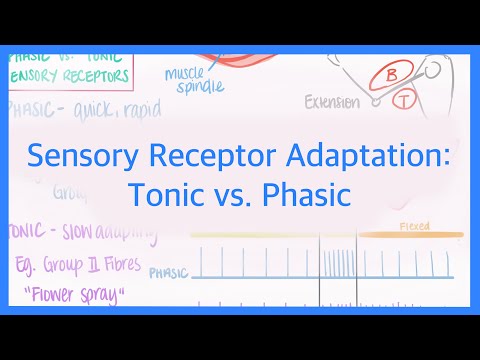
BioME: "Sensory Receptor Adaptation: Tonic vs. Phasic Receptors". Watch for how the impulse pattern of each receptor type changes during a steady stimulus.
Practice: generator potentials and adaptation
Key points
Sources and credits
Figures 1 and 2, the tables, the worked examples (with illustrative data) and the practice questions were written by Ganzaa.