Human Reproduction
Senior 6 · Biology
Human Reproduction
Lesson 3 of 5
35 min
Each month from puberty to the menopause, a woman's body prepares for a possible pregnancy: an oocyte matures and is released, and the lining of the uterus thickens to receive an embryo. If no embryo arrives, the lining is shed and the cycle begins again. In Senior 1 you met the menstrual cycle and menstrual hygiene. At A-level we explain how four hormones, two from the pituitary and two from the ovary, control each other by negative and positive feedback, and then follow what happens when an oocyte is fertilised.
Definition
Menstrual cycle: the monthly cycle of changes in the ovaries and the endometrium, on average about 28 days long (commonly 21 to 35 days). Day 1 is the first day of menstruation.
Ovulation: the release of a secondary oocyte from a mature follicle of the ovary, about 14 days before the next menstruation.
Corpus luteum ("yellow body"): the structure formed from the follicle after ovulation, which secretes progesterone and some oestrogen.
Fertilisation: the fusion of the nucleus of a sperm with the nucleus of an egg, forming a diploid zygote.
Implantation: the embedding of the early embryo (blastocyst) in the endometrium.
Worked example 1: predicting ovulation
The time from ovulation to the next menstruation (the luteal phase) is fairly constant at about 14 days, while the time before ovulation varies. A woman's cycles are regularly 32 days long. On about which day of her cycle does she ovulate? And in a 24-day cycle?
Caution: real cycles vary from month to month, so the day of ovulation can only be estimated. This is why methods of family planning that rely on counting days are less reliable than other methods (lesson 5).
During sexual intercourse (copulation), the penis becomes erect as its spongy tissue fills with blood, and is placed in the vagina. At ejaculation, waves of muscular contraction move sperm from the epididymis through the sperm ducts and urethra, mixing them with the secretions of the glands, and deposit semen at the top of the vagina, near the cervix. Sperm swim through the cervical mucus, through the uterus and into the oviducts. On the way, chemical changes to their membranes, called capacitation, make them able to fertilise an oocyte. Sperm can survive in the female tract for a few days; the oocyte survives for only about a day after ovulation.
Warning
Protecting children: sexual abuse is a crime
Sexual intercourse is for adults, with free consent. Any sexual contact with a child is abuse and a crime. In Rwanda, Law N° 68 of 2018 determining offences and penalties in general treats any sexual act with a child under 18 as child defilement, a serious offence. A child is never to blame for abuse.
If this happens to you or to someone you know, tell a trusted adult and get help. The Rwanda Investigation Bureau lists these numbers:
After a sexual assault, go to a health facility or an Isange One Stop Centre as soon as possible, and within 72 hours, when medicines can still prevent HIV infection and pregnancy.
As the zygote moves down the oviduct, it divides by mitosis (cleavage) without growing, so the cells get smaller. By about day 5 it has become a blastocyst, which reaches the uterus. Its outer layer, the trophoblast, attaches to the thick endometrium and digests its way in: implantation. The trophoblast then secretes the hormone human chorionic gonadotrophin (hCG). hCG keeps the corpus luteum alive, so progesterone and oestrogen stay high, the endometrium is not shed, and menstruation stops. Pregnancy tests detect hCG in the urine.
Worked example 2: pregnant or not?
Blood tests on two women, both on day 27 of a 28-day cycle (illustrative): Woman A has low progesterone and no hCG. Woman B has high progesterone and hCG is present. Explain the difference and predict what happens next to each.
Warning
Common mistakes
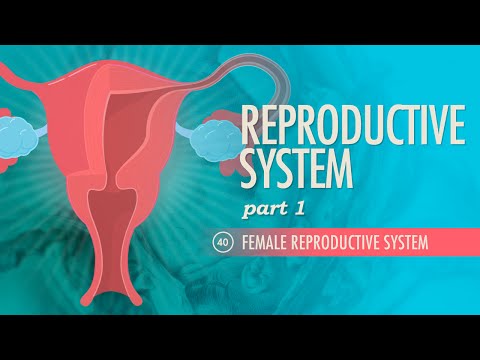
CrashCourse: "Reproductive System, Part 1 - Female Reproductive System: Crash Course Anatomy & Physiology #40". Watch for the ovarian and uterine cycles and the hormones that link them.
Practice: the cycle and fertilisation
Key points
Sources and credits
Figures 1 and 2, the worked examples (with illustrative data) and the practice questions were written by Ganzaa.