Conics
Senior 6 · Mathematics
Conics
Lesson 3 of 5
40 min
The Earth's orbit round the Sun is an ellipse with the Sun at one focus. NASA's Earth fact sheet gives its closest distance to the Sun (perihelion) as and its greatest (aphelion) as . An ellipse also explains the "whispering galleries" of some domed buildings, where a whisper at one point is heard clearly across the room at another. Both facts come from the property that defines the curve: the sum of the distances to two fixed points is constant.
Definition
Ellipse: given two points and , the foci, with , and a length , the ellipse is the set of points with
The midpoint of is the centre. The chord through the foci is the major axis (length ), its ends are the vertices, and the perpendicular chord through the centre is the minor axis (length ). Example: a loop of string of fixed length round two pins traces an ellipse when pulled tight with a pencil.
Important
Standard equation. Take , and . Then
Squaring and simplifying gives . Squaring again gives . With (so ), divide by :
The middle line also says . With the eccentricity this is : the distance to is times the distance to the line , the directrix of lesson 1.
| Element | , | , |
|---|---|---|
| major axis | on the -axis, length | on the -axis, length |
| vertices | ||
| ends of minor axis | ||
| foci | , | |
| eccentricity | , | |
| directrices | ||
| latus rectum | length | |
| parametric form | ||
The larger denominator always belongs to the major axis. If , then , , and the ellipse is a circle.
Worked example 1: the elements of an ellipse
Find the vertices, foci, eccentricity, directrices and latus rectum of .
Solution. Divide by 144: . The larger denominator is under , so the major axis is vertical, with and . Then .
Worked example 2: the equation from given data
(a) Find the ellipse with foci and major axis of length 10. (b) Find the ellipse with centre , a vertex at and eccentricity .
Solution. (a) , , , : .
(b) The vertex is 5 units from the centre along a horizontal line, so and the major axis is horizontal. and : , with foci , that is and .
Differentiating implicitly gives . At on the ellipse, the tangent simplifies (using ) to
Tangent of given slope. The line is a tangent to the ellipse if and only if . (Substitute and set the discriminant of the quadratic in to 0.) So for each slope there are two parallel tangents, .
Worked example 3: tangent and normal at a point
Show that lies on , and find the tangent and normal there.
Solution. . Tangent: , that is ; multiplying by 75 gives .
Normal: , that is ; multiplying by 12 gives . Check: satisfies it, since , and the slopes and multiply to .
The figure also confirms the definition at this point: and , and .
Worked example 4: tangents with a given slope
Find the tangents to that are parallel to .
Solution. : , so the tangents are and .
Worked example 5: the Earth's orbit
NASA gives the Earth's orbit a semi-major axis and eccentricity . The Sun is at a focus. Find the perihelion and aphelion distances and the semi-minor axis, and comment on the shape.
Solution. The Sun is from the centre. The nearest point of the orbit is the vertex on the Sun's side, at distance ; the farthest is . These agree with NASA's perihelion and aphelion to the precision of . Then : differs from by about 0.014%, so the orbit is very nearly a circle whose centre is about from the Sun.
Important
Reflecting property. The normal at any point of an ellipse bisects the angle . So a ray (of light or sound) leaving one focus is reflected by the ellipse through the other focus. This is the principle of the whispering gallery, and of the medical lithotripter, which focuses shock waves made at one focus of an ellipsoidal reflector onto a kidney stone placed at the other.
Warning
For an ellipse, , not (that is the hyperbola, lesson 4). A focus is always inside the ellipse, so .
Do not assume the major axis is horizontal. In the foci are on the -axis. Compare the denominators first.
Tip
The directrices of an ellipse lie outside it, at ; the foci lie inside, at . A quick check on any answer: . In the figure, .
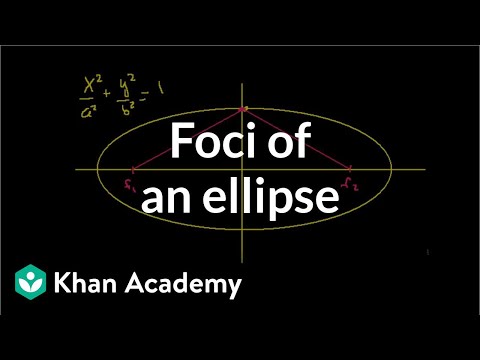
Khan Academy: Foci of an ellipse (about 13 min). Watch why the distances from any point to the two foci add up to 2a, and how this gives c² = a² − b².
Practice
Questions 1 to 3 are routine; 4 to 6 need more care; 7 asks for a proof.
Sources and credits