Conics
Senior 6 · Mathematics
Conics
Lesson 4 of 5
40 min
Two microphones 2 km apart hear the same thunderclap, one of them 3 seconds before the other. Sound travels about 340 metres per second, so the source is 1020 m nearer to the first microphone than to the second. The points with this property do not form a single point but a curve: a branch of a hyperbola. A third microphone gives a second hyperbola, and the source is where they cross. Radio navigation systems for ships worked on the same idea for decades. This lesson studies the curve defined by a constant difference of distances.
Definition
Hyperbola: given two points and , the foci, with , and a length with , the hyperbola is the set of points with
It has two branches: on the branch near and on the branch near . The midpoint of is the centre; the points where the line meets the curve are the vertices, and the segment between them is the transverse axis (length ).
Important
Standard equation. With , , the same two squarings as for the ellipse turn into . Now , so put :
Asymptotes. Solving for : . For large , is close to ; precisely, as . So the curve approaches the lines
which are the diagonals of the rectangle , . The segment from to is the conjugate axis.
| Element | ||
|---|---|---|
| transverse axis | on the -axis | on the -axis |
| vertices | ||
| foci | , | |
| eccentricity | ||
| directrices | ||
| asymptotes | ||
| latus rectum | length | |
| parametric form | ||
Here is under the positive term, whichever of and is larger.
Worked example 1: the elements of a hyperbola
Find the vertices, foci, eccentricity, directrices and asymptotes of .
Solution. Divide by 144: , so , and .
Check with the point of the figure: , so is on the curve, and , , whose difference is .
Worked example 2: a hyperbola with a vertical transverse axis
Find the hyperbola with vertices and foci , and its asymptotes.
Solution. , , so . The transverse axis is vertical: . Asymptotes: , the same lines as in worked example 1. The two hyperbolas are called conjugate: they share their asymptotes.
Implicit differentiation of gives , and, as for the ellipse,
The line is a tangent if and only if . This needs : no tangent is parallel to an asymptote, or less steep than one.
A hyperbola with is rectangular (or equilateral): its asymptotes are perpendicular and . Turned through so that the asymptotes become the coordinate axes, it has equation , with parametric form , , and tangent at parameter : .
Worked example 3: tangent and normal at a point
Find the tangent and the normal to at .
Solution. Tangent: , that is ; multiplying by 36: .
Normal: , that is ; multiplying by 20: . Check: , and the slopes and multiply to .
Worked example 4: a rectangular hyperbola
Find the tangent to at and the area of the triangle it forms with the coordinate axes.
Solution. , , and with . Tangent: . Check by differentiation: , at , the slope of .
The tangent meets the axes at and , so the area is . In general the tangent at meets the axes at and , so the area is always , whatever the point of contact.
Worked example 5: where did the sound come from?
Microphones and are at and , in kilometres. A sound reaches exactly 3 s before . Taking the speed of sound as , find the curve on which the source lies.
Solution. , so . The foci are and , so and . The source lies on
the branch nearer to , since the sound reached first. A third microphone would give a second hyperbola through the same source.

Warning
For a hyperbola, . Pupils who carry over from the ellipse put the foci inside the vertices, where there is no curve.
The hyperbola never meets its asymptotes in the standard position, but it gets as close as you like. An asymptote is not a tangent at a point.
Tip
To sketch quickly: draw the rectangle with corners , extend its diagonals as the asymptotes, mark the vertices , then draw each branch from its vertex towards the asymptotes. Replacing the 1 by 0 in the equation gives , the pair of asymptotes.
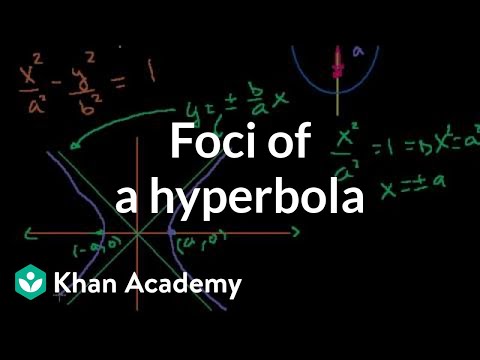
Khan Academy: Foci of a hyperbola (about 15 min). Watch how the foci are found from c² = a² + b², and compare with the ellipse in lesson 3.
Practice
Questions 1 to 3 are routine; 4 to 6 need more care; 7 asks for a proof.
Sources and credits