Agricultural Systems in Africa
Senior 3 · Geography
Agricultural Systems in Africa
Lesson 4 of 5
30 min
Let's begin
Two ways of keeping cattle could hardly be more different. A Fulani family in the Sahel may walk its herd hundreds of kilometres in a year, following the rain. A farmer in Kiambu, near Nairobi, keeps two or three Friesian cows in a shed and carries cut grass to them; smallholders like her, with one to five cows, produce about 80% of Kenya's milk (USDA, Overview of the Kenya Dairy Industry, 2024). Both are livestock farmers. Why do they farm so differently?
Definition
Livestock farming: keeping animals such as cattle, camels, goats, sheep and poultry for milk, meat, hides, wool or eggs. Pastoralism: a way of life based mainly on herding livestock on natural pasture.
In the dry lands of Africa, where rain is too low and too unreliable for crops, many peoples live mainly from their herds. They move with the animals in search of grass and water.
| People | Area | Main animals |
|---|---|---|
| Fulani | The Sahel and savanna of West Africa, from Senegal to Cameroon | Cattle, sheep, goats |
| Maasai | The rift valley plains of southern Kenya and northern Tanzania | Cattle, goats, sheep |
| Turkana and Karamojong | North-western Kenya and north-eastern Uganda | Cattle, camels, goats |
| Somali | The Horn of Africa | Camels, goats, sheep |
| Tuareg | The Sahara (Niger, Mali, Algeria) | Camels, goats |
Characteristics: people move with their herds, often to a regular seasonal pattern; they build light, temporary homes; the land and water are shared by the community; animals are mostly hardy local breeds such as the zebu, which survive heat and drought; herds are large, because cattle are wealth, bride wealth and insurance against drought; and the family lives mainly on milk, with meat on special occasions.
Figure 4. Many Fulani herds move north with the rains and south in the dry season. A regular seasonal movement like this is called transhumance.
Definition
Nomadic pastoralism: herding livestock on natural pasture while moving, with the whole family, from place to place in search of grass and water. Transhumance: the regular seasonal movement of herders and their animals between the same dry-season and wet-season pastures.

| Problems of nomadic pastoralism | Solutions |
|---|---|
| Drought kills grass and animals | Boreholes, dams and water pans; early warning; fodder banks |
| Overgrazing around water points leads to soil erosion and desertification | Controlled grazing; fewer, better animals; group ranches |
| Diseases and pests: trypanosomiasis from tsetse flies, foot-and-mouth | Vaccination, dips and veterinary services |
| Conflict with farmers over land and water, and cattle raiding | Marked grazing routes; local peace committees; security |
| Poor roads and markets, so animals sell for low prices | Livestock markets, roads, abattoirs and cooperatives |
Ranching is the commercial rearing of beef cattle (and sometimes sheep) on very large, fenced farms. It is found on the drier grasslands of Botswana, Namibia, South Africa, Zimbabwe and Laikipia in Kenya. Botswana's ranches export beef as far as Europe.
Definition
Ranching: large-scale commercial rearing of beef cattle on fenced farms, using improved breeds and scientific management. Dairy farming: keeping cattle for milk and milk products.
Where. About 90% of Kenya's dairy cattle are in the highlands of Central Kenya and the Rift Valley, in counties such as Nyeri, Kiambu, Meru, Nyandarua, Nakuru, Uasin Gishu and Nandi. Farmers there produced about 80% of all the country's milk in 2023 (USDA, 2024).
Favourable factors.
Methods. Most milk comes from smallholders with one to five cows, many kept by zero-grazing: the cows stay in a shed, and the farmer brings them cut fodder, water and concentrates. Manure from the shed goes back on the farm. Larger farms graze herds on fenced, improved pasture and milk by machine.
Problems. Yields are low: smallholders average 7.6 litres per cow per day. Feed is costly and scarce in the dry season; diseases such as East Coast fever need constant control; and most milk is sold raw through informal traders: only about 15% of the 5.76 billion litres produced in 2023 was handled by the formal sector (USDA, 2024).
Rwanda's link. Rwanda launched Girinka, "One Cow per Poor Family", in 2006 to reduce poverty and improve nutrition. A poor household receives a cow, and passes its first female calf to a neighbour (MINAGRI). Like Kenya's highland farmers, many Girinka families keep improved cows by zero-grazing and sell milk through collection centres and cooperatives.
Definition
Zero-grazing: keeping dairy cows in a shed or yard all the time and bringing them cut fodder and water, instead of letting them graze. Exotic breed: a breed brought in from another region, such as the Friesian, bred for high milk yields.
| Feature | Nomadic pastoralism | Ranching | Dairy farming (Kenya highlands) |
|---|---|---|---|
| Aim | Subsistence, wealth | Beef for sale | Milk for sale |
| Land | Communal, unfenced | Large private fenced farms | Small farms; some large estates |
| Animals | Hardy local breeds, large herds | Improved beef breeds | Friesians and other exotic breeds |
| Feeding | Natural grass; move to find it | Paddocks and rotational grazing | Zero-grazing; planted fodder |
| Climate | Hot, dry, unreliable rain | Dry grassland | Cool, wet highlands |
Worked example
Worked example 1: how much milk reaches processors? Kenya produced 5.76 billion litres of milk in 2023, and about 15% was handled by the formal sector (USDA, 2024).
Worked example
Worked example 2: the value of better feeding. A zero-grazing farmer has 3 cows, each milked for 305 days a year, at the smallholder average of 7.6 litres a day. With better feeding she hopes for 15 litres a day (illustrative).
Warning
Nomadic pastoralism and transhumance are not the same. Nomads move with no fixed home; in transhumance, herders move between the same seasonal pastures each year, often returning to a home base. And do not describe pastoralists as "wandering aimlessly": their movements are planned around rain, grass, water and disease.
Tip
Link every livestock system to its climate: dry and unreliable rain → pastoralism; dry grassland with capital → ranching; cool, wet highlands near towns → dairy farming. Then add a named example.
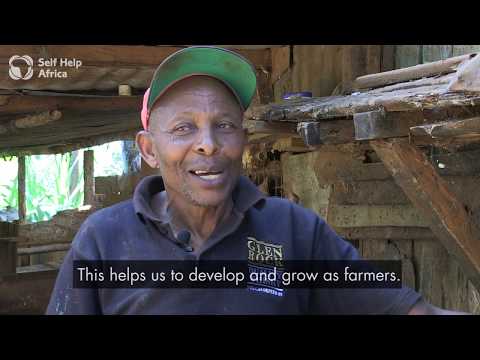
Self Help Africa: how Ndumberi Dairy Farmers Co-operative, near Kiambu town, supports its members. Note three services the cooperative gives its farmers.
Practice
Sources and credits
This lesson adapts CC BY-SA material and is shared under CC BY-SA 4.0.