Tourism and the Environment in Rwanda
Senior 3 · English
Tourism and the Environment in Rwanda
Lesson 4 of 5
25 min
Let's begin
Rwanda is known for clean streets, and since 2008 visitors have been told at the airport that plastic bags are not allowed. Yet pollution has not disappeared: it is in the smoke from burning rubbish, the fumes from old engines and the water of many streams. In this lesson you read a model composition on pollution, learn the language of cause and effect, and plan and write your own.
| Kind | Common causes | Effects |
|---|---|---|
| Air pollution | exhaust fumes from vehicles; burning rubbish, especially plastic; smoke from cooking with firewood or charcoal indoors; dust | coughing, breathing problems and lung disease; smoke-blackened homes |
| Water pollution | sewage and waste water; chemicals and mud from illegal mining; fertiliser washed from fields; rubbish dumped in rivers | diarrhoea and other water-borne diseases; fish and other water life die |
| Land pollution | plastic and other rubbish dumped or buried; old batteries and electronic waste; too much fertiliser and pesticide | blocked drains and floods; poorer soil; animals eat plastic and die |
| Noise pollution | loud music, generators, traffic and building work | poor sleep, stress, difficulty concentrating |
Pollution in Our Town: Causes, Effects and Solutions
Every morning on my way to school I cross a small river. When my mother was my age, she says, children swam in it. Today nobody would swim there: the water is brown, and plastic bottles turn slowly in the reeds. Pollution, the release of harmful substances into the air, water and land, is one of the most serious problems facing our town.
There are three main causes. First, some households and businesses pour waste water and dump rubbish straight into the river, because it is cheaper than paying for collection. Second, rubbish is often burned in the open, and the smoke from burning plastic fills the air. Third, as the town grows, more motorcycles and cars crowd the roads, and old engines release thick exhaust fumes.
The effects are serious. Polluted water carries germs that cause diarrhoea, especially among young children. Smoke and exhaust fumes damage our lungs and can lead to breathing problems. Plastic does not rot; as a result, it blocks drains, so heavy rain floods the streets and carries even more rubbish into the river.
Rwanda has already shown that change is possible. Plastic bags were banned in 2008, and in 2019 the ban was extended to many single-use plastic items. Our town could go further. If every family separated its rubbish, food waste could be turned into compost. Schools could organise river clean-ups during umuganda, and the authorities could fine those who dump waste.
Pollution is not caused by one person, so it cannot be solved by one person. But if each of us changed one habit, our children might swim in that river again.
The five paragraphs are 270 words long, not counting the title. The town and the writer are imagined; the facts about Rwanda's plastics laws come from the Rwanda Environment Management Authority (REMA).

Definition
pollution (n): harmful substances, noise or waste released into the air, water or land. The verb is pollute; something harmful that does it is a pollutant.
exhaust fumes (n): the gases that come out of a vehicle's engine.
single-use (adj): made to be used once and then thrown away, such as plastic straws and some plastic bottles.
compost (n): decayed plant and food waste, used to make soil richer.
| Paragraph | What it does | In the model |
|---|---|---|
| 1. Introduction | catches the reader with a real picture, defines the topic and states the main idea | the river; a definition of pollution; "one of the most serious problems facing our town" |
| 2. Causes | three causes in order, each explained | First … Second … Third … |
| 3. Effects | the results for people and the environment | germs, lungs, blocked drains and floods |
| 4. Solutions | what has been done and what more could be done | the 2008 and 2019 laws; compost, clean-ups and fines |
| 5. Conclusion | a final thought that links back to the start | the river, which the children might swim in again |
| Pattern | Followed by | Example |
|---|---|---|
| because, as, since | a clause | They dump rubbish in the river because collection costs money. |
| because of, due to, as a result of | a noun | The river is brown because of the waste water. |
| so, therefore, as a result, consequently | the result | Plastic does not rot; as a result, it blocks drains. |
| cause, lead to, result in | a noun (the effect) | Burning plastic leads to breathing problems. |
| be caused by, result from | a noun (the cause) | Many floods are caused by blocked drains. |
Worked example
From notes to a cause-and-effect paragraph
Notes: mining upstream; mud and chemicals; river; fish die; farmers downstream water crops with dirty water.
Worked example
Making a solution exact
Weak: "People should stop pollution." It names no one, no action and no result.
Tip
Finish where you started. A strong conclusion returns to the picture in the introduction (here, the river) and shows how it could change. It sounds complete, and it reminds the reader of what is at stake without repeating the whole essay.
Warning
Write a composition of 250 to 300 words. Choose one title:
Checklist before you hand it in
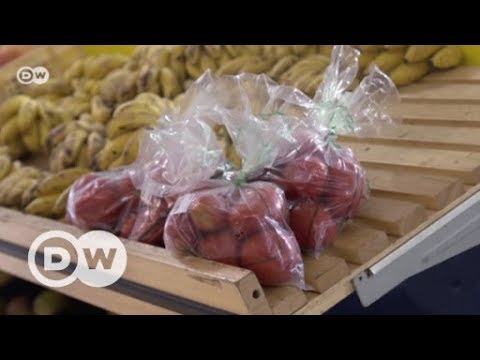
Ten years on: Rwanda's plastic ban, from DW's Eco Africa programme. Note two effects of the ban that the report shows, and use one of them as evidence in your composition.
Practice
Sources and credits
Written by Ganzaa, except the photo credited above. This lesson adapts CC BY-SA material and is shared under CC BY-SA 4.0.