Skeleton, Muscle and Movement
Senior 6 · Biology
Skeleton, Muscle and Movement
Lesson 3 of 4
30 min
In 1954 two pairs of scientists working separately, Andrew Huxley with Rolf Niedergerke, and Hugh Huxley with Jean Hanson, published the same surprising observation. When a muscle fibre contracts, its dark A bands stay exactly the same length. Only the light I bands and the H zones get narrower. If the filaments themselves were shrinking, every band would shrink. Instead, the thick and thin filaments must be sliding past each other, increasing their overlap. This is the sliding filament theory, and this lesson follows it from a nerve impulse down to a single myosin head pulling on actin.
Definition
Sliding filament theory: muscle contracts because thin (actin) filaments slide between thick (myosin) filaments towards the centre of each sarcomere, so the sarcomere shortens while the filaments keep their length.
Cross-bridge: the temporary link formed when a myosin head binds to an actin filament.
Power stroke: the tilting of an attached myosin head that pulls the thin filament along.
Neuromuscular junction: the synapse between a motor neurone and a muscle fibre; the fibre's membrane there is the motor end plate.
Motor unit: one motor neurone together with all the muscle fibres it supplies.
Creatine phosphate: a compound stored in muscle that can give its phosphate group to ADP, regenerating ATP very quickly.
| Part of the sarcomere | During contraction | Reason |
|---|---|---|
| A band | Stays the same | It is the length of the thick filaments, which do not change |
| I band | Shortens | Thin filaments slide further into the A band, so less of them lies outside it |
| H zone | Shortens and may disappear | Thin filaments from each side move towards the M line and fill it |
| Sarcomere (Z to Z) | Shortens | The Z lines, which anchor the thin filaments, are pulled towards each other |
Worked example 1: predicting band widths
In a muscle, each thick filament is 1.6 µm long and each thin filament extends 1.0 µm from its Z line. Calculate the total I band width and the H zone width in one sarcomere when the sarcomere is (a) 2.4 µm, (b) 2.0 µm long.
Why it matters. A myofibril has thousands of sarcomeres in series, so tiny shortenings add up. If 20 000 sarcomeres each shorten by 0.4 µm, the myofibril shortens by µm, which is 8 mm.
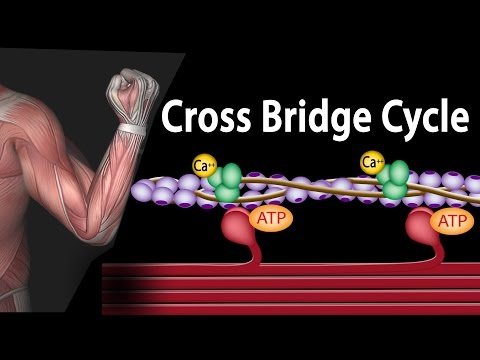
At rest, tropomyosin lies over the myosin-binding sites on actin. When Ca²⁺ binds to troponin, troponin changes shape and pulls tropomyosin away from the binding sites. The myosin heads can now attach, and each head goes round a cycle:
Each power stroke moves the thin filament only about 10 nm, but each thick filament has hundreds of heads cycling out of step with one another, so some are always attached and the filament never slips back. Because the heads on each half of a thick filament face opposite ways, both sets of thin filaments are pulled towards the M line and the Z lines are drawn together.
When the motor neurone stops firing, no more ACh is released and the sarcolemma repolarises. Ca²⁺ ions are actively pumped back into the SR, which uses ATP. Troponin loses its Ca²⁺, tropomyosin slides back over the binding sites, and cross-bridges can no longer form. The muscle does not lengthen by itself: it is pulled back to its resting length by the contraction of its antagonist or by gravity.
A single impulse makes a fibre contract fully: a fibre's response is all-or-nothing. The whole muscle produces a graded force because the nervous system controls how many motor units are active at once and how often they fire. Muscles used for precise movements, such as those that move the eye, have small motor units of a few fibres each; large postural muscles have motor units of hundreds or thousands of fibres.
ATP is used three times in each contraction: to detach and re-cock each myosin head, and to pump Ca²⁺ back into the SR. A muscle holds only enough ATP for a few seconds of hard work, so it is regenerated in three ways:
Worked example 2: how long do the phosphate stores last?
Illustrative values. A sprinter's leg muscle contains 6 mmol of ATP and 24 mmol of creatine phosphate per kilogram, and during an all-out sprint uses ATP at 3 mmol per kilogram per second. Estimate how long (a) the ATP alone, (b) the ATP plus creatine phosphate could keep the muscle working, and explain what limits a 400 m race.
Warning
Common mistakes
Alila Medical Media: "Muscle Contraction: Cross Bridge Cycle, Animation". Watch how calcium moves tropomyosin, and at which step ATP binds and is split.
Practice: the sliding filament theory
Key points
Sources and credits
Figures 1 and 2, the table, the worked examples (with illustrative values) and the practice questions were written by Ganzaa.