Human Ambitions and Moral Choices
Senior 6 · English (Languages)
Human Ambitions and Moral Choices
Lesson 3 of 4
30 min
Let's begin
In Lesson 1, Keza wrote: "The higher he climbed, the lonelier he looked." The sentence does more than compare two things; it says that one change drives another. English has a family of comparative structures that measure change, size up differences and link causes to effects. At A-level you are expected to use them precisely and in the right register.
An opinion column by an imagined careers adviser, written for this lesson.
Every year, more and more school leavers tell me they want to study medicine, law or engineering. These are fine careers, and most countries could use far more good doctors and engineers than they have. But a rush towards a handful of "prestigious" courses has a cost. The more applicants compete for the same few places, the higher the entry grades climb, and the harder it becomes for a talented student who is slightly less polished on paper to be admitted.
Meanwhile, courses in agriculture, teaching or the creative industries, which are no less important to a country's future, are often seen as a second choice. That attitude is much less sensible than it sounds. A career that suits your strengths is considerably more likely to keep you motivated than one chosen to impress your relatives, and a motivated agronomist will do a great deal more good than a miserable surgeon.
So the question to ask is not "Which career is the most respected?" but "Where will my strengths do the most good?" And the earlier you start asking it, the better.
| Structure | Form | From the column | Meaning |
|---|---|---|---|
| Double (repeated) comparative | comparative + and + comparative | more and more school leavers | A continuous increase over time |
| Modified comparative | modifier + comparative | slightly less polished; much less sensible; considerably more likely | Says how large the difference is |
| Emphatic comparative | far, much, a great deal, even, still + comparative | far more good doctors; a great deal more good | Stresses that the difference is large or surprising |
| Comparative correlative (the … the …) | the + comparative + clause, the + comparative + clause | The more applicants compete …, the higher the entry grades climb | A change in one thing causes a matching change in another |
Also note no less important: no + comparative means "not at all", so agriculture is just as important, not slightly less.
Definition
Key terms
Choose the modifier that matches the size of the difference, and the register of your writing. Very cannot modify a comparative: write much better or far better.
| Rule | Right | Wrong |
|---|---|---|
| Both clauses begin with the + comparative | The longer you wait, the harder it gets. | The longer you wait, harder it gets. |
| The comparative moves to the front, with its noun if it has one | The more questions you ask, the more you learn. | The more you ask questions, you learn more. |
| For the future, the first clause uses the present; only the second takes will | The sooner we leave, the earlier we will arrive. | The sooner we will leave, the earlier we will arrive. |
| A comma separates the clauses | The higher the risk, the greater the reward. | The higher the risk the greater the reward is being. |
| Short forms drop the verb in fixed phrases | The sooner, the better. The more, the merrier. | The more sooner, the more better. |
Why will appears only in the second clause: the first clause behaves like an if-clause ("If we leave sooner, we will arrive earlier"), and English does not normally use will in a condition.
Worked example
Analysing a correlative: "The higher he climbed, the lonelier he looked."
The correlative is shorter and more rhythmic than the plain version, which is why it is common in proverbs, speeches and essay conclusions.
Worked example
Choosing a modifier for a formal report
Data (illustrative): a school club had 40 members in 2024 and 44 in 2025, an increase of 10 per cent; a second club grew from 40 to 80, an increase of 100 per cent.
Warning
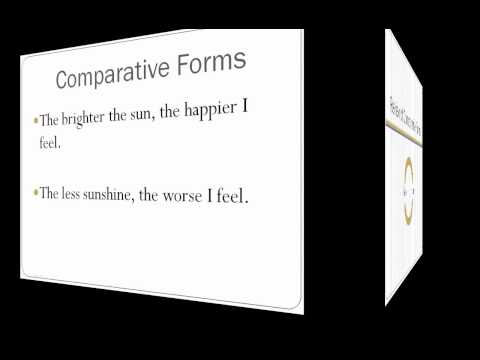
Double Comparatives, Lesson 21 of English with Jennifer's grammar series on YouTube. Watch for the two kinds she teaches ("bigger and bigger" and "the more …, the more …") and note one example sentence of each to add to your own notes.
Practice
Sources and credits