Human Ambitions and Moral Choices
Senior 6 · English (Languages)
Human Ambitions and Moral Choices
Lesson 4 of 4
35 min
Let's begin
Every literature answers the same old question: how should a person live? This lesson sets two very different answers side by side. One is the written European tradition from the theatres of ancient Greece to the satirists of the eighteenth century. The other is the oral tradition of Africa, performed rather than printed, and in Rwanda as old as the hills on which it was recited. You will read a short extract from each side, compare their methods, and see why both kept returning to moral choice.

European literature did not develop in a straight line, but each period answered the one before it. The timeline gives the main landmarks.
A. From Everyman (English morality play, late fifteenth century, author unknown). God has sent Death to summon Everyman.
Death. Everyman, stand still; whither art thou going
Thus gaily? Hast thou thy Maker forget?
Everyman. Why askst thou?
Wouldest thou wete?
Death. Yea, sir, I will show you;
In great haste I am sent to thee
From God out of his majesty.
…
Everyman. What desireth God of me?
Death. That shall I show thee;
A reckoning he will needs have
Without any longer respite.
Glosses: whither = where to; forget = forgotten; wete = know; reckoning = an account of one's deeds; respite = delay.
B. From Candide (Voltaire, 1759; anonymous English translation). After years of disasters, Candide meets an old farmer who lives contentedly on a small plot.
"I have only twenty acres," replied the old man; "I and my children cultivate them; our labour preserves us from three great evils—weariness, vice, and want."
…
"I know also," said Candide, "that we must cultivate our garden."
Definition
Key terms
Africa has well over a thousand languages and many literary traditions, so the features below are common rather than universal. In Rwanda, the oral tradition includes imigani (tales and proverbs), ibitekerezo (historical narratives), ibisigo (dynastic poetry once recited at the royal court) and ibyivugo (heroic self-praise recitations). Across the continent there are epics such as Sundiata of the Mali empire, still performed by griots, and the praise poetry of southern Africa.
A dilemma tale: The Three Gifts (Ganzaa's retelling of a pattern told in many African communities and beyond)
Three brothers went out to seek their fortunes. The first came home with a mirror in which he could see any place in the land. The second brought sandals that crossed a day's journey in a single step. The third brought a gourd of medicine that could cure any sickness. One evening the first looked into his mirror and saw that the chief's only daughter, far away, was dying. The brothers held hands, the second put on his sandals, and in one step they stood at her door. The third poured his medicine between her lips, and she sat up and asked for water. The chief had promised a herd of cattle to whoever saved her, and each brother claimed it.
Now you who are listening, tell me: which brother deserves the cattle?
| Feature | European tradition (classical to Enlightenment) | African oral tradition |
|---|---|---|
| Medium | Mostly written, and printed from about 1450; drama performed from a fixed script | Spoken, sung and performed; no fixed text |
| Author | Usually a named individual (Sophocles, Voltaire); Everyman is an exception | The community; the performer is a skilled re-teller |
| Audience | Readers, or a theatre audience that watches | Listeners who answer, sing and judge |
| Moral method | Tragedy warns, allegory instructs, satire mocks | Proverbs advise, fables warn, dilemma tales ask |
| Central figure | The tragic or epic hero; later, the reasoning individual | The culture hero, the trickster (often an animal), the ancestor |
| Structure | Unity of action (Aristotle); acts and scenes | Episodes, repetition, songs inside the story, formulaic openings |
Similarities matter as much as differences. Homer's epics began as oral performance, like Sundiata. Aesop's animal fables from Greece do the same work as African trickster tales. A Greek chorus commenting on the action is not far from a storyteller's chorus of listeners. And Horace's "teach and delight" describes a good evening of imigani as well as it describes a Roman poem.
Worked example
Comparing the extracts: how each one teaches
Conclusion for an essay: all three treat literature as moral training, but they move the authority from God (Everyman), to experience and reason (Candide), to the community of listeners (the dilemma tale).
Tip
Writing a comparison. Organise by point, not by text. Instead of one paragraph on Europe and one on Africa, write one paragraph on audience, one on moral method, one on the hero, comparing both traditions in each. Use linkers of comparison: similarly, likewise, by contrast, whereas, while, unlike.
Warning
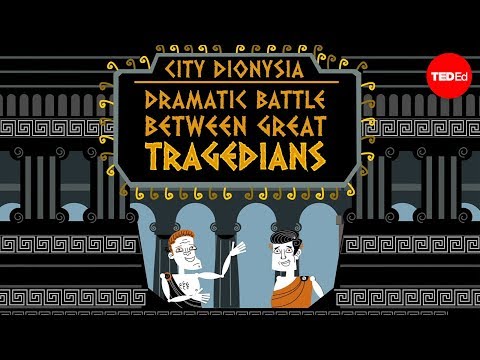
The battle of the Greek tragedies, a TED-Ed lesson by Melanie Sirof (about 5 minutes). Presented as a sports commentary, it shows how Aeschylus, Sophocles and Euripides changed Greek drama. Note one innovation by each playwright.
Practice
Further reading
Sources and credits