Theories of Social Psychology
Senior 6 · Psychology (Languages)
Theories of Social Psychology
Lesson 5 of 5
25 min
Ishimwe is an S6 student in a Languages combination. His written French is among the best in his class, yet in French lessons he almost never speaks. On Saturdays he helps his aunt at her stall in Rubavu, near the border with Goma, where he chats, bargains and jokes in French with customers for hours.
Ishimwe’s knowledge of French is the same on Tuesday morning and on Saturday afternoon. What changes is the social situation: who is listening, what is at stake, how he feels about the people around him and why he is speaking. This lesson uses the four theories of this unit, and some theories built specifically for language learners, to explain the difference.
Definition
Willingness to communicate (WTC): a person’s readiness to start speaking a second language with a particular person at a particular time (MacIntyre and colleagues, 1998).
Foreign language anxiety: the worry and tension a person feels specifically when learning or using a second language, including fear of speaking, fear of being judged and test anxiety (Horwitz, Horwitz and Cope, 1986).
Integrative orientation: learning a language to communicate with, or become closer to, the people who speak it. Instrumental orientation: learning it for a practical gain, such as a job or a scholarship (Gardner and Lambert, 1972).
Ideal L2 self: the image of the person you would like to become as a speaker of the second language (Dörnyei, 2005).
Peter MacIntyre, Richard Clément, Zoltán Dörnyei and Kimberly Noels (1998) described the decision to speak as the tip of a pyramid. Lasting factors such as personality and the relations between language groups sit at the base; the decision to speak now, to this person, sits near the top.
Figure 1. Speaking is the visible tip; many social and personal layers lie underneath.
At the market, Ishimwe wants to talk to his customers and feels confident; in class, fear of being judged by classmates lowers his willingness, even though his knowledge is the same.
Elaine Horwitz and colleagues (1986) argued that language learning carries its own kind of anxiety: you must perform in public with limited words, so your usual personality and intelligence cannot show. A 2019 review by Yasser Teimouri, Julia Goetze and Luke Plonsky, combining over a hundred samples, found a moderate negative correlation between language anxiety and achievement (about ). Because this is correlation, anxiety may lower achievement, low achievement may raise anxiety, or both.
Robert Gardner and Wallace Lambert (1972) distinguished integrative from instrumental orientations. Later, Zoltán Dörnyei argued that “integrating” with a single community makes little sense for a global language such as English, which has no single group of speakers to join. His L2 Motivational Self System focuses instead on the ideal L2 self (who I want to become), the ought-to L2 self (what others expect of me) and the learning experience (the class, the teacher, the group). In multilingual Rwanda, where Kinyarwanda, English, French and Kiswahili are all official languages (Kiswahili since 2017), a learner may hold several ideal selves at once: a Kiswahili-speaking trader, an English-speaking university student, a French-speaking diplomat.
| Theory | What it predicts for language learners | Practical step for a teacher or learner |
|---|---|---|
| Attribution theory | Learners who blame stable, uncontrollable causes (“I have no gift for languages”) give up; those who blame controllable causes (“I haven’t practised speaking”) persist. | Give feedback that links progress to strategies and practice. |
| Social facilitation | An audience helps fluent speakers and hinders beginners on new, hard tasks. | Rehearse in pairs or small groups before speaking to the whole class. |
| Social identity | A language can feel like a threat to identity or a door to a valued group; accent marks group membership. | Treat every accent with respect; connect the language to groups learners value. |
| Self-determination theory | Autonomous reasons (identified, intrinsic) predict persistence; controlled reasons fade. | Offer choice, achievable challenges and a supportive class climate. |
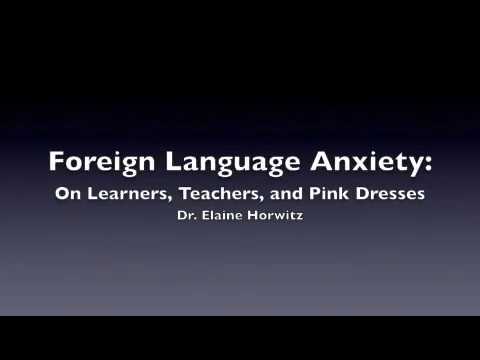
Texas Learning Center, University of Texas at Austin: “Foreign Language Anxiety On Learners, Teachers, and Pink Dresses”, a talk by Elaine Horwitz, who first described foreign language anxiety. Listen for the situations in which she says learners feel most anxious.
Important
Evaluate the evidence. Most research on willingness to communicate, anxiety and motivation uses questionnaires and correlations, often with university students in Canada, Europe or East Asia; studies of secondary-school learners in multilingual African classrooms are few. Questionnaires measure what learners report, which may differ from what they do. And because these factors influence one another (anxiety lowers confidence, which lowers willingness to speak, which reduces practice), it is hard to identify a single cause. The theories are best treated as lenses that suggest what to try, then checked against what happens in a real class.
Warning
Common mistake: assuming that a silent student does not know the language. Ishimwe shows that low willingness to communicate can hide good knowledge. In an answer, separate competence (what a learner knows) from performance (what they do in a given situation).
Tip
Exam technique: when asked to apply a theory to language learning, name the theory, state its key idea in one sentence, apply it to the learner in the question, and finish with one practical recommendation.
Practice
Further reading
Sources and credits
Written by Ganzaa: the text, the table, Figure 1 and the exercises.