Trigonometric Formulae, Equations and Inequalities
Senior 5 · Mathematics
Trigonometric Formulae, Equations and Inequalities
Lesson 5 of 5
25 min
The identities of this unit were not invented for exercises. Physicists use them every day for two things you meet in S5 Physics: vibrations, which are described by sines and cosines of time, and light bending as it crosses from air into glass or water, which is described by the sines of angles. This lesson applies the addition formulae, the harmonic form and the methods of solving equations to both.
Definition
Simple harmonic motion (SHM): motion along a line in which the displacement from a fixed centre at time is
Amplitude : the greatest displacement. Angular frequency (in ). Phase constant : fixes where the motion starts, since .
Period (Lesson 1) and frequency , in hertz (Hz).
Example: a mass bouncing on a spring, a swinging pendulum (for small swings) and a point on a guitar string all move, to a good approximation, in SHM.
Worked example 1: reading an SHM equation
A mass on a spring moves with , with in metres and in seconds. Find the amplitude, period and frequency, the displacement at , and the first time after at which the mass passes through the centre.
Solution ; , so and . At : .
The mass is at the centre when , that is . The smallest positive comes from : , so .
When one body takes part in two vibrations of the same angular frequency, such as and , the displacements add. Lesson 4 says at once that the result is again simple harmonic, with the same :
Worked example 2: superposition
A point vibrates with and at the same time ( in cm, in s). Find the resulting motion, its amplitude and period, and the first time it reaches .
Solution , and , so :
Amplitude ; period . For : , so or . The first family needs to make ; the second gives with . So the first time is . (The point starts at , rises to 4 at , then falls through 2.)
A ray of light that crosses from one transparent medium into another changes direction. Measure the angles from the normal, the line perpendicular to the surface. If the ray meets the surface at angle in a medium of refractive index and leaves at angle in a medium of index , then Snell's law holds:
Typical values: air , water , ordinary glass . Going into a denser medium (larger ), : the ray bends towards the normal.
Definition
Angle of incidence : the angle between the incoming ray and the normal. Angle of refraction : the angle between the refracted ray and the normal.
Refractive index of a medium: the ratio of the speed of light in a vacuum to its speed in the medium; it has no unit.
Lateral displacement : the perpendicular distance between the ray that enters a parallel-sided slab and the ray that leaves it.
Example: from air into glass with at : , so .

At the top face, . The two faces are parallel, so the ray meets the bottom face at angle and leaves at angle : it emerges parallel to the incident ray. In Figure 2, EF is the path in the glass and FG is perpendicular to the extended incident ray. In triangle EGF, the angle at E is and , so
Expanding with the subtraction formula of Lesson 1 gives a second form, .
Worked example 3: a glass block
A ray strikes a glass block of thickness and refractive index at an angle of incidence of . Find the angle of refraction and the lateral displacement.
Solution , so and .
The ray travels inside the glass.
Important
Critical angle. From glass or water into air, the ray bends away from the normal. It can escape only if , that is : a trigonometric inequality. The largest such angle , with , is the critical angle. For glass with , ; at larger angles all the light is reflected back inside (total internal reflection), which is how optical fibres carry internet signals.
Warning
Angles are measured from the normal, not from the surface. If a question says the ray makes with the surface of the glass, the angle of incidence is . And set your calculator to degrees when the data are in degrees.
Tip
Check with extremes. If , then and : a ray along the normal goes straight through. If , then and : no glass, no shift. A formula that fails these checks is wrong.
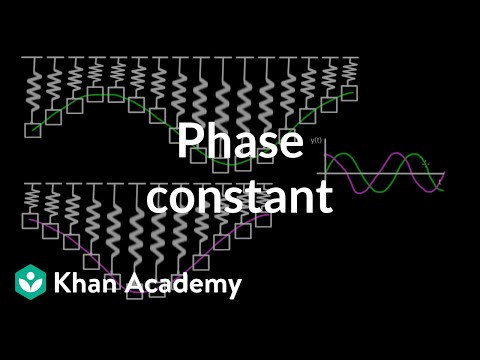
Khan Academy Physics: Phase constant (about 10 min). Watch how the constant inside the sine slides the graph of an oscillator left or right, and how to read it from the starting position.
Practice
Give answers to 3 significant figures where they are not exact. The last two are harder.
Further reading for this unit
Sources and credits