Trigonometric and Inverse Trigonometric Functions
Senior 5 · Mathematics
Trigonometric and Inverse Trigonometric Functions
Lesson 2 of 5
25 min
Put , and (in radians) into : you get , and . The values creep up to 1, yet at the fraction is and means nothing. In S4 you met limits of polynomial and rational functions, and the squeeze (sandwich) theorem. This lesson proves the one new limit that the whole of trigonometric calculus rests on, and derives the others from it.
Important
The fundamental trigonometric limit ( in radians)
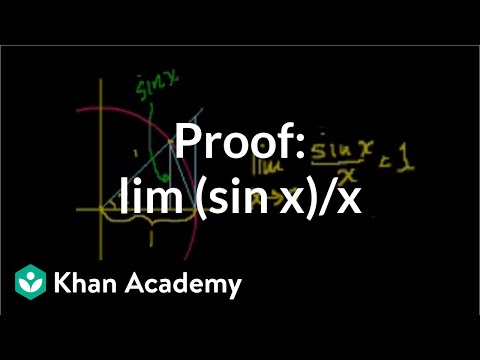
Proof. Take (Figure 1). Comparing areas, . Divide by : , and take reciprocals:
As , , so by the squeeze theorem . Since is even, the same holds as .
At infinity. and have no limit as (they keep oscillating), but they are bounded, which is often enough: for gives . And from Figure 2 of Lesson 1, and .
Continuity. The six trigonometric functions and the inverse functions are continuous at every point of their domains, so for example . At the edges of the domain of : and .
Definition
Squeeze (sandwich) theorem: if near (except perhaps at ), and , then . The same holds as .
Example: , and both bounds tend to 0, so .
Worked example 1: using the standard limits
Find (a) (b) (c) (d) .
Solution
Worked example 2: shift first, or squeeze
Find (a) (b) (c) .
Solution
Warning
Radians only. is true only when is in radians: in degrees, . And the limit is at : does not tend to 1 as (it tends to 0), and tends to 2, not 1.
Tip
Make the pattern appear. Every limit here is solved by arranging , with the "something" tending to 0. Multiply and divide by the constant you need, as in .
Khan Academy: Proof: lim (sin x)/x. Watch how the areas of two triangles and a sector of the unit circle squeeze sin x over x between cos x and 1.
Practice
The last two are harder.
Sources and credits