Matrices and Determinants of Order 3
Senior 5 · Mathematics
Matrices and Determinants of Order 3
Lesson 3 of 5
40 min
The shear of lesson 2 turned the unit cube into a slanted box, yet the box has the same base and the same height, so its volume is still 1. A reflection also keeps volume but turns space "inside out", like a left shoe in a mirror becoming a right shoe, and the projection onto the -plane squashes every solid flat, to volume 0. One number attached to a matrix records all of this: its determinant. In S4 you met the case, , which measures how a transformation of the plane scales area. Order 3 is built from it.
Definition
For of order 3:
Expanding along any row or column, each entry times its own cofactor, gives the same number (Laplace's theorem). Choose the row or column with the most zeros.
Multiplying out the expansion gives six products of three entries, one from each row and each column. Sarrus' rule is a picture of them: repeat the first two columns, add the three products along the diagonals going down to the right, and subtract the three going up to the right.
Worked example 1: the same determinant two ways
Evaluate for .
By cofactors along row 1:
By Sarrus: down-right products ; up-right products . So . ✓
Check by column 2, which has a zero: . ✓
Important
Properties of determinants ( of order 3, real). Each statement about rows is also true for columns, because of property 1.
Reasons. (2) Swapping two rows swaps the factors in each minor or moves an entry to a place of opposite sign. (3) Swapping two equal rows changes nothing, yet by (2) changes the sign, so and . (5) Expanding along row , the new determinant is plus times a determinant with two equal rows, which is 0. Property 7 is proved in later courses; check it with the matrices of lesson 2: , and .
Worked example 2: simplify first, then expand
Evaluate using property 5.
Solution. and do not change the value:
Worked example 3: factorising a determinant
Show that .
Solution. and , then expand along row 1:
Take out : the bracket left is . So the determinant is . It is zero exactly when two of are equal, which agrees with property 3: two equal columns.
Worked example 4: an equation with a determinant
Solve .
Solution. Expand along row 1:
So or . Check : rows 1 and 2 become equal, so the determinant is 0 by property 3. ✓
If is the matrix of a linear transformation, then is the volume of the image of the unit cube, and every volume is multiplied by . The sign tells whether orientation is kept () or reversed (, as in a mirror).
| Transformation (lesson 2) | Effect on a solid | |
|---|---|---|
| Shear | same volume, same orientation | |
| Rotation about the -axis | same volume, same orientation | |
| Reflection in the -plane | same volume, orientation reversed | |
| Enlargement, scale factor | volume multiplied by | |
| Projection onto the -plane | flattened: volume 0 |
A determinant of 0 means space is flattened onto a plane, a line or a point, so different points land on the same image and the transformation cannot be undone. Lesson 4 turns this into the test for an inverse.
Warning
Tip
Before expanding, look for a zero, a common factor, or two rows that are almost equal. One row operation that creates two zeros in a row or column turns the determinant into a single one.
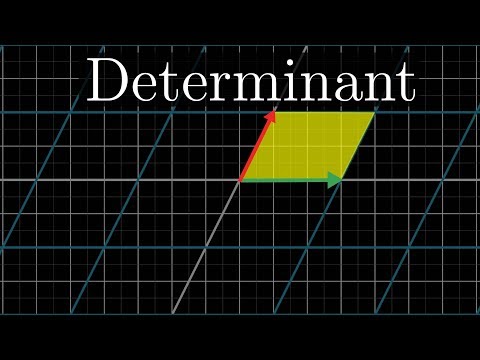
3Blue1Brown: The determinant, Chapter 6 of Essence of Linear Algebra (about 10 min). In the 3-D part, watch the unit cube become a slanted box whose volume is the determinant, and notice what a negative determinant does to orientation.
Practice
Questions 1 to 3 are routine; 4 to 6 need more care; 7 asks for a proof.
Sources and credits