Signals and Communication Systems
Senior 5 · Physics
Signals and Communication Systems
Lesson 4 of 4
25 min
Paying for a bus ticket with mobile money, a farmer in Nyagatare checking maize prices, a nurse in Nyamasheke sending a test result: each of these uses the mobile network. A city may have hundreds of thousands of phones switched on at once, yet the radio spectrum given to each operator is only a few tens of megahertz wide, enough for perhaps a few hundred calls if one powerful transmitter served the whole city. The trick that makes mobile phones possible is to divide the land into small cells and use the same frequencies again and again.
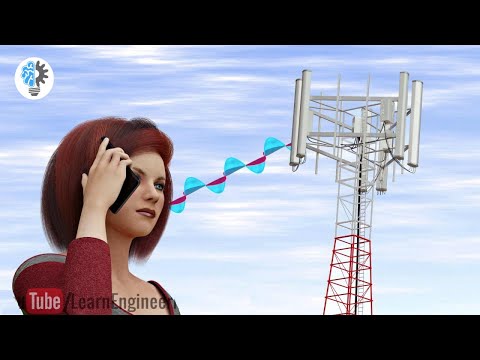
Each cell is served by a base station: a set of aerials on a mast or rooftop, with radio equipment that talks to every phone in the cell. Base stations use low power, so their signals fade out a few cells away. The operator's channels are divided into groups, and neighbouring cells always use different groups. A cluster of cells uses every group once, and the pattern is repeated across the country, so each group of frequencies is reused many times.
For hexagonal cells of radius , the distance between the centres of two cells using the same group, the reuse distance, is
A larger puts same-frequency cells further apart, which means less interference but fewer channels per cell. Making cells smaller multiplies the capacity: halving the cell radius fits four times as many cells, and so four times as many calls, into the same area. That is why cities have many small cells while rural areas have a few large ones.
Definition
A cell is the area served by one base station. Frequency reuse is the use of the same radio channels in cells far enough apart not to interfere. Handover (handoff) is the transfer of a call from one base station to the next as the phone moves, without interrupting it. Example: a passenger on a bus from Kigali to Musanze may be handed over between dozens of cells during one call.

The phone also adjusts its transmitter power, using only as much as it needs to reach the base station. This saves the battery and reduces interference.
Worked example 1: capacity from frequency reuse
An operator has 280 voice channels. (a) If one transmitter covered the whole city, how many calls could be made at once? (b) The city is instead covered by 63 cells in clusters of 7. How many channels does each cell have, and how many calls can be made at once? (c) With cells of radius 2.0 km, find the reuse distance.
Solution
(a) 280.
(b) Each cell gets channels. There are clusters, each using all 280 channels, so calls, nine times as many.
(c) km.
Worked example 2: why phone aerials are tiny
Phones use frequencies such as 900 MHz and 1800 MHz. Find the wavelength at each, and the length of a quarter-wave aerial at 1800 MHz.
Solution
: at 900 MHz, m; at 1800 MHz, 0.167 m.
A quarter-wave aerial at 1800 MHz is m, about 4 cm, small enough to hide inside the phone.
Each generation of mobile network has carried more data, more cheaply, to more people:
| Generation | First launched | Signal and key feature | Typical data rate |
|---|---|---|---|
| 1G | 1979 | Analogue FM voice; no security; poor quality | none (voice only) |
| 2G (GSM) | 1991 | Digital voice, SMS, encryption; later basic data | about 10–100 kbit s⁻¹ |
| 3G | 2001 | Mobile internet and video calls | about 0.4–10 Mbit s⁻¹ |
| 4G (LTE) | 2009 | All data sent as internet packets (even voice); OFDM modulation | about 10–100 Mbit s⁻¹ |
| 5G | 2019 | Very high rates, delays of a few milliseconds, millions of connected devices | hundreds of Mbit s⁻¹ to several Gbit s⁻¹ |
The trend follows from Shannon's formula (Lesson 2): each generation uses wider channels (more bandwidth), smarter modulation and many aerials at once to push the bit rate up. Behind the radio links, nearly all long-distance traffic now travels as light in optical fibres.
Worked example 3: comparing generations
Estimate the time to download a 50 MB video at (a) 2.0 Mbit s⁻¹ (3G), (b) 50 Mbit s⁻¹ (4G), (c) 1.0 Gbit s⁻¹ (5G).
Solution
50 MB Mbit.
(a) s, over three minutes; (b) s; (c) s.
Warning
Bits and bytes. Data rates are quoted in bits per second, file sizes in bytes. Multiply bytes by 8 before dividing, or your answer will be eight times too small.
Important
Radio waves and health. Phones and masts emit non-ionising radio waves, whose photons have far too little energy to break chemical bonds (Unit 7). International exposure limits (ICNIRP) keep heating far below harmful levels, and the World Health Organization states that no adverse health effects have been established as being caused by mobile phone use. The proven danger of phones is distraction: never use one while driving or crossing a road.
Tip
Small cells, big capacity. Capacity grows with the number of times the frequencies are reused, so more, smaller cells mean more calls.
How does your mobile phone work? by Sabin Civil Engineering (Lesics). Watch how cells, base stations and the switching centre connect a call, and how handover works.
Practice
Key points
Further reading
Sources and credits
Written by Ganzaa. The cell diagram, the timeline, the worked examples and the practice exercises are by Ganzaa.