Transport Across the Cell Membrane
Senior 5 · Biology
Transport Across the Cell Membrane
Lesson 4 of 5
25 min
The cells of a root hair hold potassium ions at a concentration hundreds of times higher than in the soil water around them. A red blood cell keeps about thirty times more K⁺ inside than the plasma outside, and far less Na⁺. Diffusion could never build gradients like these; left alone, it would erase them. The cell is moving ions uphill, and that costs energy. If you poison a root with cyanide, which stops aerobic respiration, potassium uptake almost stops. This is active transport.
Definition
Active transport: the movement of molecules or ions across a membrane against their concentration gradient (from lower to higher concentration), through specific carrier proteins, using energy from ATP made in respiration.
Pump: a carrier protein that uses ATP to move ions or molecules against their gradient. Pumps are ATPases: they hydrolyse ATP themselves.
Co-transport (secondary active transport): movement of one substance against its gradient, coupled to the movement of another substance, usually Na⁺ or H⁺, down its gradient through the same carrier protein.
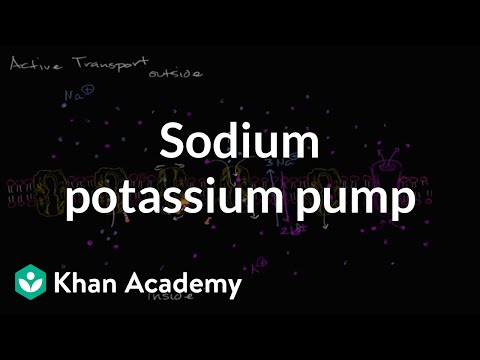
Almost every animal cell has many copies of the Na⁺/K⁺ pump in its membrane. In each cycle it moves 3 Na⁺ out and 2 K⁺ in for each molecule of ATP hydrolysed:
The phosphate attached in step 2 changes the shape of the protein, so its binding sites face outwards and lose their attraction for Na⁺; releasing the phosphate in step 3 changes the shape back. Because more positive charge leaves than enters, the pump helps make the inside of the cell negative: this is part of the resting potential of nerve cells. The pump also keeps cell volume steady by controlling the water potential of the cytoplasm. In a resting human it uses a large share of all the ATP made.
Worked example 1: evidence of accumulation
Illustrative data: the concentration of K⁺ is 0.05 mmol dm⁻³ in pond water and 54 mmol dm⁻³ in the cell sap of an alga living in it. (a) Calculate how many times more concentrated K⁺ is inside the cells. (b) Explain why this is evidence of active transport.
Worked example 2: what stops the pump?
Discs of carrot root were kept in a K⁺ solution under different conditions, and their uptake of K⁺ was measured (illustrative data, arbitrary units per hour).
| Condition | K⁺ uptake |
|---|---|
| Air bubbled through, 20 °C | 120 |
| Nitrogen bubbled through (no oxygen), 20 °C | 18 |
| Air, 20 °C, with potassium cyanide | 12 |
| Air bubbled through, 5 °C | 30 |
(a) Calculate the percentage reduction in uptake caused by removing oxygen. (b) Explain each result.
Some carriers do not use ATP directly. Instead they use a gradient of Na⁺ that a pump has built. In the epithelial cells of the small intestine (Figure 2):
The same principle saves lives. In cholera and other severe diarrhoea, the gut loses water and salts fast. Oral rehydration solution (ORS), recommended by the World Health Organization, contains both glucose and sodium. The co-transporters still work during diarrhoea, so they pull Na⁺ and glucose into the gut cells, and water follows by osmosis. A drink of plain water, or of very sugary water without salt, does not do this.

Worked example 3: counting the cost
A nerve cell pumps out mol of Na⁺ while recovering from activity. How many moles of ATP are used, and how much energy is that? (Hydrolysis of ATP releases 30.5 kJ mol⁻¹.)
Khan Academy: "Sodium potassium pump". Watch for how phosphorylation changes the shape of the pump, and why 3 Na⁺ leave for every 2 K⁺ that enter.
Warning
Common mistakes
Tip
Spotting active transport in data: look for (1) accumulation against a gradient, (2) a sharp fall when oxygen is removed or a respiratory poison is added, and (3) a fall at low temperature. Any one of these is evidence; all three together are strong evidence.
Practice: active transport
Key points
Sources and credits
Figures 1 and 2, the table, the worked examples and the practice questions are written by Ganzaa. The data in Worked examples 1 and 2 are illustrative.