Transport Across the Cell Membrane
Senior 5 · Biology
Transport Across the Cell Membrane
Lesson 2 of 5
25 min
Set up the osmometer in Figure 1: a bag of Visking tubing full of sucrose solution, tied to a narrow glass tube and hung in distilled water. Within minutes the liquid starts to climb the tube, because water enters the bag by osmosis. But after some hours the level stops rising, even though the solution in the bag is still more concentrated than the water outside. To explain why, biologists stopped talking only about concentrations and began to measure water potential, which includes the effect of pressure. You met the term in Senior 2. In this lesson you calculate with it.
Definition
Osmosis: the net movement of water molecules from a region of higher water potential to a region of lower water potential, through a partially permeable membrane.
Water potential, (psi): a measure of the tendency of water to move out of a system, in kilopascals (kPa). Pure water at atmospheric pressure has ; every solution has a negative .
Solute potential, : the part of the water potential due to dissolved solutes. It is always negative; more solute makes it more negative.
Pressure potential, : the part due to pressure. In a plant cell the wall pushes back on the swelling protoplast, so is usually positive.
Osmotic pressure: the pressure that must be applied to a solution to stop pure water entering it across a partially permeable membrane. It has the same size as the solute potential but the opposite sign: osmotic pressure .
The water potential of a cell is the sum of its two components:
Water always moves from the higher (less negative) water potential to the lower (more negative) one. Now the osmometer makes sense. At first the bag's is well below 0, so water enters. As the column rises, its weight presses on the solution, raising . When , the bag's water potential equals that of the pure water outside, and net movement stops. The height of the column then measures the osmotic pressure of the solution.
For dilute solutions, the solute potential follows the van 't Hoff equation:
where is the concentration in , , is the temperature in kelvin, and is the number of particles each solute unit gives in solution (1 for sucrose, about 2 for NaCl, which forms Na⁺ and Cl⁻). With these units, comes out in pascals. Solute potential depends on the number of dissolved particles, not their type or size. Concentrated sucrose solutions deviate from the equation and have a more negative than it predicts.
Worked example 1: solute potential of a sucrose solution
Calculate the solute potential of a 0.30 mol dm⁻³ sucrose solution at 25 °C. Then compare it with a 0.30 mol dm⁻³ NaCl solution at the same temperature.
Interpretation: at the same molar concentration, a salt solution draws water about twice as strongly as a sugar solution. This is why salting fish or meat dries it out so effectively.
Worked example 2: which way does water move?
Figure 2 shows three neighbouring plant cells. Find the water potential of each cell and the direction of water movement.
Notice that you cannot decide from alone: Y has a less negative than X, but you must add each before comparing.
Worked example 3: a cell reaching equilibrium
A flaccid plant cell () has . It is placed in a solution of water potential . Assuming the cell's does not change, find at equilibrium.
Important
Older terms you may meet. Some books describe osmosis with pressures instead of potentials:
| Older term | Water potential term |
|---|---|
| Osmotic pressure (OP) | |
| Turgor pressure (TP), or wall pressure | |
| Suction pressure, or diffusion pressure deficit (DPD) = OP − TP |
Water moves towards the cell with the higher suction pressure, which is the same as the lower water potential.
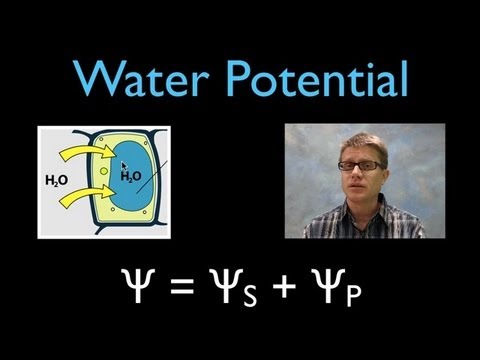
Bozeman Science: "Water Potential". Watch for how solute potential and pressure potential add up, and for the worked problems near the end, which use the same equation as this lesson.
Warning
Common mistakes
Tip
Memory hook: "Water runs downhill." Picture water potential as height: 0 is the top of the hill, and water always flows down towards more negative values.
Practice: water potential
Key points
Sources and credits
Figures 1 and 2, the tables, the worked examples and the practice questions are written by Ganzaa.