Market Structures
Senior 5 · Economics
Market Structures
Lesson 3 of 5
45 min
Every home in Rwanda that is connected to the national electricity grid buys its power from the same supplier, Rwanda Energy Group (REG), through its utility company. No rival company has built a second set of poles and wires down the same streets, and none is likely to. In most towns, piped water also comes from a single supplier, the Water and Sanitation Corporation (WASAC). The prices both charge are not set freely by the companies: they are approved by the Rwanda Utilities Regulatory Authority (RURA). This lesson asks why such markets end up with one seller, how a single seller chooses its price and output, and why governments rarely leave it alone.
Definition
Monopoly: a market structure with a single seller of a product that has no close substitute, protected by barriers that stop other firms entering. The firm is the industry, so its demand curve is the market demand curve, which slopes downward.
Price maker: a firm that can choose its price, accepting that a higher price means it sells less. A monopolist is a price maker: it can choose the price or the quantity, but not both, because the demand curve links them.
| Form | Meaning | Illustration |
|---|---|---|
| Natural monopoly | Economies of scale are so large that one firm can supply the whole market at a lower average cost than two or more could | Electricity transmission lines, water mains, a railway track |
| Statutory (legal) monopoly | A monopoly created by law or by an exclusive government licence | A national postal service's sole right to carry certain letters |
| Public monopoly | A monopoly owned by the state | A state-owned utility company |
| Private monopoly | A monopoly owned by private shareholders | A private firm holding the only patent on a medicine |
| Spatial (local) monopoly | The only seller within a distance that buyers find too costly to travel beyond | The only fuel station or pharmacy for many kilometres on a rural road |
| Simple and discriminating monopoly | A simple monopolist charges every buyer the same price; a discriminating one charges different prices for the same product (Lesson 4) | One fare for all, versus cheaper student tickets |
| Collusive monopoly (cartel) | Several firms agree to act as if they were one seller | Producers jointly fixing output and price, as OPEC tries to for crude oil |
A monopoly lasts only as long as something keeps rivals out. The main barriers are:
Definition
Natural monopoly: an industry in which the long-run average cost curve is still falling where it meets market demand, so a single firm supplies the market at a lower cost than any number of competing firms could. In the diagram one firm produces Q1 at average cost A1; two firms splitting the market would each produce half as much at the higher cost A2.
To sell one more unit, a monopolist must lower its price, and (if it is a simple monopolist) it must lower it on all the units it sells, not just the extra one. So the extra revenue from the extra unit is less than its price: at every output after the first.
Worked example 1: the revenue schedule for P = 100 − 2Q
| Q | P = AR (Frw) | TR = P × Q | MR = ΔTR |
|---|---|---|---|
| 10 | 80 | 800 | – |
| 11 | 78 | 858 | 58 |
| 20 | 60 | 1,200 | – |
| 21 | 58 | 1,218 | 18 |
| 25 | 50 | 1,250 | – |
| 26 | 48 | 1,248 | −2 |
Selling the 11th unit raises revenue by only 58, although its price is 78: the firm gains 78 on the new unit but loses 2 Frw on each of the 10 units it was already selling, . For a straight-line demand curve , the MR curve is
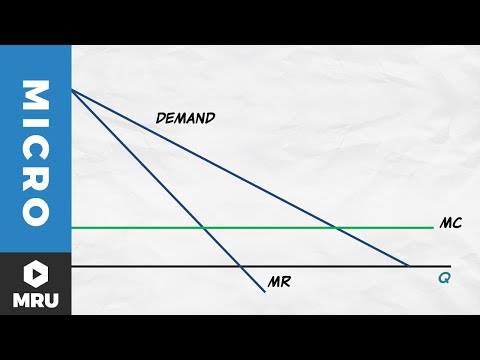
It starts at the same point on the price axis and is twice as steep, cutting the quantity axis halfway along. Here , which is zero at , where TR is at its maximum of 1,250.
Important
A monopolist never produces where demand is inelastic. Where demand is inelastic, MR is negative, so cutting output would raise revenue and lower costs at the same time. Any profit-maximising monopolist with positive marginal cost therefore produces on the elastic, upper part of its demand curve, where MR is positive.
Like every firm, a monopolist maximises profit where . The difference is in the next step: it reads the price off the demand (AR) curve, which lies above MR.
Because barriers stop new firms entering, this abnormal profit can last in the long run, unlike under perfect competition. A monopolist can make a loss in the short run if demand is weak (AR below ATC at every output), but it will not stay in the industry in the long run unless it earns at least normal profit. Note also that a monopolist has no supply curve: the quantity it offers at a given price depends on the shape of demand, not on price alone.
Worked example 2: monopoly against competition, in numbers
A firm protected by a patent faces demand . Its marginal and average cost are constant at 20 (illustrative units).
Monopoly. . Set :
Perfect competition. Price is driven to marginal cost: .
The cost of monopoly. Consumer surplus falls from to . Of the 1,200 lost, 800 goes to the monopolist as profit, and
is gained by nobody: units that consumers valued at more than they cost to make are simply not produced.
| Possible advantages | Disadvantages |
|---|---|
| Economies of scale can give lower costs than many small firms (the natural monopoly case) | Higher price and lower output than under competition, with a deadweight loss |
| Abnormal profits can fund research and new products (the reason patents exist) | Allocative inefficiency: |
| Avoids wasteful duplication of networks such as pipes and power lines | Productive inefficiency: no pressure to produce at minimum ATC, so costs may drift up (X-inefficiency) |
| A public monopoly can cross-subsidise poorer users or remote areas | Less choice for consumers and less pressure to improve quality |
| Stable supply and planning in industries of national importance | Transfers income from consumers to owners; may use its power against suppliers |
Warning
Three slips to avoid. (1) Reading the price off the MR curve: the price is always read up from to the demand curve. (2) Drawing MR meeting the quantity axis at the same point as demand: for a straight-line demand, MR cuts it halfway. (3) Saying "a monopolist charges the highest price it can": it charges the price that maximises profit, and a higher price would lose more in sales than it gains.
Marginal Revolution University, "Maximizing Profit Under Monopoly" (about 11 minutes). Watch how the profit-maximising quantity is found where MR = MC and the price then read from the demand curve, the same three steps as in the diagram above.
Practice
Sources and credits
Written by Ganzaa: the text, the four diagrams (values computed from the stated demand and cost functions), the tables, the worked examples and the practice items. All prices, costs and quantities in the examples are illustrative.